


Infertility Treatment
Part of the Metabolic, Endocrine & Women’s Disorders Centre
Infertility is a finding that something else is producing. The useful question is not how to force conception but what is preventing it.
Where most couples are when they call us
By the time couples reach us, they have usually been trying long enough that it has stopped being something they mention casually.
There have often been investigations, sometimes a diagnosis of “unexplained”, and sometimes a recommendation to move to assisted reproduction.
And attention often settles on one partner rather than both.
Infertility is a finding. The useful question is what is producing it — and in a substantial share of cases the answer involves both partners.
The questions couples bring to a first consultation
Answered plainly, including the ones that do not have a simple yes.
What does Ayurveda actually say about infertility?
The framework, and what it assesses before treating.
Read the answer →Is IVF the only option if I have PCOS?
No — and also not never. What decides it.
Read the answer →What about male factor?
Involved in a large share of cases, simpler to assess, and frequently investigated last.
Read the answer →Where does this sit alongside modern medicine?
We are not an alternative to reproductive medicine and will say when it is indicated.
Read the answer →It is a symptom, not a diagnosis
Difficulty conceiving is an outcome, and outcomes have causes. Underneath it there is usually something identifiable: ovulatory dysfunction, frequently PCOS-related; thyroid involvement; metabolic factors; structural causes; or male-factor contribution, which accounts for a substantial share and is routinely investigated last.
“Unexplained infertility” is a real category, but it is also sometimes a description of how far the investigation got rather than of the biology. Treating the finding without identifying the cause is why cycles get repeated without a changed result.
Both partners, not one
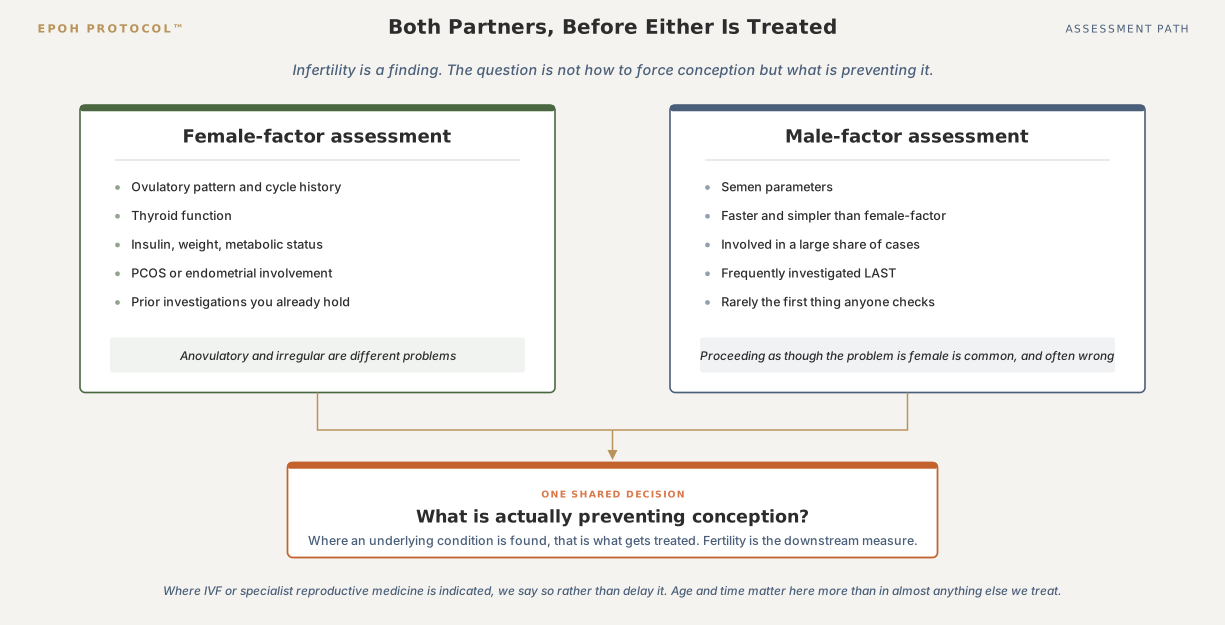
Male factor is involved in a large proportion of cases, and it is faster, simpler and less invasive to assess than female factor. It is also, consistently, the last thing anyone checks.
Where a couple presents, we would want both assessed before either is treated. Proceeding on the assumption that the problem is female is common and frequently wrong, and it costs months that in this particular condition are not recoverable.
What assessment actually covers
Cycle and ovulatory pattern first — specifically whether cycles are irregular or genuinely anovulatory, which are different problems needing different treatment and are often conflated.
Thyroid function, because hypothyroidism disrupts ovulation, is common, is straightforward to identify, and will limit anything else attempted while it is untreated.
The metabolic picture — insulin, weight trend, inflammatory load — because where PCOS is present it is usually the driver, and treating it is treating the cause rather than the symptom.
And whatever you already have. Prior investigations, timelines, what was tried and what happened. Repeating tests you have already had is not thoroughness.
| Assessed | Why | What it changes |
|---|---|---|
| Ovulatory vs irregular cycles | They are different problems, frequently conflated | Anovulation needs the driver treated; irregularity may not |
| Thyroid function | Common, disrupts ovulation, easy to identify | Corrected first — nothing else holds while it is untreated |
| Insulin and weight trend | Where PCOS is present it is usually the driver | Treatment targets the metabolic picture, not the cycle |
| Semen parameters | Large share of cases; fastest test available | May move the whole plan to the other partner |
| Prior investigations | Repeating tests you already have is not thoroughness | Avoids months lost to duplication |
How we approach it
Where an underlying condition such as PCOS or thyroid dysfunction is present, that is what gets treated. Fertility is the downstream measure, not the treatment target — which sounds like a distinction without a difference until you notice that treatments aimed directly at conception leave the underlying condition exactly where it was.
Formulations are oral and compounded to the driver profile identified in assessment. Where weight and insulin resistance are central, that is where the work goes; where the thyroid is involved, that is corrected first because nothing else will hold otherwise.
Timelines are set at assessment, not discovered later. If your circumstances mean waiting is costly, that should shape the plan from the start.
What we will not tell you
We will not promise conception. The variables include age and factors that no treatment controls.
We do not perform or replace assisted reproduction. Where IVF or specialist reproductive medicine is indicated — a structural cause, severe male factor, age-related urgency — we will say so rather than delay it, and delaying it is the specific harm that alternative-medicine fertility treatment is most often responsible for.
Age matters, and time matters, more than in almost anything else we treat. That is said at assessment rather than after months.
| Situation | What we would say |
|---|---|
| Structural cause identified | Reproductive medicine, not us — and not after a delay |
| Severe male factor | ART is the appropriate route; we will say so at assessment |
| Age-related urgency | Time is the binding constraint. Do not spend it here first |
| Already mid-cycle in an ART programme | Continue it. We are not an alternative to it |
| No underlying condition found | There may be nothing here for us to treat, and we will tell you |
What we measure, and when we judge it
With fertility the drivers move before the outcome does. We track the ovulatory, thyroid and metabolic picture from your first consultation, so you can see the underlying pattern changing rather than waiting month to month on a single result.
The drivers, not the outcome alone
Ovulatory pattern and cycle regularity. Thyroid and metabolic status. Weight and insulin picture. Semen parameters where male factor is assessed. Conception is the downstream measure, not the treatment target.
Three to six months for the drivers
Where an underlying condition such as PCOS or thyroid dysfunction is present, that is what should change first, over three to six months. If those markers are not moving, continuing without reassessment is not reasonable.
We will say so early
Where there is a structural cause, severe male factor, or age-related urgency, assisted reproduction may be the right route — and we will say so at assessment rather than delay it. Time matters here more than in almost any condition we treat.

Talk to Us Directly
No forms. Message or call the clinic and a doctor’s team member will take your history.
Replies during clinic hours, Mon–Sat.