


Recurrent Abscess Treatment
Part of the Hidradenitis & Recurrent Skin Disorders Centre
An abscess that is drained and returns — to the same fold, the same site, sometimes within weeks — is telling you something the drainage did not address.
What most people describe when they reach us
Most people have had one drained before — more than once, often in the same place — and been sent home with antibiotics and told it was a boil.
It healed, then came back near the same spot, or in the same fold on the other side. Many people can feel one starting days before it shows.
What is usually missing is an explanation of why it keeps happening — only what to do each time it does.
Recurrence at a fixed site is not bad luck. It is the most useful diagnostic information you have.
The questions people ask us first
Answered plainly, including where the answer is “sometimes” rather than yes.
Is this actually HS?
Recurrence in the same fold, onset around puberty, lesions that connect under the skin — those point one way. This sets out how the two are told apart.
Read the answer →Why does it come back after drainage?
Drainage removes the collection, not what produced it. Where the process is inflammatory rather than a one-off infection, the lesion reforms.
Read the answer →What about boils under the breast?
Inframammary recurrence has its own pattern and is frequently mistaken for a hygiene or friction problem.
Read the answer →Will this respond to treatment?
Honestly, it depends on stage and duration. This sets out who does well and who does not.
Read the answer →What recurrence actually means
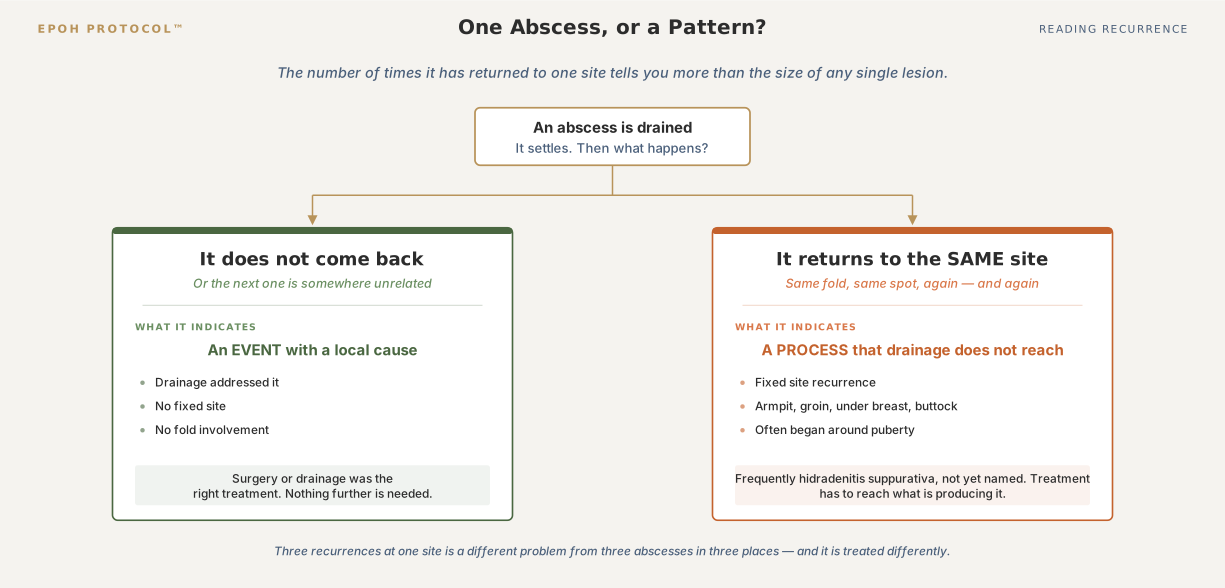
A single abscess is an event. An abscess that returns to the same site is a pattern, and the distinction decides the treatment. Incision and drainage resolves the collection; it does not change whatever produced it. Where the cause was local and one-off, that is enough. Where it was not, the lesion reforms — and it reforms in the same place, because the thing producing it never moved.
So the useful question at your third abscess is not how large it is. It is whether it is the third one there. Three recurrences at one site is a different problem from three abscesses in three places, and it is treated differently.
When recurrent abscesses are actually HS
Recurrent abscesses in the armpit, groin, under the breast or between the buttocks are frequently hidradenitis suppurativa that has not yet been named. This is one of the longest diagnostic delays in dermatology: patients are treated for boils, repeatedly, for years, by clinicians each seeing a single lesion rather than the pattern.
The features that point that way are specific. Recurrence at a fixed site rather than randomly. Involvement of skin folds, where apocrine glands sit. Onset around puberty. Lesions that connect under the skin rather than sitting isolated. A family history. And antibiotic courses that work and then stop working — characteristic of an inflammatory process rather than a transmissible one.
If several of those apply, the HS pages are the ones you want, and the delay you have already spent is the argument for looking properly now.
What else it can be
Not every recurring abscess is HS, and treating everything as though it were would be its own error. The distinctions that matter:
Pilonidal disease sits in the natal cleft and follows the same drainage-and-recurrence arc, but has its own anatomy and its own surgical considerations.
An infected cyst recurs because the cyst wall was left behind. That is a genuinely surgical problem, and excision of the wall resolves it — which is exactly the case where we would tell you surgery is the right answer.
Furunculosis is recurrent staphylococcal infection, often with colonisation, and behaves differently: it moves around rather than fixing to one site, and it responds to decolonisation in a way HS does not.
Establishing which of these you have is the substance of assessment. It changes everything downstream.
| Condition | How it recurs | What actually resolves it |
|---|---|---|
| Hidradenitis suppurativa | Fixed site, in skin folds, often from puberty; lesions connect under the skin | Treating the inflammatory drivers; surgery addresses tissue, not cause |
| Pilonidal disease | Natal cleft, same drainage-and-recurrence arc | Its own anatomy and surgical considerations |
| Infected cyst | Same spot, because the cyst wall was left behind | Excision of the wall — a genuinely surgical problem |
| Furunculosis | Moves around rather than fixing to one site | Decolonisation, which HS does not respond to |
What it is not
It is not caused by poor hygiene, and washing more will not prevent the next one. Scrubbing an inflamed fold strips the barrier and makes it worse — the loop tightens rather than breaking.
It is not, in most fixed-site cases, an infection you keep catching. If it were, antibiotics would clear it rather than suppressing it for a while.
And it is not something you are failing to manage. Being told to try harder, at a lesion that returns regardless of what you do, is a common experience and an unhelpful one.
How we approach it
The first task is establishing what the recurrence indicates. That determines whether this is HS, another follicular or inflammatory condition, or something with a discrete local cause that surgery would in fact resolve — and we would rather say the third than treat everything the same way.
Where the process is inflammatory, treatment works on the inflammatory load and the drivers producing it rather than on individual lesions. What that changes is the frequency and severity of what forms next, which is the only measure that matters when the complaint is recurrence.
Where established tracts and scarring exist, that tissue is structural. Internal treatment does not dissolve it, ours included, and a surgical opinion may still be appropriate — we will give you our clinical reading to take into it rather than competing with it.
Honest expectations
Recurrence frequency is the measure, and it is a slow one to read. You cannot judge it in a fortnight, because the gap between lesions was already weeks or months — a quiet three weeks proves nothing either way.
What tends to change first is what happens within a lesion: less drainage, shorter duration, less pain, resolving without a course of antibiotics. Those shift before the interval between lesions visibly lengthens, and they are worth tracking because they move earlier.
Scarring already present does not resolve. If what troubles you most is how the area looks rather than how often it flares, that part will not change, and we would rather say so now.
| What changes | When it typically moves | Why that order |
|---|---|---|
| Drainage volume and duration | Weeks 3–8 | Inflammatory load falls before lesion frequency does |
| Pain within a lesion | Weeks 4–10 | Tracks drainage rather than appearance |
| Need for antibiotic courses | Months 2–5 | Lesions start resolving without them |
| Interval between lesions | Months 3–8 | The headline measure, and the slowest to read |
| Existing scarring | Does not resolve | Structural; no internal treatment dissolves it |
What we measure, and when we judge it
Recurrent abscesses are judged on how often they come back and how long the gaps between them get — the measure that actually changes your year. We track that from your first consultation and review it at every follow-up, against the timeline set out below.
Recurrences per year, not lesion size
Frequency of recurrence, time between episodes, drainage volume and persistence, pain, and medication load — particularly repeated antibiotic courses.
A single smaller lesion tells you little. Six months without one tells you a great deal.
Not before month four
Weeks 1–4 digestion, sleep and energy shift first. Months 2–4 is when recurrence frequency should begin to change. Sustained remission is assessed from month eight, not before.
What advanced disease changes
Where extensive tunnelling and dense scarring are already established, that tissue is structural and internal treatment does not dissolve it — the realistic goal becomes lower inflammatory burden and lower medication load.
And where an abscess has a discrete local cause that surgery would in fact resolve, we will say so rather than treat it as inflammatory disease.

Talk to Us Directly
No forms. Message or call the clinic and a doctor’s team member will take your history.
Replies during clinic hours, Mon–Sat.