


Part of the Hidradenitis Suppurativa Knowledge Library
Every consultation you have had ended with a plan. Not one opened by asking whether you were the sort of patient the plan works on. That is not usually dishonesty — it is the shape of an appointment — but it means that after years of HS you have been offered a great many treatments and never once told, in advance, what your realistic ceiling was.
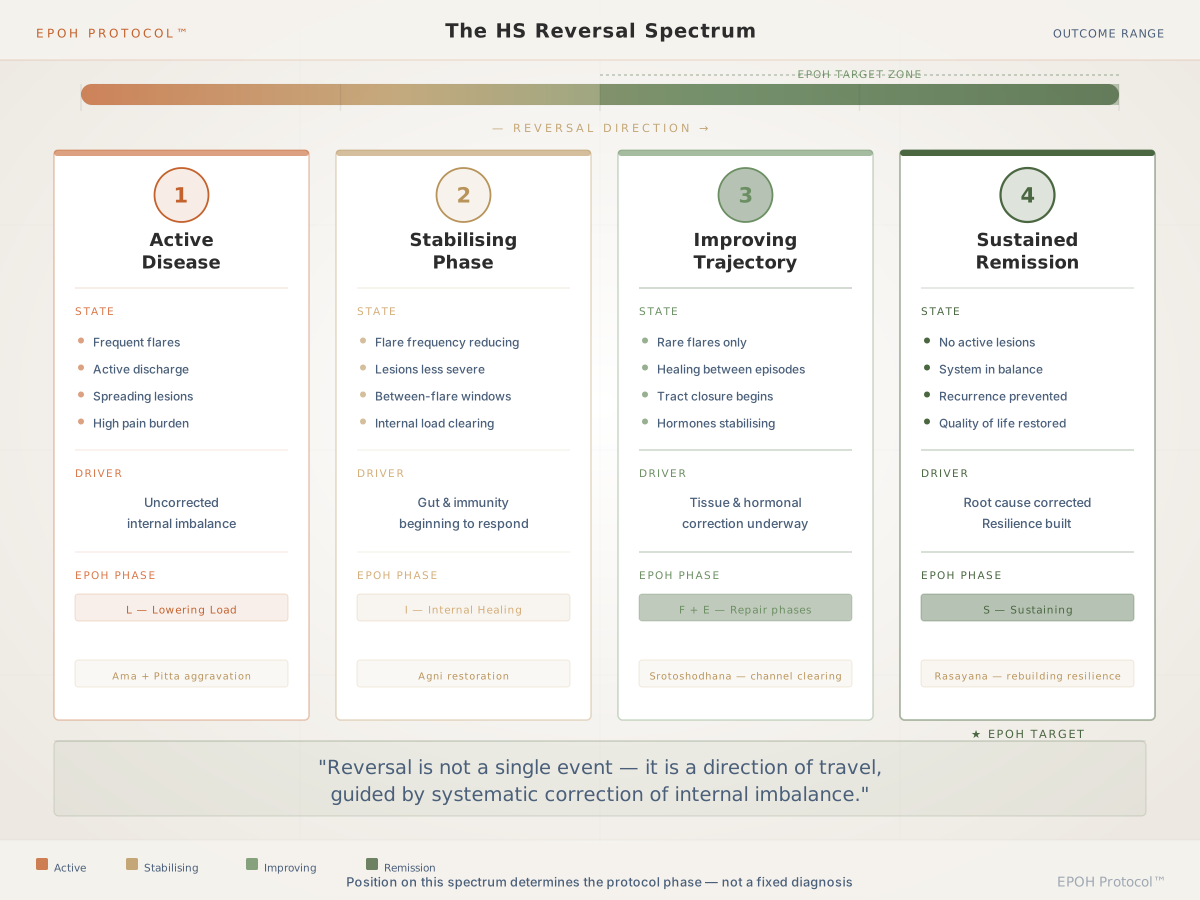
Some people respond to internal correction almost completely. Some respond partially, or slowly. Some will not reach full remission, and deserve to be told so before they spend months finding out. Here is how those groups are told apart, and why the distinction is biological rather than an excuse assembled afterwards.
What actually decides it
HS is not a skin condition with systemic complications. It is a systemic condition expressing through the skin: gut dysbiosis, then immune dysregulation, then local tissue pathology. Weakened Agni, accumulated inflammatory load (Ama), vitiated Pitta and Kapha obstructing the Svedavaha Srotas — and at the end of that chain, a lesion.
All of that is a process, and a process can be redirected. That is what Phase 2 (Internal Healing) exists to do: gut lining integrity, microbiome repair, immune recalibration, hormonal patterns.
But a process leaves a record. Every flare that runs the full Dushta Vrana cycle — deep pustular inflammation, rupture, incomplete healing, re-inflammation — lays down scar. Repeat that in one site often enough and the tract stops being an event and becomes an anatomical structure. It epithelialises. It acquires a lining of its own. From that point it is not being generated by anything; it simply exists, the way a hole exists.
Internal correction acts on the process. Fibrosis and epithelialised tunnelling are the record of the process. Stopping the process stops the record from growing. It does not erase what is already written.
Which is why EPOH-DSS stage predicts response better than almost anything else assessed at intake. It is, in effect, a measure of how much of your disease is still process and how much has already become architecture.
Who responds most completely
Earlier EPOH-DSS stages. EPOH-DSS Stage 1 (Early Nodular) and EPOH-DSS Stage 2 (Inflammatory) — broadly Hurley I and early Hurley II — are still overwhelmingly process. The affected structures are obstructed, not destroyed. Reduce what is driving the obstruction and the tissue has somewhere to return to.
Shorter disease duration. Fewer years of cycling means fewer laid-down layers of Mamsa dhatu damage, whatever the surface looks like today.
A clearly identifiable dominant driver. Treatment is built from the driver profile, not the condition name. A patient whose flares track the menstrual cycle with unusual fidelity, on a long history of gut disturbance, has a legible hormonal–gut axis: the correction has an obvious target. A patient in whom all five systems — gut health, hormonal balance, immune regulation, metabolic function, stress and cortisol — are moderately and equally disturbed is a harder problem. Not untreatable; just without a single lever.
Intact repair capacity. The question is not whether your flares are severe. It is whether they close. Lesions that are violent but eventually resolve indicate more remaining repair capacity than lesions that have simply been open for a year.
And, bluntly: patients who stay through the Partial Improvement Plateau. Somewhere around weeks three to six, improvement stalls. Digestion has settled, sleep is better, something has clearly shifted — and the flares keep coming anyway. This is not the treatment failing. It is Phase 1 (Lowering the Load) having finished its work while Phase 2 has not yet had time to do its own. It is also, reliably, when people leave. Patients who quit, quit here — and someone who walks away at week five with EPOH-DSS Stage 1 disease and an excellent driver profile will never appear in anyone's outcome data as anything but a person for whom it did not work. The majority of patients who discontinue do so inside this window — not because the treatment has failed, but because its visible payoff has not yet arrived.
The comparison that would demonstrate the stage effect is the one we track: how many patients staged EPOH-DSS Stage 1–2 at baseline reach Recovery Stage 3 or beyond, set against how many of those staged Stage 3–4 do. Earlier-stage disease, caught before sinus tracts and scarring are established, has consistently more room to respond — which is the whole argument for not waiting. The audited figures will be published here once the follow-up window is long enough to state them honestly.
Who responds partially, or more slowly
- EPOH-DSS Stage 3 (Sinus) and EPOH-DSS Stage 4 (Advanced Tunnelling) — more of the disease has already become structure.
- Long disease duration, especially where flares have recurred in the same sites for years.
- Extensive fibrosis — the physical embodiment of lost repair capacity. Scarred tissue does not regain function because the environment around it improves.
- Multiple simultaneous drivers. Sequencing takes longer, Phase 2 runs at the longer end of its window, and improvement arrives in smaller increments across more systems at once.
- Significant metabolic involvement — insulin resistance, central adiposity, metabolic syndrome — which keeps feeding fresh inflammatory input into the system while everything else is corrected. Correction is not impossible here; it is working into a headwind.
For this group, internal correction remains the most effective route available, and the reason is structural rather than rhetorical. Antibiotics reduce bacterial load temporarily and over time disrupt the gut microbiome, itself a primary driver: temporary reduction, then recurrence at greater intensity. Steroids and biologics suppress immune signalling without correcting why the immune system misfires; the suppression holds for exactly as long as it continues. Surgery removes lesions but cannot alter the systemic environment that produced them, which is why new lesions so often form in adjacent skin. None of this makes those treatments wrong — each does precisely what it was designed to do. It does mean that where disease is still actively generating new tissue damage, the generator is the only thing whose correction changes the trajectory.
But the most effective available route is not a synonym for complete resolution. The honest expectation here is meaningful reduction — fewer flares, shorter flares, less drainage, less pain, a lower medication load stepped down with the prescribing physician. Not a clear-skin photograph.
Who may not achieve full remission
Not every patient responds equally. Disease duration, degree of organ involvement, and remaining biological repair capacity all influence outcomes. Patients with very advanced structural changes — severe fibrotic HS, extensive established tunnelling, dense scar plaques across the axillae, groin or perineum — may not achieve full remission. A personalised evaluation is the only way to assess your specific response potential.
That is not hedging. It follows directly from the section above: you can correct the process that generates lesions, and you cannot un-scar a tunnel that has already epithelialised.
What remains worth doing here is not a consolation prize. In advanced HS the disease's next move is almost always into skin that is currently unaffected, so slowing the rate at which the process generates new disease is what protects the axilla that is still intact. Drainage, odour and pain are frequently what makes the condition unliveable, and they are not the same variable as scarring. Long-term antibiotic dependence can still come down. And if you and your surgeon decide on excision, that decision belongs with your surgeon — what internal correction addresses is the environment that produced the lesions, which is the reason excision so often holds locally while the disease reappears somewhere new.
Who is a poor fit, whatever the staging says
Anyone who needs a fast result. Recovery Stage 1 (weeks 1–4) is defined by internal markers — digestion, bowel regularity, sleep, energy — because those are what move first. Visible surface change follows internal change; it does not precede it. There is no version of this in which your skin is different in three weeks, and it is better to say so now than to take your money and say it later.
Anyone who will not take formulations daily for months. They are compounded to your driver profile, couriered to you, and taken at home unsupervised. There is no procedure, nothing is done to you, and no clinic visit for most patients — so the whole mechanism rests on you taking them. Erratic dosing does not produce a slower result. It produces an uninterpretable one, and burns months proving nothing.
Anyone unwilling to keep their prescribing physician involved. EPOH begins while your current medication continues. Reduction, when correction makes it possible, is a structured decision taken with the doctor who prescribed the drug. A patient who intends to quietly stop their biologic or their antibiotic at home is not a candidate — and not out of deference. An uncontrolled withdrawal flare is clinically indistinguishable from treatment failure, and it destroys the only evidence either of us has about whether the correction is working.
Why it is worth being told no
A clinic that accepts everybody has told you nothing by accepting you.
Being placed in the third group is more useful than being sold a place in the first. It gives you an expectation you can hold someone to, it keeps your dermatologist and your surgeon in the conversation where they belong, and it means that when you are told your flare frequency should fall, you have some reason to believe it.
Which group you are in is not something a website can tell you, and not something a photograph can tell us. It takes a driver profile across the five systems, an EPOH-DSS stage, a disease and medication history, and an honest assessment of how well your tissue still heals. That is what a personalised evaluation is for. It is done by video or WhatsApp; formulations, where appropriate, arrive by courier. And if the assessment is that full remission is unlikely for you, you will hear it at the assessment — not months later.
Medical disclaimer. This article is for general information and is not a substitute for personalised medical advice. Ayurvedic treatment at EliteAyurveda™ is individualised following clinical assessment. Do not start, stop or alter any prescribed medication without consulting your treating physician.

