


Part of the Hidradenitis Suppurativa Knowledge Library
You have almost certainly done everything that can be done to the skin. Antibacterial washes. Dressings you have become expert at applying one-handed. Long antibiotic courses. A steroid injection into a nodule that came back anyway. Possibly an excision, and the months of wound care after it. And still, the month after the axilla finally settles, something starts in the groin.
That pattern is the most important piece of clinical information you own, and nobody interprets it for you. Nothing done to the surface has changed the rate at which the surface produces disease. Not because those treatments were wrong. Because they were aimed at the wrong level.
HS is not a skin condition with systemic complications. It is a systemic condition expressing through the skin.
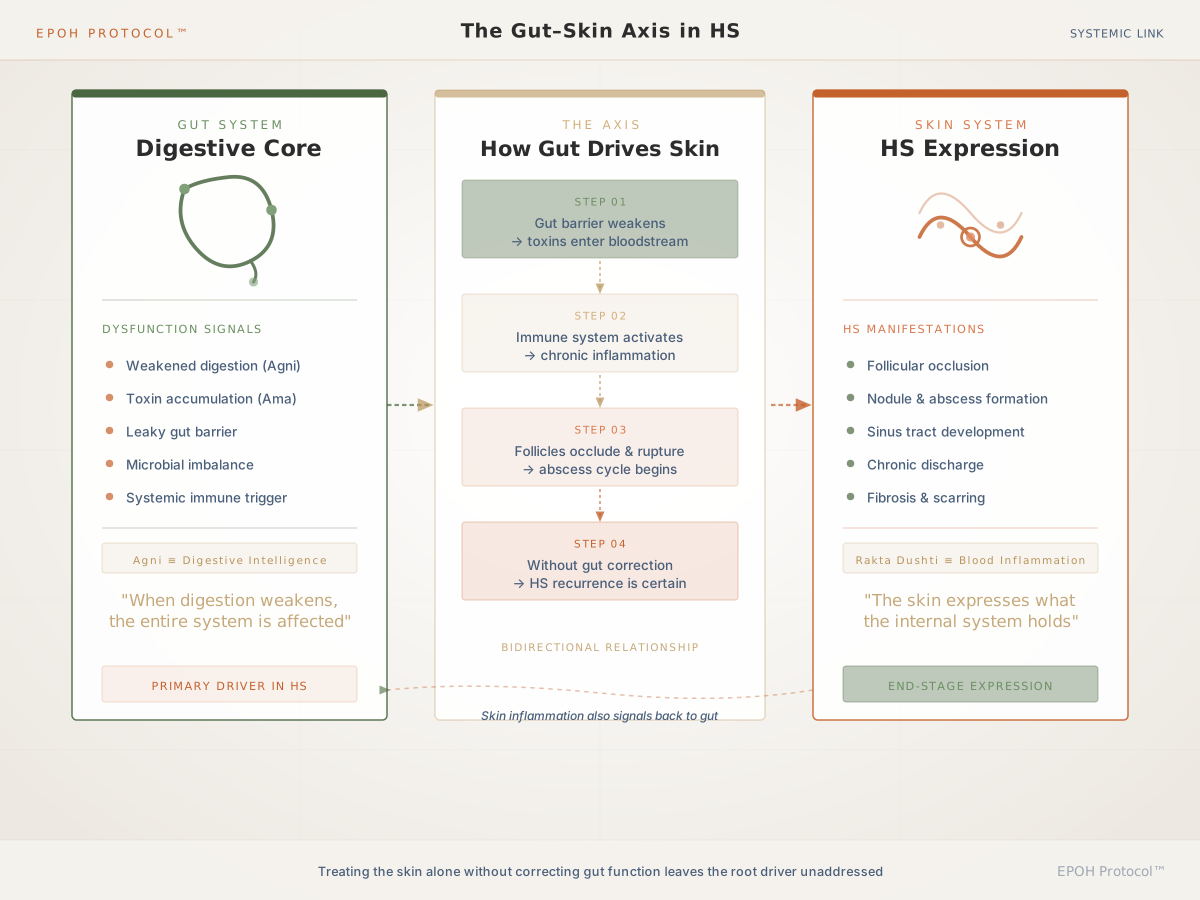
Start with the company HS keeps
Notice how little of what HS travels with is dermatological. It clusters with inflammatory bowel disease, Crohn's in particular. With insulin resistance and metabolic syndrome. With polycystic ovary syndrome. With a family of neutrophil-driven inflammatory conditions that share no anatomy with it whatsoever. Diseases that genuinely originate in skin do not behave like this. When a condition keeps company this consistently with the gut and with metabolism, the gut and metabolism deserve to be treated as the origin, not as a footnote.
The mechanism, in four steps
1. Barrier compromise. Your intestinal lining is a single layer of cells held together by tight junctions: not a wall, but a selective border doing an enormous amount of discriminating work every hour. Chronic dysbiosis, a heavily refined-carbohydrate load, repeated antibiotic courses and sustained cortisol all loosen those junctions.
2. Signal leakage. Material that should have stayed inside the lumen crosses into the portal circulation — bacterial cell-wall fragments (endotoxin), incompletely broken-down food antigens, metabolic by-products. The quantity crossing at any given moment is small. The exposure is continuous. That combination is what matters.
3. Immune activation. The innate immune system reads those fragments as evidence of a breach. Pattern-recognition receptors engage. Inflammatory signalling along the IL-1, TNF and IL-17 pathways settles at a raised baseline. This is not an infection anywhere in your body. It is a standing alarm, and it never fully switches off, because the signal never fully stops arriving.
4. Expression at the most susceptible tissue. Raised systemic inflammatory tone reaches every tissue you have and declares itself where the tissue is least able to absorb it. In HS that is apocrine-bearing skin: axillae, groin, inframammary folds, perineum, buttocks. Those follicular units are hormonally responsive, structurally prone to occlusion, and sitting in warm, moist, friction-loaded folds. The follicle hyperkeratinises, occludes, dilates, and ruptures — spilling keratin and follicular contents into the dermis, where an already-primed immune system meets them and responds far out of proportion.
The nodule, the abscess, the tract: all of that is step four. Everything that determined whether step four would happen happened in steps one to three, in a part of your body nobody examined.
And the bacteria on the swab? They arrive after the rupture, colonising a lesion inflammation has already opened for them. Passengers, not driver.
The same chain, in an older notation
Agni is digestive capacity: the ability to transform what you take in. Weakened Agni means incomplete transformation, and the residue of incomplete transformation is Ama, accumulated inflammatory load. That is a functional description of precisely what step two produces — material circulating because it was never properly processed or cleared.
Ama reaching the blood produces Rakta Dushti, disturbance at the level of Rakta. Vitiated Pitta and Kapha then obstruct the Svedavaha Srotas (the sweat channels) and the Raktavaha Srotas, and obstruction in those particular channels is where the lesion appears. Which is exactly why this disease selects sweat-gland-bearing skin, and not, say, the shin.
The doshas map cleanly onto what you see: Pitta drives the heat, the inflammation and the pus; Kapha the swelling and the hard, cord-like induration under an old scar; Vata the pain and the unpredictability. Pidaka is the deep pustular lesion, Dushta Vrana the chronic wound that will not close. And Kushtha, the classical category HS belongs to, was never filed as a skin problem. It was filed as a systemic disorder that surfaces.
Why surface treatment cannot resolve a gut-driven process
| Intervention | What it acts on | Why it does not hold |
|---|---|---|
| Topicals, antiseptic washes | Surface colonisation, local inflammation | Acts on the lesion that already exists. The production line is upstream, and untouched. |
| Antibiotics | Bacterial load, plus a real anti-inflammatory effect | Reduce load temporarily; over time disrupt the gut microbiome, itself a primary driver. Temporary reduction, then recurrence at greater intensity. |
| Surgery | Existing structural damage | Removes lesions. Cannot alter the systemic environment that produced them. New lesions form, often in adjacent areas. |
| Steroids, biologics | Immune signalling, downstream | Suppress the response without correcting why the immune system misfires. Control only while suppression continues. |
None of these is a mistake, and none of this is a criticism of the clinicians who prescribed them. Each does precisely what it was designed to do, and each has pulled real patients out of real crises. The difficulty is one of level, not of competence. All four act at or below the skin. The process generating the disease runs above it.
Where correction happens: Phase 1, then Phase 2
EPOH runs as five sequential phases. For a gut-led presentation, the first two carry almost all of the work.
Phase 1 — Lowering the Load (4–8 weeks). Oral formulations reducing accumulated inflammatory load (Ama), supporting digestive capacity, and calming immune reactivity. Taken at home. Diet supports this phase; diet is not this phase.
Phase 2 — Internal Healing (8–16 weeks). The primary correction phase, and the one that addresses the gut–skin axis directly: gut lining integrity, microbiome repair, immune recalibration, hormonal patterns. This is where the mechanism above is interrupted rather than intercepted.
A word about sequence, because people get hurt here. Phase 3 (Functional Detox) — oral formulations supporting lymphatic and tissue-level clearance from within, not a procedure and nothing you travel for — sits third, not first. Mobilising accumulated internal load before L and I are stable releases more than the body can currently clear, and the skin gets worse. If you once tried a cleanse and flared badly: the timing was the problem, not the idea.
And a word about weeks three to six. There is a well-recognised point here, the Partial Improvement Plateau, where things improve and then flares continue anyway. It reads exactly like failure. It is not. It signals that Phase 1 has done its job and that Phase 2 should begin. Patients who quit, quit here.
Your drivers, not your diagnosis
Gut health leads in most HS presentations, but it rarely travels alone. Hormonal balance, immune regulation, metabolic function, and stress and cortisol all load the same system, and the mix is individual. Two patients who are both EPOH-DSS Stage 3 (Sinus) can carry entirely different driver profiles and therefore receive materially different formulations. Treatment is built from the driver profile, not from the condition name.
It is also why severity and response are tracked on separate scales. EPOH-DSS describes what your disease is doing now; Recovery Stage describes how you are responding. You can be EPOH-DSS Stage 3 and Recovery Stage 2 at the same time, and both readings are accurate.
Not every patient responds equally. Disease duration, degree of organ involvement, and remaining biological repair capacity all influence outcomes. Patients with very advanced structural changes (severe fibrotic HS) may not achieve full remission. A personalised evaluation is the only way to assess your specific response potential.
Timelines are not negotiable either. Expect four to eight weeks of internal work before visible surface change; that quiet at the surface is the process working, not failing. Stable remission (Recovery Stage 4) is a months-eight-and-beyond conversation. And nothing here is a reason to stop anything you are currently taking: EPOH begins alongside your existing medication, with any reduction reviewed and structured with your prescribing physician.
Where to start
The useful next step is not another product aimed at your skin. It is establishing which of the five internal drivers are actually loaded in your case, and in what order they need to be addressed.
That evaluation is done by video or WhatsApp consultation. Personalised formulations are dispatched by courier and taken at home.
Medical disclaimer. This article is for general information and is not a substitute for personalised medical advice. Ayurvedic treatment at EliteAyurveda™ is individualised following clinical assessment. Do not start, stop or alter any prescribed medication without consulting your treating physician.

