


Part of the Hidradenitis Suppurativa Knowledge Library
Someone told you that you are Hurley Stage II — quite possibly in the same appointment in which you were told there was not much more to be done. It is a number that arrives without instructions. It does not tell you whether you are getting better or worse. It does not tell you what is causing this. It does not tell you what is still recoverable.
That is not because anything was withheld from you. Hurley staging was never built to answer those questions. It answers a different one, and answers it well. Knowing precisely what it does and does not measure is the reason a second reading exists.
What Hurley staging actually says
Hurley staging, in use since the late 1980s, classifies a body region by the presence of two things: sinus tracts and scarring.
- Hurley Stage I — abscesses, single or multiple, with no sinus tracts and no scarring.
- Hurley Stage II — recurrent abscesses with tract formation and scarring; lesions separated from one another by areas of normal skin.
- Hurley Stage III — diffuse or near-diffuse involvement; multiple interconnected tracts and abscesses across the whole region, with little or no normal skin between them.
Two details are routinely missed. First, Hurley is applied per region: you can be Hurley Stage II in one axilla and Hurley Stage I in the groin. A single Hurley number for a whole patient is already a simplification. Second, Hurley describes structure, not activity — a patient flaring twice a year and a patient flaring fortnightly can sit at the same Hurley stage.
Its strengths are real. It is instant, needs no equipment, is understood by any dermatologist anywhere, and it reliably drives conventional decisions: medical treatment early, surgical consideration late.
What Hurley staging cannot tell you
The limitation is not accuracy. It is scope.
It is a snapshot of accumulated surface damage. Hurley counts the wreckage — tracts and scars. Those are the consequences of the condition, not the condition.
It does not name a driver. Nothing in a Hurley stage refers to gut health, immune regulation, hormonal patterns, metabolic function or cortisol. Two patients at the same Hurley stage can be driven by different internal systems and need entirely different treatment.
It cannot move backwards. This is the one that quietly harms patients. Tracts and scars are permanent structures, so a Hurley stage can worsen but effectively never improves. It is a ratchet — structurally incapable of telling you that you are recovering. Patients who look to it for reassurance conclude, wrongly, that nothing is changing.
Dermatology knows this, which is why activity-based instruments such as IHS4 and HiSCR were developed to count active nodules, abscesses and draining tunnels over time. They exist precisely because Hurley cannot do that job.
And it does not tell you what is still reversible — which is the question you actually have.
EPOH-DSS: reading the condition as a process
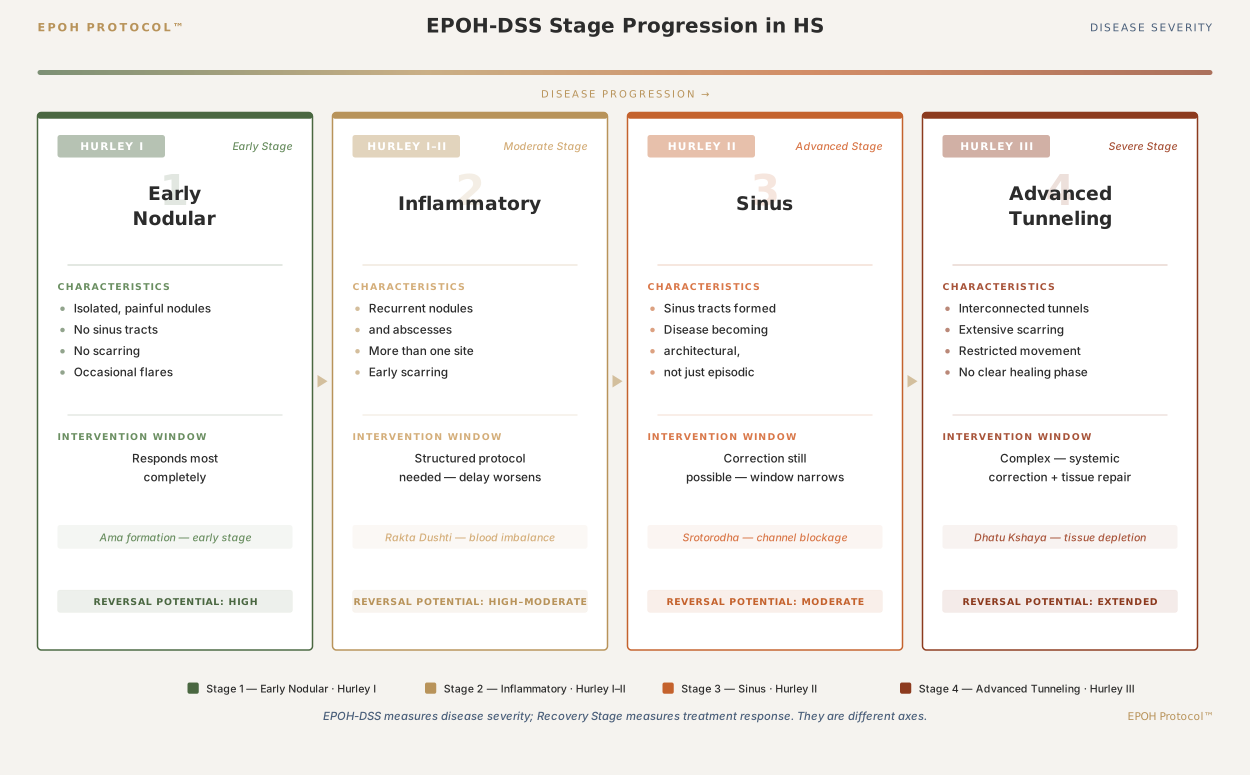
The EPOH Dynamic Staging System reads HS as a progression rather than a photograph. It is built on the classical Ayurvedic principle of Samprapti — pathogenesis understood as an ordered sequence from accumulation through to full structural manifestation, in which each step is a distinct opportunity to intervene and the opportunities narrow as the sequence advances. The question it asks is not only "how much damage is present" but "how far along is this, and how much is still correctable".
| EPOH-DSS Stage | Clinical name | What is happening | Closest Hurley equivalent |
|---|---|---|---|
| EPOH-DSS Stage 1 | Early Nodular | Small firm nodules, mild pain. No pus, no discharge, no tracts. The most reversible point in the condition. | Hurley Stage I (early) |
| EPOH-DSS Stage 2 | Inflammatory | Increased pain, redness, heat, swelling; pus beginning to form. No established tract yet. The critical intervention window. | Hurley Stage I (established); sometimes early Hurley Stage II |
| EPOH-DSS Stage 3 | Sinus | A sinus tract has formed and drains. Chronic recurrence at the same site. Surface treatment alone is insufficient. | Hurley Stage II |
| EPOH-DSS Stage 4 | Advanced Tunneling | Multiple interconnected tracts, continuous discharge, fibrotic thickened skin, sometimes restricted movement. | Extensive Hurley Stage II through Hurley Stage III |
The mapping is indicative, not exact. The two systems are partly measuring different things, and any table claiming a clean one-to-one conversion would be misleading you.
Look at where they diverge most. Hurley Stage I contains both EPOH-DSS Stage 1 and EPOH-DSS Stage 2. In Hurley terms, "firm nodules, nothing has ruptured" and "abscesses rupturing repeatedly, no tract yet" fall into one category, because neither has yet produced a tract or a scar. In EPOH terms they are different clinical situations with very different urgency. EPOH-DSS Stage 2 is the last point before the pathology stops being inflammatory and turns structural — the moment before a tract forms and lines itself. Hurley does not flag that moment, because it was not designed to. EPOH-DSS is designed for almost nothing else.
The second axis: Recovery Stage
Now the distinction that matters most, and the one most often garbled.
- EPOH-DSS Stage answers: how far has the condition progressed? Severity, now.
- Recovery Stage answers: how is your body responding to correction? Treatment response, over time.
Two instruments. Two different questions.
| Recovery Stage | Name | Timeline | What it looks like |
|---|---|---|---|
| Recovery Stage 1 | Internal Shift | Weeks 1–4 | Digestion, sleep and energy improve. The skin may not visibly change yet. This is still progress. |
| Recovery Stage 2 | Reduced Frequency | Months 2–4 | Flares become less frequent and shorter, and resolve more completely in between. |
| Recovery Stage 3 | Reduced Severity | Months 4–8 | The same triggers produce smaller responses. Longer quiet periods. Medication review becomes appropriate, with your prescribing physician. |
| Recovery Stage 4 | Stable Remission | Months 8+ | Extended periods without active disease. Monitoring replaces treatment. Formulations taper. |
Which is why the following sentence is not a contradiction, and describes a great many patients: you can be EPOH-DSS Stage 3 and Recovery Stage 2 at the same time.
You still have an established sinus tract — a structure that will not vanish because your gut improved, and that may not fully resolve. And your flares are becoming less frequent, shorter and less severe, because the internal drivers producing them are being corrected. The tract is a record of the past. The Recovery Stage is a report on the present. Read only the first and you will conclude that nothing is happening, stop, and end up where you started.
This is the thing a Hurley stage structurally cannot give you: a way to say "improving".
What your stage changes — and what it does not
It changes what to expect. EPOH-DSS Stage 1 and EPOH-DSS Stage 2 are the most reversible; timely correction can prevent structural progression altogether, and the gap between acting and waiting is widest here. EPOH-DSS Stage 3 and EPOH-DSS Stage 4 are more complex — structural change has already occurred, and the first objective shifts from resolution to halting the production of new lesions. Internal correction remains the most effective path toward sustained remission at every EPOH-DSS Stage; what changes is how complete the endpoint is likely to be.
Not every patient responds equally. Disease duration, degree of organ involvement, and remaining biological repair capacity all influence outcomes, and patients with very advanced structural changes — severe fibrotic HS — may not achieve full remission. A personalised evaluation is the only way to assess your specific response potential.
It does not change the sequence. Every patient begins at Phase 1 (Lowering the Load, 4–8 weeks), moves into Phase 2 (Internal Healing, 8–16 weeks), and only then to Phase 3 (Functional Detox), with Phase 4 running through them. An EPOH-DSS Stage 4 patient does not leap ahead to external care because the lesions are worse; they carry a heavier load into Phase 1, generally need longer in Phase 2, and lean far more on Phase 4 later. The EPOH-DSS Stage sets duration and emphasis. It does not reorder the phases.
And it does not, by itself, determine your treatment. Treatment is built from your driver profile — gut health, hormonal balance, immune regulation, metabolic function, stress and cortisol — not from the condition name, and not from the stage name either. In HS the dominant axis is gut dysbiosis driving immune dysregulation, expressing in the apocrine-bearing skin; but which drivers are active, and in what proportion, is individual. The EPOH-DSS Stage tells us the terrain. The driver profile determines the formulations.
One timing note. Around weeks three to six, many patients meet the Partial Improvement Plateau — genuine improvement in digestion and energy, but flares that have not stopped. It gets read as failure, and patients quit there. It is not failure: it is the signal that Phase 1 has done its work and Phase 2 should begin. In staging terms, it is what late Recovery Stage 1 looks like from the inside.
If you know your Hurley stage but not what is driving your HS, you are holding one of the two readings. Establishing your EPOH-DSS Stage and your driver profile is what a personalised evaluation is for — by video or WhatsApp, with formulations compounded to that profile and dispatched by courier.
Medical disclaimer. This article is for general information and is not a substitute for personalised medical advice. Ayurvedic treatment at EliteAyurveda™ is individualised following clinical assessment. Do not start, stop or alter any prescribed medication without consulting your treating physician.

