


Part of the Hidradenitis Suppurativa Knowledge Library
You probably did the sensible thing. You read that HS is inflammatory, that it is connected to the gut, that something inside you is driving what keeps erupting on the outside. So you went looking for a way to clear it out. You found a cleanse, a flush, a fast, a "toxin removal" programme — and you started there, because starting there felt like starting at the root.
Then, somewhere between the second and the fourth week, you got worse. A new lesion in a place you had never had one. An old site that had been quiet for months came back angrier than before. You stopped, concluded that whatever this was, it was not for you, and quietly filed the whole idea away.
That flare was not random, and it was not evidence that internal work cannot help you. It was the predictable result of doing a reasonable thing in an unworkable order.
Detox does not remove load. It moves it.
Everything else in this article rests on that sentence.
The accumulated inflammatory load behind HS — what Ayurveda calls Ama — is not sitting in a reservoir waiting to be drained. It is distributed: bound into tissue, embedded in obstructed channels (Svedavaha Srotas, the sweat channels, and Raktavaha Srotas, the blood-carrying channels), sustained by a gut lining that is leaking inflammatory signal into circulation, and read continuously by an immune system that is already misfiring.
A detox — of any kind — acts on exactly one variable. It increases mobilisation: it prises that load out of the tissue and returns it to circulation.
It does nothing to the second variable. Clearance capacity — your system's actual ability to process and eliminate what has been mobilised — depends on gut barrier integrity, on hepatic and lymphatic function, and on how much inflammatory signalling the immune system is already carrying. Those are precisely the things that are compromised in HS. That is, in large part, what HS is.
So the arithmetic is unforgiving.
If mobilisation exceeds clearance, the load is not eliminated. It is redistributed.
And it is not redistributed at random. It re-deposits where the channels are already obstructed and the tissue is already inflamed — the axillae, the groin, the inframammary folds, the gluteal cleft. It goes to the apocrine-bearing skin. It goes exactly where your HS already lives.
Meanwhile a gut barrier that is already compromised does not hold the line. Load that should have left the body re-enters circulation instead. And an immune system that is already dysregulated does not treat a sudden surge of circulating inflammatory signal as neutral. It treats it as fuel.
You did not fail the detox. The detox handed your body a bill it did not have the capacity to pay.
What that flare actually told us
Here is the part nobody says out loud: if an early cleanse made your HS worse, that is genuinely useful clinical information about you.
It means mobilisation outran clearance. Which means that at that moment your gut barrier and your clearance channels could not handle what was released into them. Which means gut health is a live driver in your case — and that Phase 1 and Phase 2, the two phases everyone wants to skip past, are the two you most need.
A flare on an early detox is not a verdict. It is a reading.
What has to be true before you clear anything
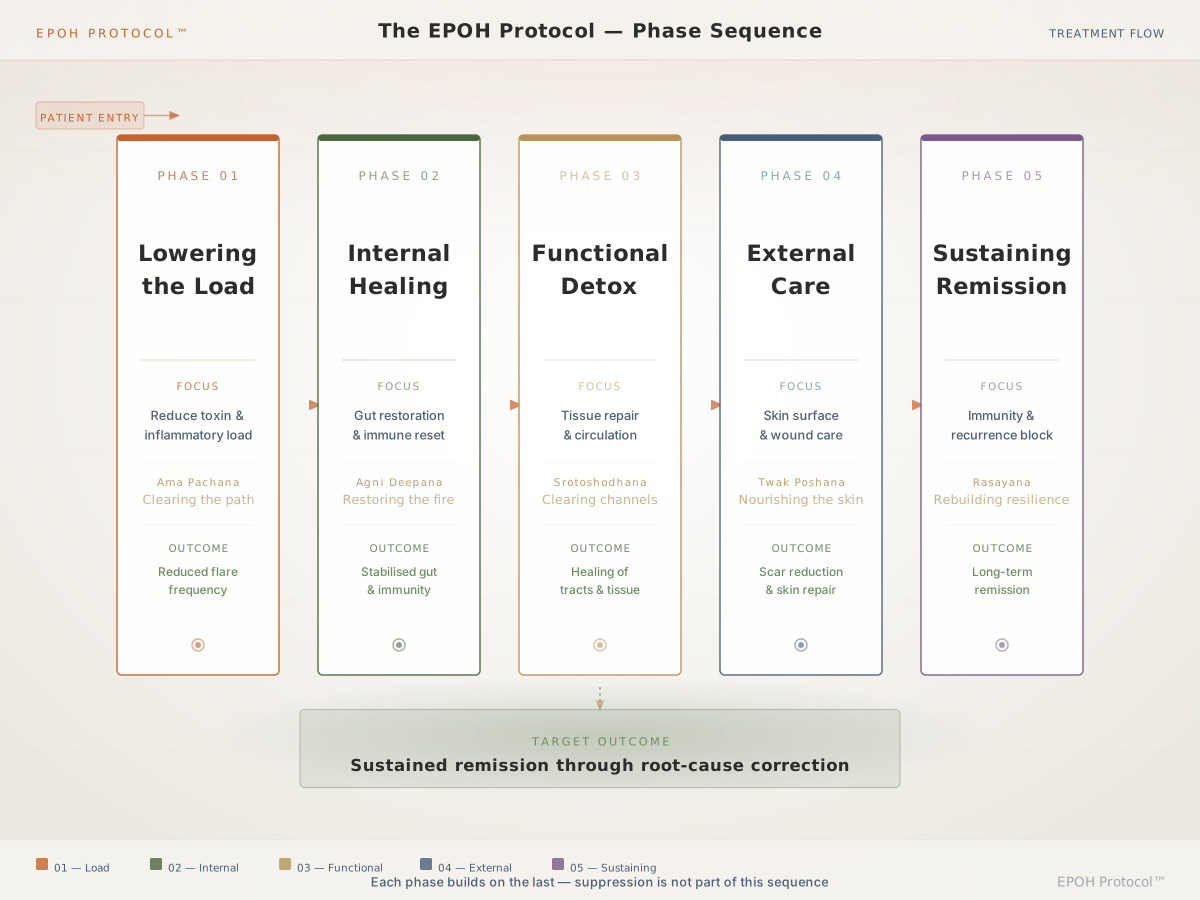
EPOH runs five sequential phases — Lowering the Load, Internal Healing, Functional Detox, External Care, Sustaining Remission. Clearance sits third. Not out of caution for its own sake, but because two conditions must be met before mobilising anything is safe.
One: the load has to stop growing. Phase 1 — Lowering the Load, 4–8 weeks. Inflammatory Load Reduction formulations, taken orally at home, bring down the accumulated burden and calm overactive immune signalling, while supporting Agni — the digestive and metabolic capacity whose weakness generated the load in the first place. You cannot empty a bath with the tap running. Phase 1 closes the tap and lowers the water. Dietary guidance runs alongside it: complementary, not the phase itself.
Two: the exit has to be open. Phase 2 — Internal Healing, 8–16 weeks. This is the primary correction phase, and it is what makes clearance possible at all. Internal Correction formulations work on gut lining integrity, microbiome repair, immune recalibration, and the hormonal patterns riding on top of them. A restored gut barrier is the entire difference between mobilised load leaving and mobilised load recirculating. Until that barrier holds, whatever you release goes back into you.
Only once those two things are true does clearance become a treatment rather than a hazard.
What Phase 3 actually is
Phase 3 — Functional Detox, 6–12 weeks, frequently running concurrently with Phase 2. Functional Clearance formulations, taken orally, supporting lymphatic drainage and tissue-level clearance from within, and re-opening the channels that HS has obstructed.
Notice what that description excludes. Phase 3 is not a procedure. It is not a fast. It is not a juice cleanse, a purge, a colonic, a sweat therapy or a residential programme. There is nothing to travel for, nothing to book, and nothing to endure. It is a set of oral formulations, compounded to your driver profile, that arrive by courier and are taken at home — like every other phase.
The reason the same idea harms in first position and works in third is not the formulations. It is the terrain they are acting on.
Why we will not start there, even when a patient asks
Patients do ask, and it is a reasonable request. Phase 3 is the phase that sounds like it is doing something. It names the thing you feel is wrong with you and offers to take it out.
We do not start there, because handing a patient clearance formulations in week one would be selling them the failure they have already bought once. The sequence is not packaging around the treatment. The sequence is the treatment. Phase 3 applied before Phases L and I are stable mobilises internal load faster than the system can clear it, and the condition worsens. That is a mechanism, not a house rule.
There is one moment when this matters more than any other. Around weeks three to six, many patients meet the Partial Improvement Plateau — real change in digestion, energy and sleep, but flares that have not stopped. It reads like failure. It is not: it is the signal that Phase 1 has done its work and Phase 2 should begin. It is also, precisely, the moment a frustrated patient reaches for something drastic. Reaching for clearance here, before internal healing, is how a plateau becomes a setback. If you remember one timing rule from this entire article, remember that one.
If you tried a detox and got worse
The idea was sound. Your body genuinely does carry an accumulated inflammatory load; that load genuinely does drive HS; and it genuinely does have to be cleared. What was wrong was the order.
HS is not a skin condition with systemic complications — it is a systemic condition expressing through the skin, driven in most patients by gut dysbiosis feeding immune dysregulation, which then localises in the apocrine-bearing skin. You cannot clear a system faster than it is able to clear. First you lower what is there. Then you repair what is leaking. Then — and only then — you open the channels.
Not every patient responds equally. Disease duration, degree of organ involvement, and remaining biological repair capacity all influence outcomes, and patients with very advanced structural changes — severe fibrotic HS — may not achieve full remission. A personalised evaluation is the only way to assess your specific response potential.
If a cleanse once made your HS worse, that history is worth bringing to an evaluation rather than being embarrassed by: it tells us something real about your gut barrier and your clearance capacity. Evaluation is by video or WhatsApp, and formulations are compounded to your driver profile and sent by courier. There is nothing to attend and no procedure to undergo — only a sequence, run in the order the body actually permits.
Medical disclaimer. This article is for general information and is not a substitute for personalised medical advice. Ayurvedic treatment at EliteAyurveda™ is individualised following clinical assessment. Do not start, stop or alter any prescribed medication without consulting your treating physician.

