


Crohn's Disease Treatment
Part of the Inflammatory Bowel Disease Centre
Crohn's is not an inflamed bowel that occasionally affects the rest of you. It is a systemic failure of the gut barrier and the immune system that responds to it — which is why suppressing the inflammation has never ended it.
- 5internal driver systems assessed
- 5sequenced treatment phases
- Remotefirst, with in-clinic intensives where needed


What most people describe when they reach us
Most people with Crohn’s know where every toilet is — on the commute, in the restaurant, at the airport — and have cancelled plans without saying why.
Crohn’s is usually described as a condition to be controlled rather than resolved: stepping up through the drugs as they stop working, with surgery when they run out. Many people have already had surgery and watched the disease return at the join.
None of that means the disease is untreatable. It means it was being treated at the level of the inflammation, and not at the level of what keeps producing it.
The questions people ask us first
Does this actually work, or is it another thing that will not?
Ayurveda has a real problem with unverifiable claims, and most of what is sold for Crohn's is procedure-based or herb-of-the-week. Here is what is actually different, and what we cannot do.
Read the answer →I have tried Ayurveda before and it did nothing.
Most people who tried Ayurveda for Crohn's were given a cleanse first. That sequence makes this disease worse. Your experience was real; the approach was wrong.
Read the answer →Will I ever be off medication?
Active inflammation can resolve. Fibrotic scar does not, and resected bowel does not grow back. The honest answer depends on what has already become structural.
Read the answer →Three things that make this different
We treat the barrier, not the flare
Conventional care targets the inflammatory signal. We target the gut-barrier failure and the immune dysregulation that generate it — because a signal that is suppressed while its source is untouched returns the moment suppression stops.
The sequence is the treatment
Five phases, in a fixed order, for a reason. Most Ayurvedic care for Crohn's that fails, fails because it began with clearance. Doing that before the load is lowered and the barrier is stable makes this disease worse, and we will not do it.
Nothing about it requires you to travel
Formulations are compounded to your driver profile and couriered to your door. Consultations and phase transitions happen by video or WhatsApp. No clinic visit is required for most patients — which, for a disease that plans its own life around toilet access, is not a small thing.
Five phases, and the order is the medicine
Every phase is delivered as a personalised formulation, compounded to your driver profile, couriered to your door and taken at home. There is no procedure for most patients in this protocol.
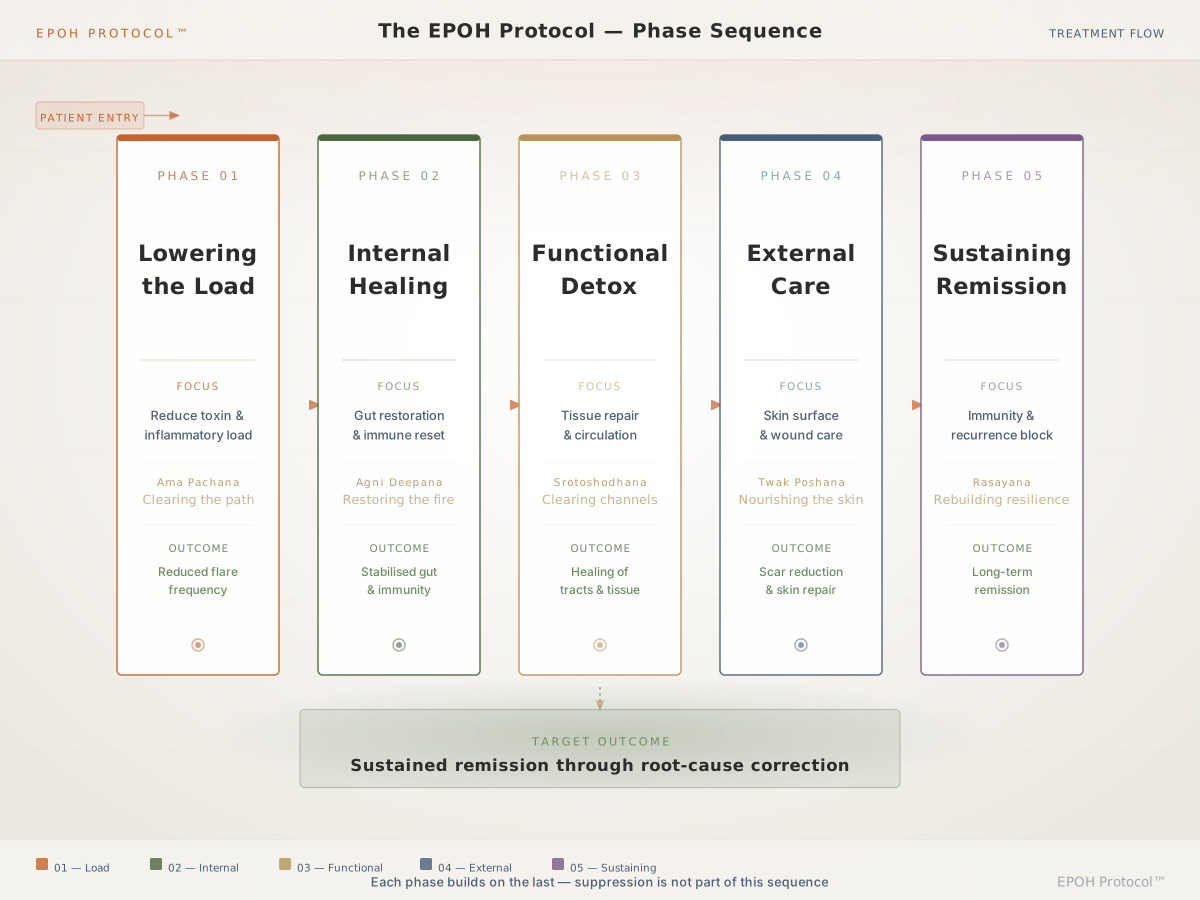
| Phase | What actually happens | Duration | |
|---|---|---|---|
| L | Lowering the Load | Oral formulations that reduce the accumulated inflammatory burden (Ama) and calm the immune over-recruitment. Digestive support. This is where treatment starts — always. | 4–8 weeks |
| I | Internal Healing | The primary correction phase. Gut lining integrity, microbiome repair, immune recalibration. Oral formulations. | 8–16 weeks |
| F | Functional Detox | Oral formulations supporting lymphatic and tissue-level clearance from within. Not a procedure. Not Panchakarma. Nothing is administered to you. | 6–12 weeks, often concurrent with I |
| E | External Care | Topical formulations you apply yourself, at home — principally for perianal disease and fistula sites. Effective because the internal environment has already shifted. | ongoing through I–F |
| S | Sustaining Remission | Formulation tapering, resilience, monitoring. Not indefinite suppression. | 6–12 months active monitoring |
Why the load comes down before the gut is rebuilt — even though this is a gut disease
This is the part that is counter-intuitive, and it is the part that most often explains a previous failure.
Crohn's is a disease of the bowel, so every instinct — and most of the Ayurvedic care sold for it — says repair the bowel first. The protocol says no. The load has to come down before the bowel is rebuilt. Gut restoration attempted while the systemic inflammatory load is still high gives incomplete results: the repair cannot hold in the environment it is being asked to hold in. You rebuild the lining, and the same load degrades it again.
And the sharper version of the same rule: Detox done before the load is down and the gut is repairing releases waste faster than your system can clear it — which makes the condition worse. This is why "detox first" is the single most damaging thing done to Crohn's patients under an Ayurvedic banner.
If you have tried a cleanse-led programme and deteriorated, you were not imagining it, and it was not that your disease is untreatable. The timing was wrong. Why lowering the load comes before gut repair →
EPOH compared to conventional management
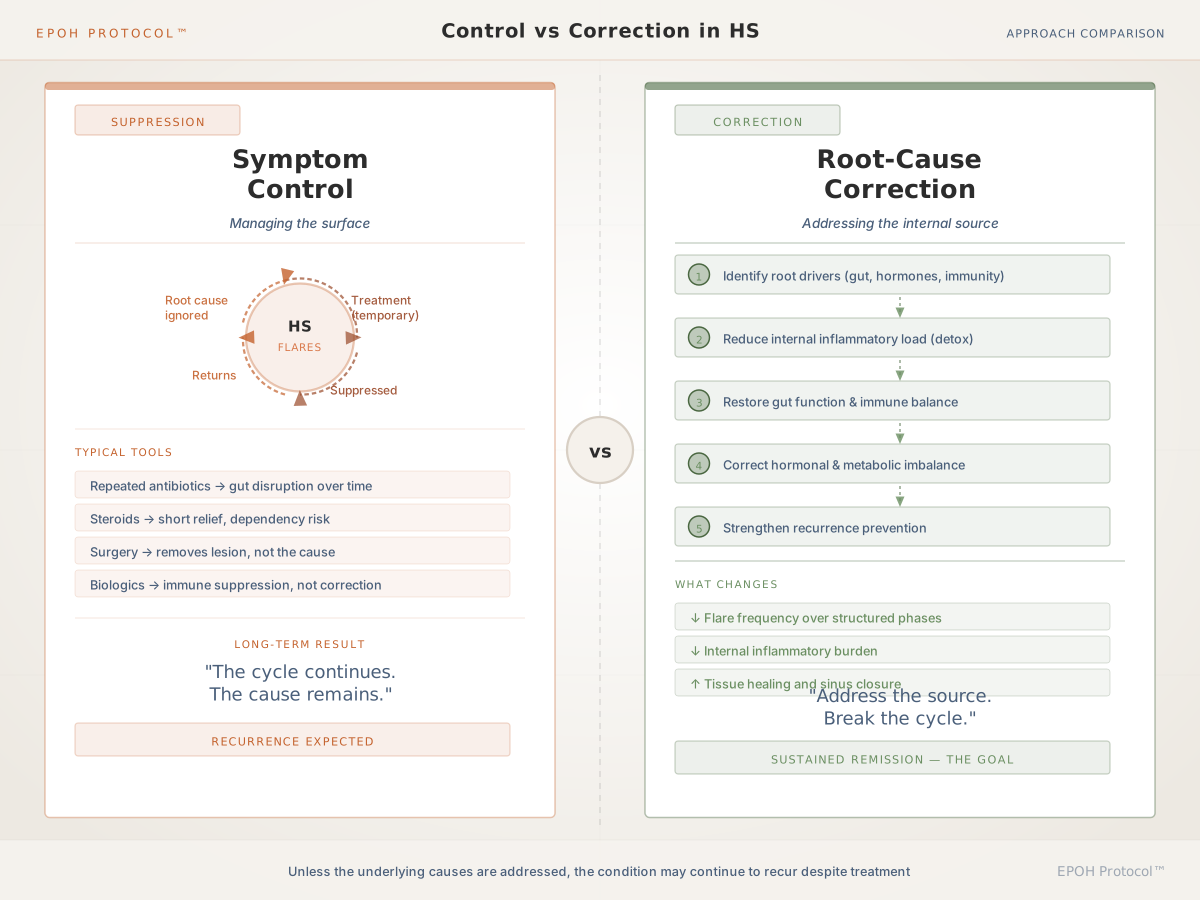
| Aspect | Conventional | EPOH |
|---|---|---|
| Primary target | Inflammatory signalling in the bowel wall | The barrier failure and immune dysregulation generating it |
| Treatment model | Management — control symptoms indefinitely | Correction — resolve the underlying drivers |
| Personalisation | Protocol-based — the same agent for the same diagnosis | Compounded to the individual driver profile |
| Recurrence logic | Expected; a permanent feature of the disease | Indicates an unresolved root cause — addressed directly |
| Microbiome | Not typically addressed; antibiotics often worsen it | A central priority of the internal-repair phase |
| Medication trajectory | Ongoing, often escalating through the biologic classes | Structured reduction, with your prescribing physician |
| Long-term aim | Minimise flares, maintain control | A stable internal state in which the condition no longer drives symptoms |
People who were where you are
Documented courses of treatment — what changed, over what timeframe, and what did not. Identifying details are withheld and outcomes are not generalised. Individual response varies, and not every course ends in remission.
Twenty-One and Losing Weight Every Week
He was twenty-one, and he was losing weight faster than he could eat it back.
Read this story →The clinical background, if you want the detail
Everything below is reference material — what Crohn’s does, why it does it, how it behaves at each location, and how it is staged. You do not need any of it to start. It is here because some people want to understand the disease properly before they decide anything, and every page links back here.
Symptoms
What Crohn's actually does, day to day, and what each symptom is telling you.
5 pages →Causes
The five internal driver systems. In Crohn’s the gut barrier and immune regulation are the PRIMARY drivers, not secondary ones.
5 pages →Complications
Fistulas, strictures, abscesses, malabsorption — what is reversible, what is not, and what is an emergency.
4 pages →Crohn's by location
Crohn's is named for where it sits. The location changes the symptoms, the deficiencies it produces, and what treatment must prioritise.
5 pages →Disease behaviour
Inflammatory, stricturing, penetrating — the classification your gastroenterologist already uses, and the biggest determinant of what is achievable.
Read →Treatment
The EPOH protocol, in sequence. Including the rule that surprises everyone: even in a gut condition, the inflammatory load comes down before the bowel is rebuilt.
Read →Outcomes
What we measure, when we judge it, and when it is not the right treatment.
Read →FAQ
The questions patients actually ask, answered without marketing.
Read →Research
The clinical reasoning in depth — mechanism, objections, treatment experience and outcomes.
134 articles →Patient stories
Told in the patient’s own words — what living with the condition was like, and what changed.
1 story →Crohn's by location — find yours
Crohn's is named for where it sits. The location changes the symptoms, the deficiencies it produces, and what treatment has to prioritise.
Ileocolitis
The commonest pattern: the end of the small intestine and the colon together. Cramping in the lower right abdomen, diarrhoea, weight loss.
Read more →Ileitis
The terminal ileum alone. The same right-sided pain, and the site where B12 and bile salts are absorbed — which is why deficiency appears here first.
Read more →Jejunoileitis
Patchy inflammation of the upper small intestine. Cramping after meals, and malabsorption that is often severe out of proportion to the visible disease.
Read more →Gastroduodenal Crohn's
Stomach and duodenum. Frequently mistaken for ulcer disease or gastritis for years before it is correctly identified.
Read more →Granulomatous Colitis
Colon only — Crohn's colitis. The pattern most often confused with ulcerative colitis, and the distinction changes the treatment.
Read more →The clinical reasoning, in depth
Why Lowering Inflammatory Load Comes Before Gut Repair
Even in a gut disease, gut repair is not step one. Why inflammatory load must fall first, and why clearing out too early makes Crohn's patients worse.
Read →Strictures in Crohn's: Inflammation Versus Fibrosis
An inflammatory stricture can soften. A fibrotic stricture is scar tissue and does not reverse. Knowing which one you have decides what is realistically possible.
Read →Crohn's Fistulas and Why They Keep Coming Back
Crohn's fistulas tunnel through the full bowel wall. Why local repair fails while the systemic driver is active, and what an honest recovery path looks like.
Read →Frequently Asked Questions
Active inflammation can resolve, and an inflammatory stricture can soften as it does. But fibrotic tissue is scar, and scar does not reverse — with any internal treatment, ours included. Nor does resected bowel grow back. The honest answer is that what is reversible depends on what has already become structural. That is assessed individually, and we would rather tell you before you begin than after.
No — and you should not. Treatment begins while you continue everything you are currently taking. Stopping a biologic or a steroid abruptly risks a severe flare and, with biologics, loss of response if you later restart. As internal correction takes effect, medication is reviewed with your prescribing physician and reduced gradually, if and when that becomes appropriate.
No. There is no procedure, no in-clinic therapy and no clinic visit for most patients. Treatment is delivered entirely through personalised formulations — oral compounds and topical preparations — dispatched by courier and taken at home. Consultations happen by video or WhatsApp.
Because doing it first makes Crohn's worse. The clearance formulations mobilise accumulated inflammatory load. If the inflammatory load has not yet been lowered and the gut barrier has not begun to stabilise, that load moves faster than the body can clear it. If you have tried a "detox-first" approach and deteriorated, the approach was not necessarily wrong — the sequence was.
No, but be clear about what is on the table. Surgery removed the damaged segment; it did not change the internal environment that produced it, which is why recurrence at the join is common. Correcting that environment is exactly what this addresses. What surgery removed, however, is gone — so the goal is to protect what remains, not to restore what does not.
Not by your bowel first. In Recovery Stage 1 (weeks 1–4) it is usually energy, sleep and digestion that shift, while stool frequency has not yet changed — and that is progress, not a failure. Weeks 3–6 often bring a plateau. The disease itself should begin to change in Recovery Stage 2, months 2–4. We will not put a date on your remission.
No. Keep your gastroenterologist, keep your scopes, and keep your bloods and calprotectin monitoring. Those are how both you and we find out whether this is working, objectively. Anyone who tells you to abandon conventional monitoring is putting you at risk. If you are in an acute severe flare, have an obstruction, or have signs of perforation, you need emergency conventional care, not us.
Yes. Formulations are compounded and couriered internationally, and every consultation and phase transition happens by video or WhatsApp. Because there is no clinic visit for most patients in the protocol, nothing about the treatment depends on where you live.
Nothing about this requires you to travel
- Consultation by video or WhatsApp. Your history, your disease course, your prior treatments, your current medication, and a full assessment of your five driver systems.
- Formulations compounded to your driver profile. Oral compounds and, where the disease is perianal, topical preparations. No two patients receive the same formulations.
- Dispatched by courier — across India and internationally, to your door.
- Monitoring and phase transitions by video or WhatsApp. Your gastroenterologist keeps doing their bloods and their scopes, and we work alongside that.
There is no procedure, no in-clinic therapy, and no clinic visit required — for most patients.
If you have Crohn's, you already know why that matters. Travelling to a clinic for weekly treatment is not a minor inconvenience when you cannot reliably be forty minutes from a toilet. What a remote consultation actually involves →
With you,
throughout your treatment journey

Easy Appointments avaliable Online & Offline with the Best Ayurveda Experts in India

Evidence-based Approach for Progressive Health with Dedicated 1:1 Support

Medicines Delivered to your door-step Worldwide Hassle-Free

Structured, AYUSH Vetted Root Level Treatments for Rebalanced Cellular & Metabolic Conditioning

Personalised for Changes on a Deeper Level that will have a Long-Lasting Impact on your Health
Speak to a specialist about your Crohn's
A consultation assesses your driver profile, your disease behaviour, and what root-cause correction can realistically achieve in your case. If we do not think we can help you, we will tell you.
Consultations by video or WhatsApp. Formulations couriered to your door, in India and internationally. Remote first, with in-clinic intensives where the disease needs them.
Our Crohn’s Disease
Treatment Highlights
Understand the Approach that Makes Us the Most Successful Ayurveda Center for Crohn’s Disease Treatment
We strive to enhance the quality of medicines to give you the holistic benefit of latest in treatment knowledge and optimally potent herbal medicines.
Medical disclaimer. This page is general clinical information, not personalised medical advice. Individual response varies with disease duration, degree of involvement and remaining biological repair capacity — not every patient reaches the same outcome. No medication should be started, stopped or altered without consulting your treating physician.
EliteAyurveda™ in Numbers
28,000+
Patients Treated
Among World's leading experts on Ayurveda treatment with over 28k+ patients treated worldwide
30+
Years Experience
Our doctors have combined treatment experience that surpasses 30+ Years
Remote
First, In-Clinic Where Needed
Formulations are compounded to your profile and dispatched by courier. Consultations by video or WhatsApp. No clinic visit is required — for most patients.
Trust of Authentic Ayurveda - Awards & Recognition




Talk to Us Directly
No forms. Message or call the clinic and a doctor’s team member will take your history.
Replies during clinic hours, Mon–Sat.