


Part of the Crohn's Disease Knowledge Library
You have started eating around it. Soft food. Small portions. Nothing with skin, nothing fibrous, nothing that might get stuck. You know the feeling that comes forty minutes after a meal — the swelling, the cramping, the loud gurgling, the wave of nausea — and you have organised your life around avoiding it.
A stricture is a narrowed segment of bowel. But there are two completely different kinds, they feel almost identical from the inside, and the difference between them decides what is honestly achievable for you.
This is the article where we tell you the thing most clinics will not.
Two strictures, one symptom
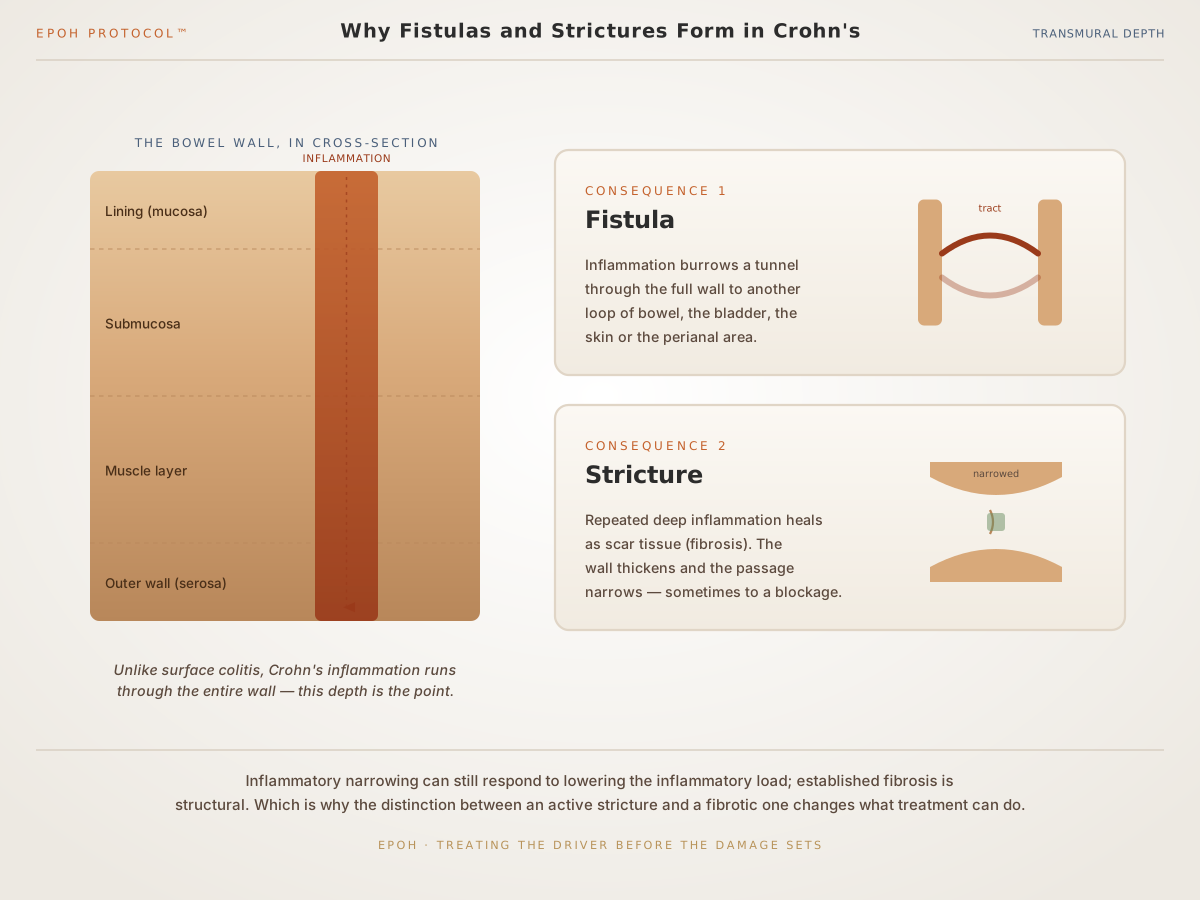
An inflammatory stricture is narrowed because the bowel wall is swollen. Active inflammation thickens the tissue, oedema fills it, and the passage through it shrinks. The narrowing is made of inflamed living tissue.
A fibrotic stricture is narrowed because the bowel wall has been replaced by scar. Repeated cycles of deep, full-thickness injury and healing lay down collagen. The wall becomes thick, stiff, and permanently contracted. The narrowing is made of scar tissue.
Both cause the same thing: obstruction. Cramping after meals, bloating, audible bowel sounds, nausea, vomiting, weight loss, and eventually a bowel that cannot pass anything at all.
Most real strictures are mixed — some inflammation, some fibrosis, in some proportion. The proportion is the whole question.
Here is the honest part
An inflammatory stricture can soften. Take the inflammation down and the swelling goes down with it. The wall thins. The passage widens. People who could not eat solid food find they can again. This is real, it happens, and it is the reason strictures are worth treating internally at all.
A fibrotic stricture does not reverse. Not with formulations. Not with diet. Not with biologics. Not with any internal treatment offered by anyone, in any system of medicine, anywhere. Scar tissue is not inflamed tissue that has gone quiet — it is a different tissue, structurally, and there is no known internal intervention that turns collagen scar back into functioning bowel wall.
If a clinic tells you they can dissolve an established fibrotic stricture, they are lying to you, and you should walk away from them.
We would rather lose you as a patient than lie to you to keep you.
Why the distinction changes everything
Because it determines what "success" means for you.
If your stricture is predominantly inflammatory, reducing the systemic driver can genuinely restore the calibre of that segment, and sustained remission is a reasonable goal.
If your stricture is predominantly fibrotic, then no amount of internal work will widen it. What internal work can do is:
- stop new strictures from forming elsewhere,
- reduce the inflammatory component sitting on top of the fibrotic core — which is often the difference between "obstructed" and "tight but passable",
- reduce the systemic inflammatory load that is driving the fatigue, the malabsorption and the extra-intestinal misery,
- and reduce the rate at which further fibrosis is being laid down.
Those are not small things. They may be the difference between one surgery and three. But they are not the same as the narrowing going away, and you deserve to know which conversation we are having.
How the two are told apart
Nobody can distinguish them from your symptoms alone, and any practitioner who claims to over a video call, without imaging, is guessing.
The distinction is made with cross-sectional imaging — MR enterography or CT enterography, sometimes intestinal ultrasound. What the radiologist is looking for is whether the thickened wall shows the signal characteristics of active inflammation and oedema, or the characteristics of dense fibrotic tissue. Contrast behaviour, wall layering and signal on specific sequences all carry information. Inflammatory markers in blood and stool add supporting evidence. Endoscopy tells you the passage is narrow but is poor at telling you what the narrowing is made of.
If you do not have this imaging, get it before you commit to any long protocol — ours included. It is the single most decision-relevant investigation you can have, and it should be done through your gastroenterologist.
Honest candidacy, in practice
EPOH has a rule that costs us patients, and we keep it anyway: we tell people when their structural change is beyond what internal correction can reach.
Advanced fibrotic stricturing, extensive prior resection, severe fixed damage — these are cases where full remission may simply not be achievable. If that is you, we will say so at consultation. We may still be able to help you meaningfully. We will not pretend the scar will melt.
What triggers this honesty rule:
- a stricture that is long, dense and unchanged across serial imaging despite adequate anti-inflammatory therapy,
- repeated obstructive episodes requiring hospital admission,
- prior resections with recurrent fixed narrowing at the join,
- imaging that clearly reads as fibrotic rather than inflammatory.
If you are in that group, the right conversation is with your surgeon about the options that actually address scar — and there is no shame in that, and no failure in it. Internal work then has a supporting role: bringing down the systemic driver so the next segment does not go the same way.
For predominantly inflammatory strictures: how it is treated
EPOH is entirely formulation-based. For most patients there is no procedure and no clinic visit. Consultation is by video or WhatsApp; compounded formulations are couriered to you.
The EPOH phase sequence is fixed:
L — Lowering the Load (4–8 weeks). Oral Inflammatory Load Reduction formulations reduce the accumulated inflammatory load (Ama) that keeps the Pitta-driven gut inflammation burning. In a stricture, this phase is also where the swelling component first begins to move.
I — Internal Healing (8–16 weeks). Oral Internal Correction formulations rebuild gut lining integrity, repair the microbiome and recalibrate immune signalling — the actual reason the wall keeps being injured and keeps trying to heal itself with scar.
F — Functional Detox (6–12 weeks, often overlapping with I). Oral Functional Clearance formulations, not a procedure. Critically, in stricturing disease this phase is never brought forward. Mobilising load faster than a partially obstructed system can clear it is a recipe for a very bad week.
E — External Care (ongoing through I and F). Topical External Tissue Repair formulations applied at home.
S — Sustaining Remission (6–12 months). Tapered Remission Maintenance formulations with monitoring — including repeat imaging, because in stricturing disease the imaging is the truth-teller, not how you feel on a good week.
Formulations are compounded to your driver profile. Gut barrier failure and immune dysregulation are primary in Crohn's; the hormonal, metabolic and cortisol drivers modify the compounding. There is no fixed recipe.
What progress looks like — and what it does not
Recovery Stage 1, the Internal Shift (weeks 1–4), is mostly systemic: energy, appetite, inflammatory markers. Your stricture will not have widened in four weeks and nobody should tell you it has.
Then comes the Partial Improvement Plateau in weeks 3–6, when it feels like nothing further is happening. It is not failure. It means Phase 1 is complete and Phase 2 should start.
Reduced Frequency (months 2–4) often shows up as fewer obstructive episodes. Reduced Severity (months 4–8) as a wider tolerance of food textures. Stable Remission from month 8 onward, confirmed on imaging rather than on hope.
Continue your current medication while you begin. Any reduction is reviewed with your prescribing physician and tapered gradually.
And an urgent safety note: complete obstruction is a surgical emergency. Persistent vomiting, no passage of stool or gas, severe distension and severe pain mean hospital, now. Not a formulation. Not a phone call to us. Hospital.
Where to go from here
The most useful thing you can do this month is find out which kind of stricture you actually have. Everything else follows from that answer.
The rest of the Crohn's disease hub covers skip lesions, fistulas, fatigue and malabsorption through the same lens. If you want an honest assessment of your own case — including an honest "this is beyond what we can reverse", if that is the truth — a consultation can be booked by video or WhatsApp, and formulations, if appropriate, are couriered to you.
Medical disclaimer. This article is for general information and is not a substitute for personalised medical advice. Ayurvedic treatment at EliteAyurveda™ is individualised following clinical assessment. Do not start, stop or alter any prescribed medication without consulting your treating physician.

