


Part of the Crohn's Disease Knowledge Library
If you are reading this at 2am, somewhere between the bathroom and the bed, you have probably been handed one sentence to explain your entire life: your immune system is attacking your own bowel.
It is a sentence that closes conversations. It tells you the fault is inside you, that it is permanent, and that the only sensible response is to suppress the attacker for as long as you can tolerate the drugs.
We want to reopen that conversation, because the sentence is incomplete. And the missing part is exactly the part that determines what you should treat first.
The immune system is not the first thing that goes wrong
Crohn's disease is immune-mediated. That is not in dispute. The granulomas, the inflammation running through the full thickness of the bowel wall, the raised calprotectin in your stool test — these are immune events, and they are real.
But a classification describes what is happening. It does not tell you what started.
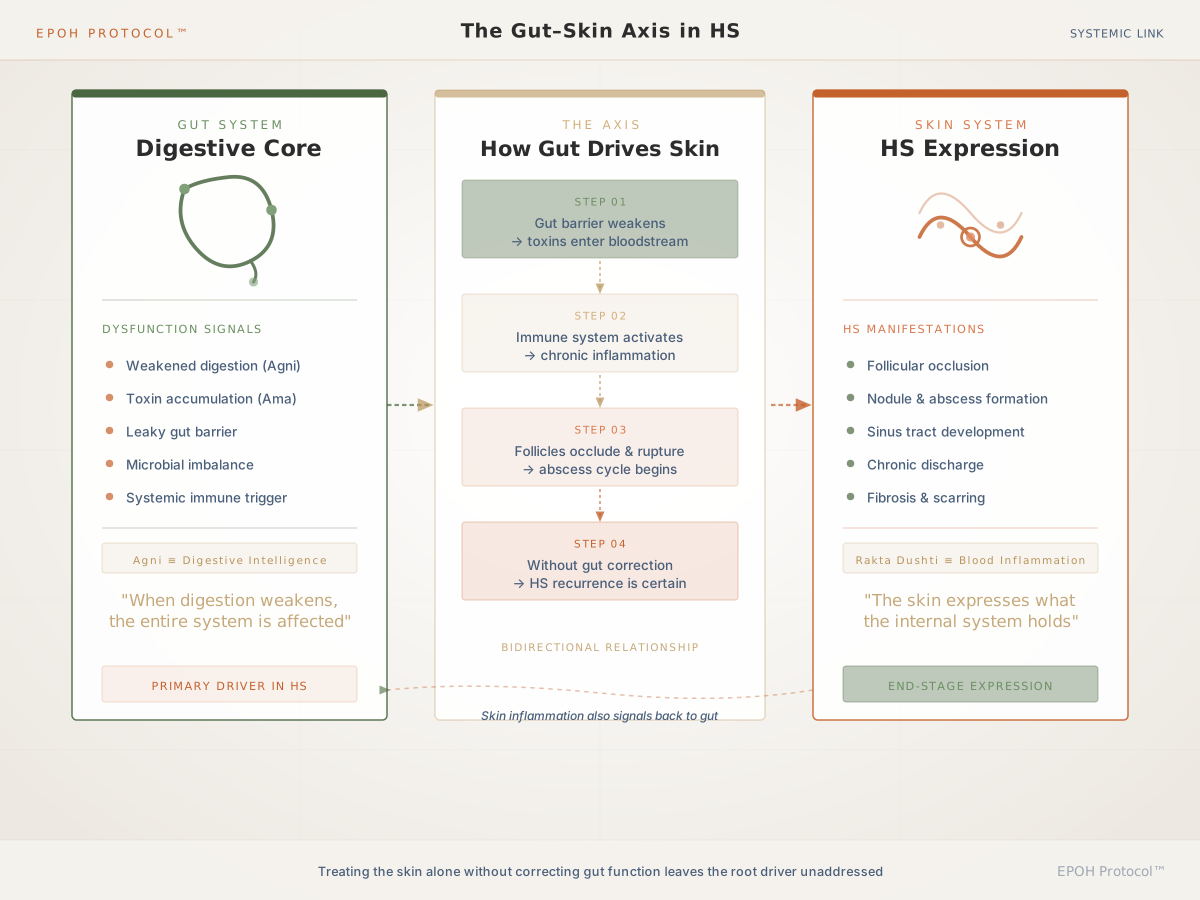
Look at the sequence rather than the snapshot. Before the immune tissue in your gut wall becomes hyperreactive, something must bring it into sustained contact with material it was never meant to meet. That something is the failure of the intestinal barrier.
What the barrier actually is
The lining of your intestine is not a wall. It is a single layer of cells — one cell thick — separating everything inside your gut from your bloodstream and from the densest concentration of immune tissue anywhere in your body.
That single layer is held together by tight junction proteins that open and close like gates. Above it sits a mucus layer that keeps bacteria at a distance. Within it sit specialised cells that release antimicrobial peptides. Below it sits the gut's immune tissue, constantly sampling, constantly deciding what is food, what is friend, and what is threat.
When this system holds, bacterial fragments and undigested particles stay inside the tube and pass through. When it fails, they cross.
Permeability comes first
This is the part that changes everything.
Increased intestinal permeability — a leaking barrier — is not merely a consequence of inflammation. It is measurable in people who do not yet have the disease. It is found in healthy first-degree relatives of Crohn's patients who have no symptoms and no lesions on scope. It is measurable in patients sitting in clinical remission, and when it rises in someone who is currently well, a flare tends to follow it rather than precede it.
Read that again, because it inverts the story you were given. The barrier opens, and then the disease flares.
Which means the immune activation you have been taught to fear is, at the beginning, a correct response to an incorrect situation. Your immune system is not misfiring at random. It is doing precisely what it exists to do — mounting a defence against bacterial material sitting where it should not be. The dysregulation, the granulomatous inflammation, the collapse of tolerance: these develop because that exposure never stops.
Why this changes what you treat first
If the initiating lesion is barrier failure, then treatment aimed only at the immune response is treating the alarm and leaving the fire.
This is not an argument against immunosuppression, and it is certainly not an argument against your gastroenterologist. Steroids and biologics work. They reduce inflammation, they close fistulas, they rescue people from severe flares, and in acute severe disease they are the right tool at the right moment.
But notice carefully what they do and do not do. They lower the volume of the immune response. They do not close the barrier. They do not correct why it opened. And so the pattern is consistent and predictable: things improve while suppression continues, and the disease reasserts itself when suppression is withdrawn, or when the body gradually stops responding to the drug.
That is not the drug failing. That is a drug being asked to do a job it was never designed to do.
What actually opens the barrier
Barrier failure is not one event. In assessment we map five internal driver systems: gut health, immune regulation, metabolic function, hormonal balance, and stress and cortisol.
In most chronic conditions the gut is a background driver. In Crohn's disease, gut barrier failure and immune dysregulation are the primary drivers. They are not the context of the disease. They are the disease.
The other three are rarely innocent bystanders. Cortisol dysregulation loosens tight junctions directly. Metabolic disturbance changes the fuel available to the cells that maintain the lining. Microbial imbalance strips the mucus layer that shields it. Every patient arrives with a different weighting of these, which is why there is no single correct formulation for Crohn's disease — only a correct formulation for one specific driver profile.
The order we work in
EPOH is delivered through the EPOH protocol, and its sequence is clinically non-negotiable.
Phase 1 — Lowering the Load (4–8 weeks). Oral Inflammatory Load Reduction formulations bring down the accumulated inflammatory load (Ama) circulating through the system. This comes before any attempt at gut repair, and if you take only one idea from this article, take this one: a barrier cannot rebuild inside a high-inflammation field. Tissue you repair there is simply re-injured.
Phase 2 — Internal Healing (8–16 weeks). The actual barrier work. Internal Correction formulations addressing gut lining integrity, microbiome repair and immune recalibration. It is slow, because epithelial restoration is slow.
Phase 3 — Functional Clearance (6–12 weeks, usually running alongside I). Oral Functional Clearance formulations supporting the body's own clearance pathways — started only once those pathways can cope with what is being mobilised.
Phase 4 — External Care. Topical External Tissue Repair formulations, applied by you, at home.
Phase 5 — Sustaining Remission (6–12 months). Tapered Remission Maintenance formulations, and monitoring.
There is no procedure for most patients of this, and no clinic visit for most patients. EPOH is entirely formulation-based: oral compounds and topical preparations, compounded to your driver profile and couriered to you.
What the early weeks honestly look like
Recovery Stage 1 (Internal Shift, weeks 1–4) is internal work, and you may not feel dramatic change during it. Somewhere between weeks three and six, many patients hit what we call the Partial Improvement Plateau — the early gains stall.
This is where people quit. It is precisely the wrong moment to. The plateau is a signal, not a verdict: it usually means Phase 1 has done its job and Phase 2 needs to begin.
After that: Recovery Stage 2, reduced frequency (months 2–4). Recovery Stage 3, reduced severity (months 4–8). Recovery Stage 4, stable remission (months 8+).
And an honest limit, offered before you spend anything. If you already have established fibrotic stricturing or extensive structural bowel damage, scar tissue cannot be talked back into being intestine. You may still gain real inflammatory relief and real stability. Full remission may not be achievable for you. We would rather say that at assessment than after.
About your current medication
Do not stop anything. Not on the strength of an article.
You begin EPOH while continuing your current prescriptions exactly as written. As internal correction takes hold, your medication is reviewed with your prescribing physician, and any reduction is gradual and structured, guided by objective markers rather than by how you feel during a good week.
Where to go next
This article belongs to our Crohn's disease hub. The companion piece — on why lowering inflammatory load must come before gut repair, and why sequence errors rather than effort explain most failed attempts — is the one to read next.
If you want your own driver profile assessed, consultations are by video or WhatsApp, and your formulations are couriered to you. There is no procedure, and no clinic visit is required for most patients in treatment.
Medical disclaimer. This article is for general information and is not a substitute for personalised medical advice. Ayurvedic treatment at EliteAyurveda™ is individualised following clinical assessment. Do not start, stop or alter any prescribed medication without consulting your treating physician.

