


Part of the Crohn's Disease Knowledge Library
You had it drained. Maybe you had a seton placed. Maybe you had a flap, or a plug, or a course of antibiotics that made it quiet for a while. And then it opened again — sometimes in the same place, sometimes half a centimetre away, sometimes on the other side.
By the third or fourth time, most people stop believing they will ever be rid of it. What almost nobody explains is that the repairs were not failing because they were done badly. They were failing because they were repairing the exit wound while the thing making the wound was still running.
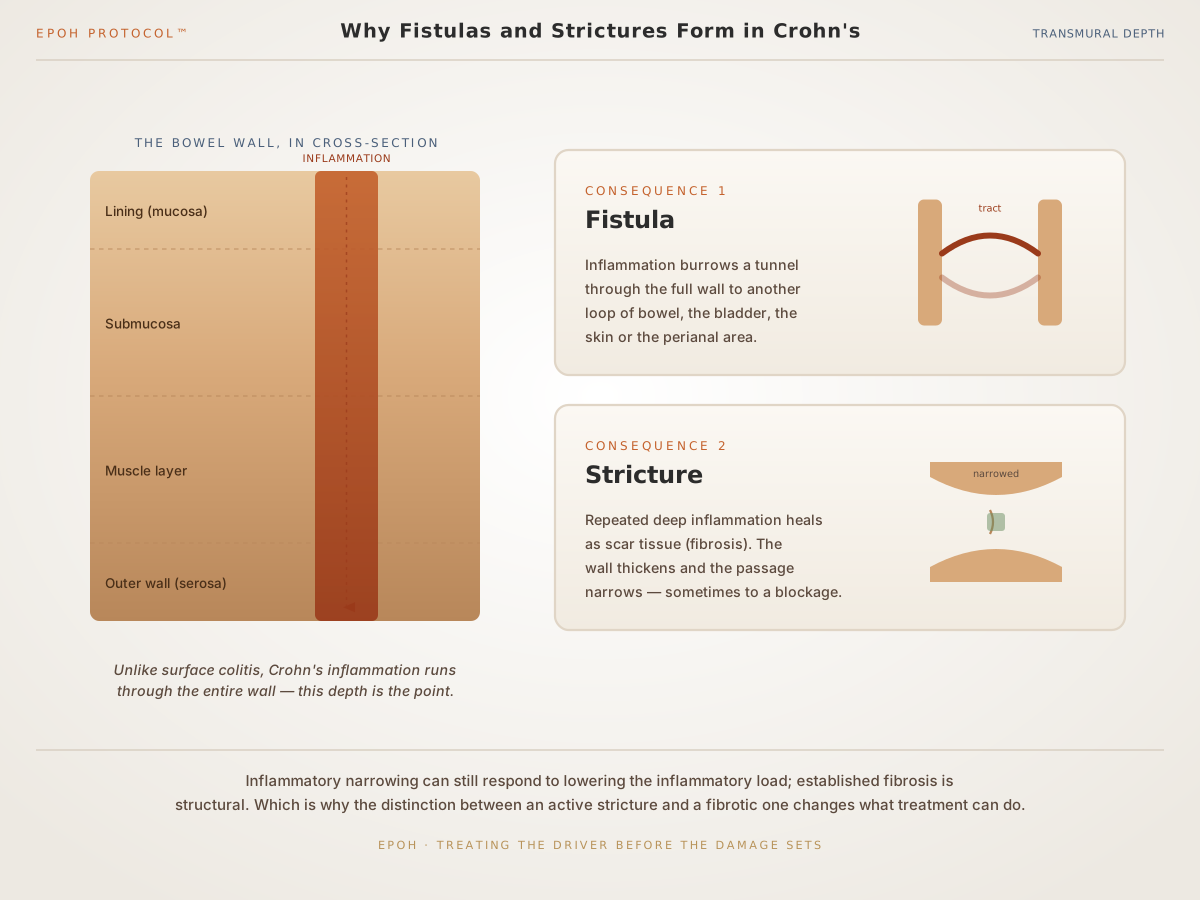
What a fistula actually is
Crohn's inflammation is transmural — it involves the whole thickness of the bowel wall, not just the lining. A deep ulcer in a wall does not stay a surface problem. It burrows.
When that burrowing tract breaks through the outer surface of the bowel, it has to go somewhere. It finds the path of least resistance and connects to whatever is adjacent:
- Perianal fistula — a tract from the anal canal or rectum to the skin around the anus. The most common, the most painful, the most life-limiting.
- Enterocutaneous fistula — bowel to skin, often through the abdominal wall, sometimes at an old surgical scar.
- Enteroenteric fistula — bowel to bowel, which can short-circuit whole segments of the digestive tract and cause malabsorption and diarrhoea that no diet explains.
- Enterovesical and rectovaginal fistulas — bowel to bladder, bowel to vagina. These carry the additional weight of shame that patients almost never say out loud, and there is nothing shameful about them. They are a plumbing consequence of a deep wound.
A fistula is not an infection that arrived from outside. It is a tunnel your own inflammation excavated from the inside out, and it is lined with the same chronically inflamed, non-healing tissue that created it.
Why the body cannot close it on its own
An ordinary wound closes because two conditions are met: the injury stops, and the tissue has the raw material and the signalling to rebuild.
In active Crohn's, neither is met.
The injury has not stopped. The tract is being continuously re-eroded by ongoing inflammation at its origin inside the bowel wall.
The tissue cannot rebuild. Chronic inflammation degrades the extracellular matrix and pushes tissue into a permanent remodelling state. On top of that, most people with fistulising Crohn's are protein-depleted, mineral-depleted and often anaemic — because the same disease is wrecking their absorption. You are being asked to build a wall with no bricks.
The tract has stabilised. Given time, a fistula epithelialises. Its walls become lined. A lined tube is a structure, not a wound. It has no reason to close.
That is the honest picture. It is also why the timeline for fistulising disease is longer than for luminal disease, and anyone who promises you otherwise is not being straight with you.
Why local repair keeps failing
Surgical and interventional management of fistulas is skilled, necessary work, and drainage of an abscess is not optional — sepsis kills. This is not a criticism of the surgeons who have treated you. It is a structural observation about what any local repair can and cannot do.
A plug, a flap, a glue, a ligation — each of these addresses the tract. None of them addresses the inflamed segment of bowel that opened the tract. If the origin is still ulcerating full-thickness, the repaired tract is a patch on a pipe that is still bursting. A new tract forms, often adjacent to the old one, and the cycle restarts.
Antibiotics reduce the bacterial load in the tract and can genuinely calm things. They also disrupt the microbiome, which is one of the very drivers keeping the barrier broken. Immunosuppressive and biologic therapy can close fistulas and for many people is the right thing to be on. But it works by suppressing the inflammatory signal, not by correcting the reason the signal is being generated — which is why response can fade, and why withdrawal so often means return.
What has to change for a fistula to have a chance
Three things, in order.
- The systemic inflammatory driver has to come down. Not be suppressed — come down.
- The gut barrier and immune regulation behind it have to be repaired, so that the origin segment stops eroding.
- The local tissue has to be given repair support while it is no longer being actively destroyed.
Anything that does step three without steps one and two is patching a pipe under pressure.
How EPOH sequences it
EPOH is entirely formulation-based. There is no procedure and no clinic visit for most patients — consultation is by video or WhatsApp, and your compounded formulations are couriered to you. The sequence is fixed for clinical reasons.
L — Lowering the Load (4–8 weeks). Oral Inflammatory Load Reduction formulations bring down the accumulated inflammatory load (Ama) driving the Pitta-driven gut inflammation that is eroding the wall. This comes first even though your most visible problem is local. Working on the tract while the driver is at full strength is wasted effort.
I — Internal Healing (8–16 weeks). Oral Internal Correction formulations address gut lining integrity, microbiome repair and immune recalibration. This is the phase that goes after the origin of the tract, which is the only place a fistula can genuinely be closed from.
F — Functional Detox (6–12 weeks, usually overlapping with I). Oral Functional Clearance formulations support internal clearance. It is a formulation phase, not a procedure. It must not run before L and I are stable — mobilising load faster than a compromised system can clear it makes fistulising disease worse, not better.
E — External Care (ongoing through I and F). Topical External Tissue Repair formulations, applied by you at home, supporting the perianal or cutaneous tissue directly while the internal work proceeds. In fistulising disease this phase carries real weight, because the external tissue is under constant assault from drainage and moisture.
S — Sustaining Remission (6–12 months). Tapered Remission Maintenance formulations with monitoring, because a closed tract that reopens six months later has taught you nothing.
Formulations are compounded to your individual driver profile — gut health and immune regulation are almost always primary in fistulising Crohn's, but hormonal, metabolic and cortisol drivers change the compounding. There is no fixed recipe.
What honest expectations look like
We are going to be blunt with you, because you have been promised things before.
Established fistulising disease is complex and response varies. Some tracts settle. Some reduce in output and stop dominating a person's life. Some, particularly long-standing, branching, epithelialised tracts with prior multiple repairs, do not fully close. A tract that has been open for years, has been operated on repeatedly, and sits in scarred tissue is a structural object, and structure is the one thing internal treatment cannot reliably undo.
What is realistic, in most people, is that the disease driving new tracts can be brought down, and that matters enormously — because the person who terrifies you is not the you with one fistula. It is the you with four.
An abscess still needs drainage. Sepsis is an emergency. Nothing in this article changes that, and you should never delay urgent care because you are on a recovery protocol.
What progress feels like
Recovery Stage 1, the Internal Shift, arrives in weeks 1–4 and is mostly invisible from the outside: less fatigue, steadier appetite, less systemic feverishness. Then most people meet the Partial Improvement Plateau around weeks 3–6, where nothing seems to be moving. That is not failure. It is the signal that Phase 1 has done its job and Phase 2 must begin. This is the point where people quit, and quitting here is the single most common reason a protocol does not work.
Reduced Frequency across months 2–4 — for fistulising disease, that often shows as reduced discharge and fewer acute painful episodes. Reduced Severity across months 4–8. Stable Remission from month 8 onward.
You begin all of this while continuing your current medication. Any reduction is discussed with your prescribing physician and tapered gradually, on the evidence of how you are actually doing.
Where to go from here
The tract on your skin is the last stop on a journey that started deep in your bowel wall. Treating the last stop has already been tried, more than once.
The rest of the Crohn's disease hub covers the same logic applied to skip lesions, strictures, fatigue and malabsorption. If you want your own case looked at properly, a consultation can be arranged by video or WhatsApp, and your formulations couriered to you. You will not be asked to travel, and there is no clinic visit for most patients.
Medical disclaimer. This article is for general information and is not a substitute for personalised medical advice. Ayurvedic treatment at EliteAyurveda™ is individualised following clinical assessment. Do not start, stop or alter any prescribed medication without consulting your treating physician.

