


Part of the Crohn's Disease Knowledge Library
There is a particular kind of patient we meet often, and you may be one of them.
You did not sit passively with your diagnosis. You read. You found that Crohn's disease involves a damaged, leaking gut lining, and you concluded — sensibly — that what you needed was gut repair. So you went looking for it. Gut-healing protocols. Cleanses. Something to clear out the system and start fresh.
And you got worse. Not slightly worse. More frequency, more urgency, more pain, a fatigue that flattened you, and possibly a flare that landed you back on steroids.
From that you drew a reasonable conclusion: this approach does not work for me.
We think you drew the wrong conclusion. The approach was not the problem. The order was.
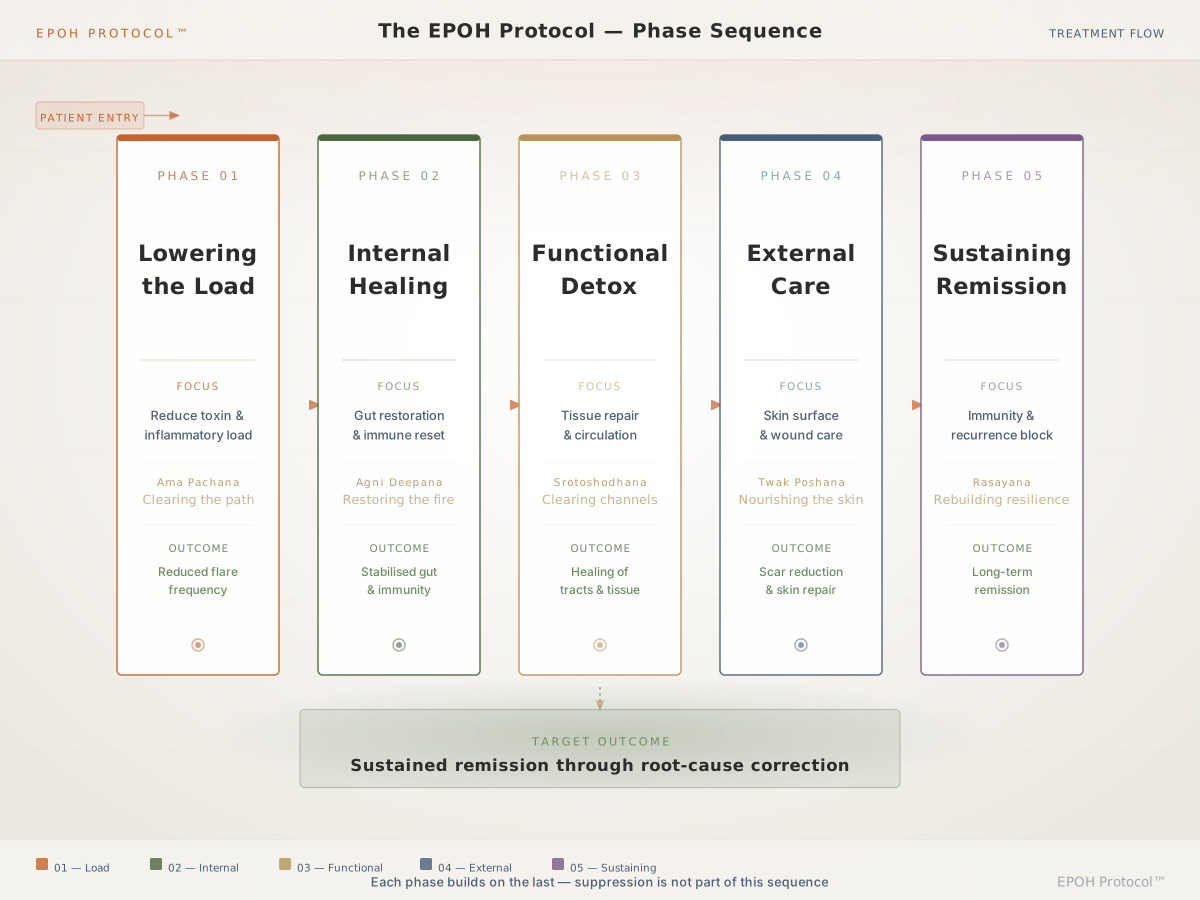
The intuition that traps almost everyone
Crohn's disease is a gut condition. The lesion is in the gut. So repair the gut.
It is completely logical, and it is the single most common reason people fail. Because in the EPOH protocol, even in a disease whose entire pathology sits in the intestine, Phase 2 — Internal Healing, the actual gut repair phase — does not come first.
Phase 1 does. Lowering the Load.
Why repair cannot hold in an inflamed field
Every surgeon understands this instinctively. You do not graft new skin onto an actively infected wound bed. Not because the graft is a bad idea, but because the bed will destroy it. You clean the field first. Then you graft.
The intestinal barrier obeys the same rule, and the mechanism is not mysterious.
A high inflammatory environment is chemically hostile to the exact repair you are trying to achieve. The inflammatory signalling that dominates active Crohn's actively degrades tight junction proteins — the gates holding your epithelial cells together. It drives the death of epithelial cells faster than the crypts beneath them can produce replacements. It thins the mucus layer. It shifts the metabolic conditions at the gut surface in a direction that favours precisely the bacteria you least want there.
So when you push gut-repair support into that field, some of it lands and some of it is immediately overwritten. You are laying new brick into a wall that is being knocked down at the same rate.
This is the mechanism behind an experience you may recognise: partial results that never consolidate. Something helped, a little, for a while. Then it stopped. That is not a weak formulation. That is repair being attempted in an environment that cannot hold it.
What Phase 1 actually does — and why it feels like nothing
Phase 1 runs 4–8 weeks. Oral Inflammatory Load Reduction formulations, compounded to your driver profile, work to bring down the accumulated inflammatory load (Ama) circulating through your system — not just at the gut wall but systemically, because the inflammatory environment your bowel sits inside is not confined to your bowel.
Here is the difficult truth about this phase: for much of it, you may not feel very much.
Phase 1 is not a symptom phase. It is a terrain phase. It is changing the conditions under which the next phase becomes possible. Patients who expect week two to feel like a rescue are patients who quit in week three.
Then, somewhere in weeks three to six, many people hit what we call the Partial Improvement Plateau. Early improvement stalls. Nothing seems to be moving.
This is the most misread moment in the entire protocol. It is not failure. In most cases it is the opposite — it is the signal that Phase 1 has done its work and that Phase 2 should now begin. The load has come down far enough that continuing to lower it yields little; what the system now needs is repair. Patients who understand this cross the plateau. Patients who do not, drop out at exactly the point where the treatment was about to start working.
Then, and only then, Phase 2
Phase 2 — Internal Healing, 8–16 weeks. This is the gut repair you originally went looking for: Internal Correction formulations addressing gut lining integrity, microbiome restoration and immune recalibration.
The same formulation category, in the same patient, does more in Phase 2 than it would have done in week one — because the field it is landing in has changed. Sequence is not a scheduling preference. It is a condition of efficacy.
Notice too that Phase 2 is long. Epithelial and microbial restoration take the time they take.
The sequence error that actively harms people
Now the more serious one.
Phase 3 — Functional Clearance, 6–12 weeks — must not be brought forward. It belongs after Phase 1, and it usually runs concurrently with Phase 2. Applied before L and I are stable, it does not merely underperform. It makes people worse.
The mechanism is straightforward once you see it. Clearance-supporting formulations mobilise accumulated internal load — they lift it out of the tissues and into circulation so the body can eliminate it. That is the whole point of them. But mobilisation and elimination are two different capacities, and they are not automatically matched.
If you mobilise internal load faster than the system can actually clear it, that load does not vanish. It circulates. And in Crohn's disease, this is uniquely dangerous, for one structural reason: the gut is both your primary clearance route and your injured organ. In a skin condition, the barrier under strain is external. Here, the tissue you are asking to handle a surge of mobilised load is the same inflamed, permeable, ulcerated tissue you are trying to protect.
So the mobilised load meets an open barrier and a primed immune system. It re-enters. It lands back in exactly the tissue you were trying to heal. And the result is a symptom surge — more frequency, more urgency, more pain, deep fatigue — which patients quite understandably experience as the treatment attacking them.
This is what happened to almost everyone who tells us they "tried a cleanse first and got much worse." The intervention was not wrong in principle. It was administered into a system that had no capacity to handle what it released. The timing was the injury.
The rule, stated plainly
Lower the load. Then heal the gut. Then support clearance — and only once the first two are holding.
L, then I, with F alongside I. Never F first. Not because of tradition, but because the body has a finite clearance capacity, and exceeding it deliberately is not treatment.
The remaining phases follow the same logic. Phase 4 — External Care uses topical External Tissue Repair formulations, applied by you at home, running through I and F. Phase 5 — Sustaining Remission, 6–12 months — tapers Remission Maintenance formulations while monitoring markers, because remission that is not held is just a longer gap between flares.
Every phase of this is formulation-based. Oral compounds, topical preparations, compounded to you and couriered to you. For most patients there is no procedure and no clinic visit.
What recovery looks like against the clock
Recovery Stage 1 — Internal Shift, weeks 1–4 — is internal, and largely invisible to you. Recovery Stage 2 — Reduced Frequency, months 2–4. Recovery Stage 3 — Reduced Severity, months 4–8. Recovery Stage 4 — Stable Remission, months 8+.
We do not use the word "cure", and we will not promise you a timeline shorter than the biology allows. What we will tell you honestly is this: if you already carry established fibrotic stricturing or extensive structural bowel damage, full remission may not be achievable, and correct sequencing will not change that. Meaningful reduction in inflammatory load and greater stability often still are.
Your current medication stays where it is
Begin EPOH while continuing everything your gastroenterologist has prescribed, exactly as prescribed. Nothing is stopped on our say-so. As internal correction takes effect, medication is reviewed with your prescribing physician, and any reduction is gradual, structured, and evidenced by objective markers.
If this describes you
If you tried to heal your gut first, or clear your system first, and were punished for it — you were not failing at treatment. You were doing the right things in the wrong order, which is a fixable problem.
Return to our Crohn's disease hub for the rest of the cluster, particularly the piece on why barrier failure precedes immune dysregulation. And if you want your own sequence worked out properly, consultations are by video or WhatsApp, and your formulations are couriered to you. No procedure. No clinic visit required, for most patients.
Medical disclaimer. This article is for general information and is not a substitute for personalised medical advice. Ayurvedic treatment at EliteAyurveda™ is individualised following clinical assessment. Do not start, stop or alter any prescribed medication without consulting your treating physician.

