


Part of the Crohn's Disease Knowledge Library
For a while after the operation, you felt well. Perhaps better than you had felt in years. The diseased segment was gone, the obstruction was relieved, the pain that had defined your days simply stopped. You allowed yourself to think it was over.
Then, somewhere in the following months or years, something familiar came back. A scan or a scope found new inflammation — and if you have looked at the report, it was almost certainly not in a random place. It was right where your bowel was joined back together, or in the stretch of ileum immediately above it.
You need to understand what that means, and what it does not mean.
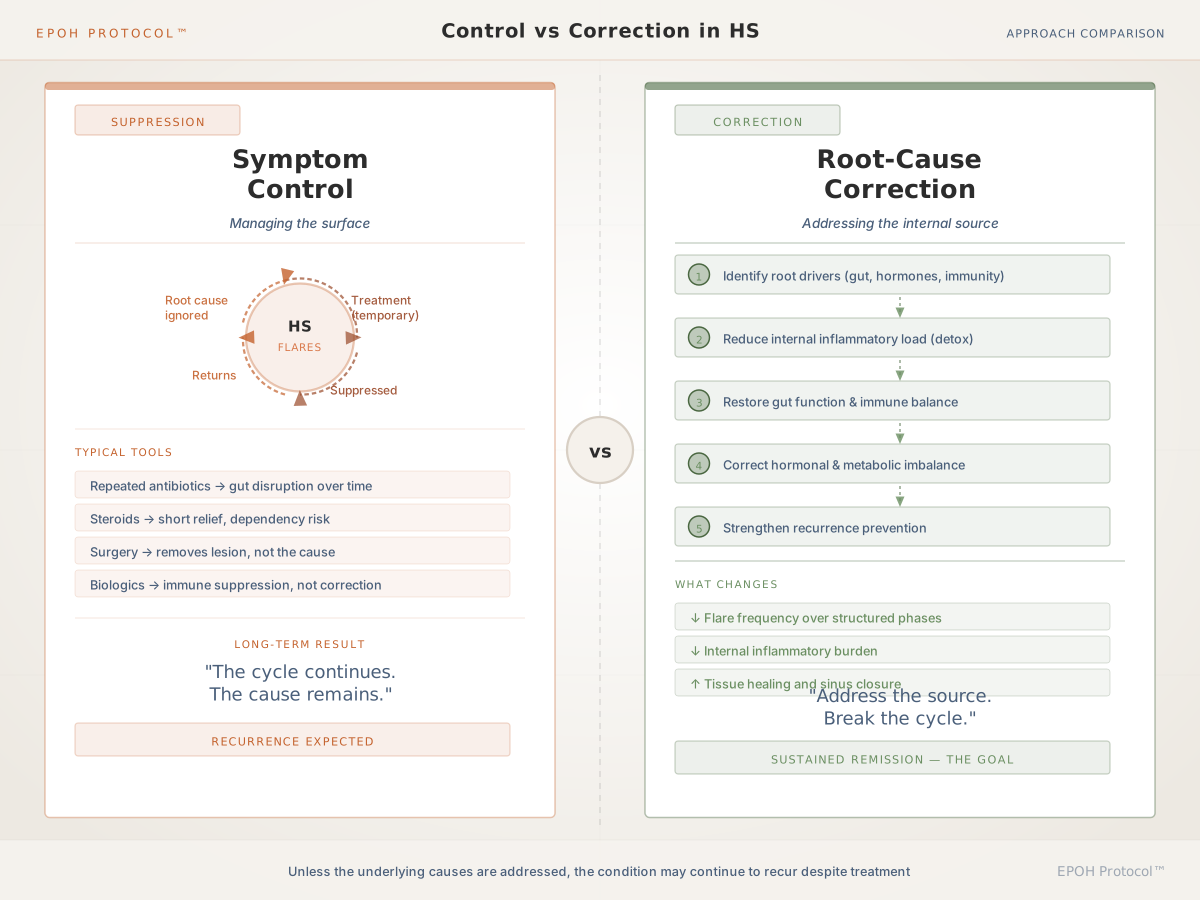
Your surgery was not a failure, and your surgeon did nothing wrong
Start here, because most patients arrive at this point angry, and the anger is aimed in the wrong direction.
Resection is often the correct decision, and sometimes the only one. When there is a fixed obstructing stricture, an abscess, a perforation, a fistula that will not close, or a segment so damaged it is beyond any biological rescue, surgery is definitive in a way that nothing else is. It removes the immediate danger. It gives you back the ability to eat.
Your surgeon removed the diseased tissue with skill. That is what the operation is for. What the operation was never designed to do is change the conditions that made that tissue diseased.
Surgery removes the consequence. It does not remove the environment.
Why the recurrence appears exactly where it does
The pattern of post-surgical recurrence is one of the most consistent observations in the whole field, and it tells you almost everything.
Recurrence overwhelmingly appears at the anastomosis — the join — and in the neo-terminal ileum, the new stretch of small bowel that now sits immediately upstream of it. Visible lesions turn up there first, often long before you feel anything at all.
Ask why that spot and not another, and the answer becomes obvious. That is the piece of previously healthy bowel that is now doing the job of the piece that was removed. It is now the segment where the intestinal contents pool and slow before passing on. It is where the bacterial load is highest, where the barrier is under the most pressure, and where the immune tissue of the gut wall is now doing the most sampling.
In other words: it is the new front line. The disease did not "come back" out of nowhere. It re-established itself at the site where the same conditions that produced the first lesion now apply.
The observation that proves the point
There is a long-standing surgical observation that settles this argument. When the intestinal contents are diverted away from the joined segment, that segment stays clean. Restore the flow of intestinal contents to it, and inflammation appears.
The tissue is not the variable. The environment it sits in is.
Which is why removing tissue cannot be a definitive answer to a disease of the environment. You can keep removing bowel — and some patients, over years, do exactly that, one resection at a time — and each new segment inherits the same conditions the last one failed under.
What actually needs to change
If the environment is the driver, then the environment is what treatment has to reach. In assessment we map five internal driver systems: gut health, immune regulation, metabolic function, hormonal balance, and stress and cortisol. In Crohn's disease, gut barrier failure and immune dysregulation are the primary drivers — not background factors.
None of these were altered by your operation. The barrier is still permeable. The microbial population is still skewed. The immune tissue in your gut wall is still primed to react to bacterial material crossing where it should not. Systemic inflammatory load is still high — in fact, in the weeks after major surgery, it is higher.
This is also why the post-operative window matters so much. Your bowel has just been reduced in length and your body is repairing a join. The conditions that damage a new segment do not require a decade to do their work. Correction started early, in a properly ordered sequence, is protecting a segment that is not yet damaged — which is a far better position than correcting one that already is.
The sequence, and why it cannot be rearranged
EPOH runs on the EPOH protocol, and after surgery the order matters more than ever, not less.
Phase 1 — Lowering the Load (4–8 weeks). Oral Inflammatory Load Reduction formulations bring down the accumulated inflammatory load (Ama). This comes first. Attempting to rebuild the integrity of your remaining bowel while systemic inflammation is still high produces repair that cannot hold — the same inflammation you skipped past will dismantle it.
Phase 2 — Internal Healing (8–16 weeks). Internal Correction formulations addressing gut lining integrity, microbiome repair and immune recalibration — the work of making the neo-terminal ileum a place where disease does not want to establish itself.
Phase 3 — Functional Clearance (6–12 weeks, usually concurrent with I). Oral formulations supporting the body's own clearance pathways. This is never brought forward. Applied before L and I are stable, it mobilises internal load faster than the system can clear it, and in a post-surgical bowel that is not a small mistake.
Phase 4 — External Care. Topical External Tissue Repair formulations, applied at home.
Phase 5 — Sustaining Remission (6–12 months). Tapered Remission Maintenance formulations with monitoring.
Everything is formulation-based: oral compounds and topical preparations, compounded to your driver profile and couriered to you. There is no procedure for most patients, and no clinic visit is required for most patients — which, for someone recovering from abdominal surgery, is not a trivial detail.
Being honest about what is possible
Recovery Stage 1 — Internal Shift — covers weeks 1–4 and is largely internal. Expect the Partial Improvement Plateau somewhere in weeks three to six: early gains stall, and it feels like the treatment has stopped. It has not. It usually means Phase 1 has completed its work and Phase 2 should begin. Recovery Stage 2 brings reduced frequency (months 2–4), Recovery Stage 3 reduced severity (months 4–8), Recovery Stage 4 stable remission (months 8+).
And the honest limits. We do not use the word "cure", about surgery or about our own work. If you have already had multiple resections, or you carry established fibrotic stricturing elsewhere, or your remaining bowel is short, full remission may not be achievable. What is often still achievable is a substantial reduction in inflammatory load and a genuinely more stable remaining bowel. If your assessment says otherwise, we will tell you before you commit to anything.
Your medication, and your surgical follow-up
Keep both. You begin EPOH while continuing every prescription exactly as written, and you keep every scope and every review your surgical team has scheduled. Post-operative surveillance is how recurrence is caught early, and we want it caught early. As internal correction takes effect, your medication is reviewed with your prescribing physician, and any reduction is gradual and structured.
Where to go from here
Our Crohn's disease hub holds the rest of this cluster — including why the disease begins at the gut barrier rather than in the immune system, and why the loop between them cannot be broken by suppressing one arm of it.
If you are in the window after surgery and you want the environment addressed rather than waiting for the next lesion, consultations are by video or WhatsApp, and your formulations are couriered to you. No procedure, no clinic visit, for most patients.
Medical disclaimer. This article is for general information and is not a substitute for personalised medical advice. Ayurvedic treatment at EliteAyurveda™ is individualised following clinical assessment. Do not start, stop or alter any prescribed medication without consulting your treating physician.

