


Part of the Crohn's Disease Knowledge Library
You have almost certainly had this experience. A drug works. Genuinely works. The urgency settles, the pain retreats, you eat a meal without calculating the distance to the nearest bathroom. And then, months later — sometimes on the same dose, at the same interval, with nothing changed — it stops working.
Nobody has an easy explanation for you. You are told the disease "escaped", or that you have "lost response", and you are moved to the next agent.
There is an explanation. It has to do with the shape of the thing you are treating. Crohn's disease is not a straight line from cause to effect. It is a loop. And a loop does not stop because you interrupt it at one point.
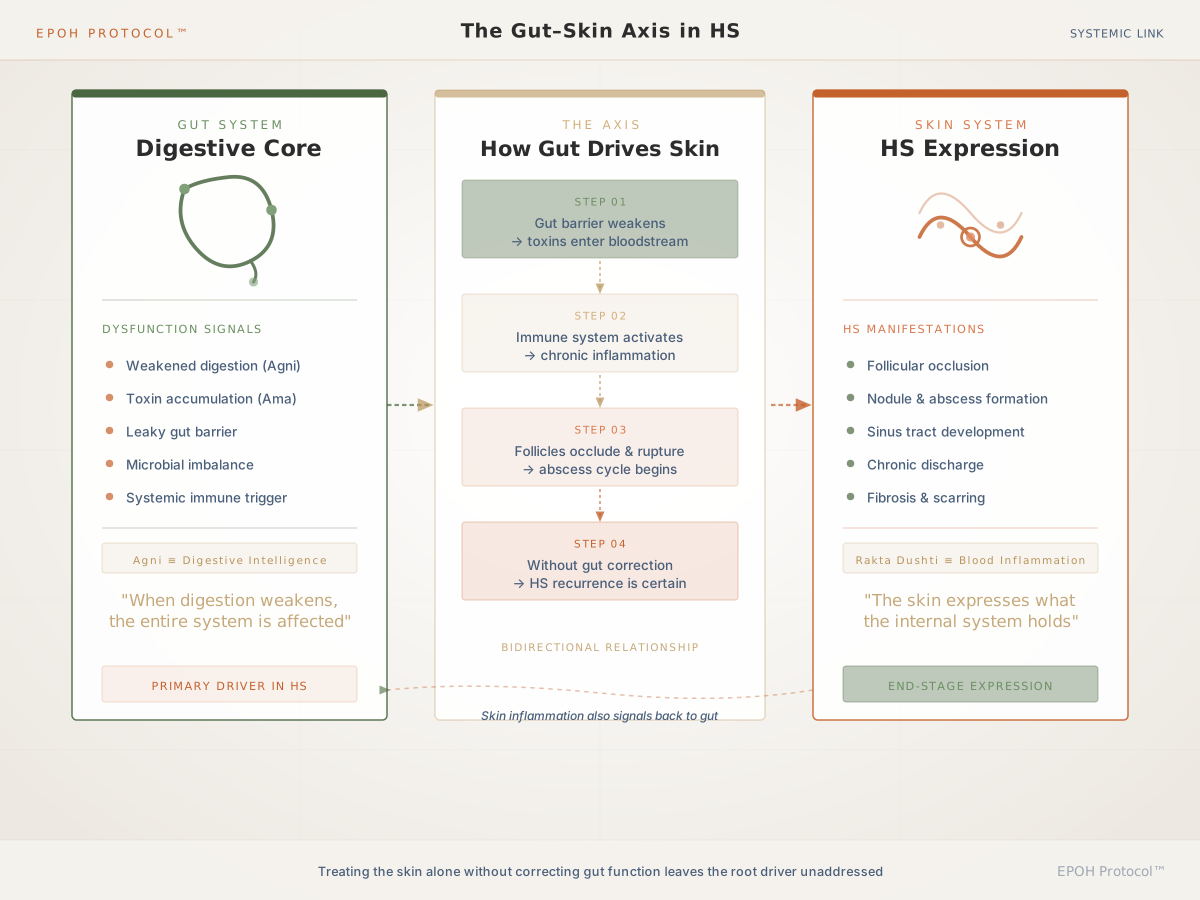
The four turns of the loop
One: the barrier opens. The lining of your intestine is a single cell thick, sealed by tight junction proteins and covered by mucus. When those junctions loosen and the mucus thins, bacterial fragments, microbial byproducts and food antigens cross from the gut lumen into the gut wall — into territory they are never supposed to reach.
Two: the immune system responds. The gut wall holds the densest concentration of immune tissue in the body, and its sensors are built precisely to recognise bacterial structures. When those structures appear on the wrong side of the barrier, the sensors do exactly what they were designed to do. Macrophages and dendritic cells activate. Inflammatory signalling ramps up. At this stage, nothing about your immune system is malfunctioning. It is responding correctly to a genuine breach.
Three: the response organises into chronic, granulomatous inflammation. Because the breach never closes, the exposure never ends, and an acute response that should have resolved in days is instead sustained for years. T cells are recruited and polarised into persistently inflammatory subsets. Cytokine output — the tumour necrosis factor and interleukin signalling your biologics are aimed at — stays high. Immune cells aggregate into granulomas. The inflammation stops respecting the surface and drives down through the full thickness of the bowel wall. This is what produces the transmural disease, the fissuring, the fistulas.
Four: that inflammation damages the barrier further. And here the loop closes. The very cytokines produced in step three degrade tight junction proteins directly. They accelerate the death of epithelial cells beyond the replacement capacity of the crypts. They strip the protective mucus layer. They shift conditions at the gut surface in favour of the aggressive, inflammation-tolerant bacteria that put the most pressure on the barrier.
So the immune response to a leaking barrier widens the leak. The widened leak drives more immune response. Round it goes.
Why the loop is self-sustaining
Once the circuit is closed, you no longer need the original trigger. Whatever first cracked your barrier — an infection, a course of antibiotics, a period of severe stress, a metabolic shift — is long gone and completely irrelevant to what is happening in your bowel today.
The loop feeds itself. This is why "what caused my Crohn's?" is, clinically, a less useful question than "what is currently holding the loop open?" It is also why removing a suspected trigger years later changes so little.
Why suppressing one arm does not break it
Now the part that explains your drug.
Immunosuppression enters the loop at step three. Biologics are exceptionally precise instruments: they neutralise a specific cytokine or block a specific signalling pathway with a degree of accuracy that older medicine could not approach. When it works, it works impressively.
But look at what happens to the rest of the loop while that one node is blocked.
Step one is untouched. The barrier is still permeable. Step two is untouched — bacterial material is still crossing, still being detected, still activating immune sensors. The pressure driving the loop has not been reduced at all. It has simply been prevented from expressing itself through one channel.
Inflammatory signalling in the human gut is redundant by design. It evolved with backups, because an organism that could be disarmed by blocking a single cytokine would not survive its first serious infection. So the same continuous stimulus, blocked at one node, tends over time to find expression through alternative pathways.
That is a large part of what "loss of response" actually is. The disease did not become stronger or cleverer. The driving pressure was never removed, and the loop re-formed around the block.
The same structural logic explains why steroids hold only while you take them, why antibiotics purchase relief and then hand back a worse microbial substrate, and why surgery removes a damaged segment but not the environment that damaged it.
What breaking a loop actually requires
You cannot break a self-sustaining circuit by pressing harder on one point of it. You have to unload it at several points, in an order the body can survive.
That is the whole design of the EPOH protocol, and the order is not negotiable.
Phase 1 — Lowering the Load (4–8 weeks). Oral Inflammatory Load Reduction formulations reduce the accumulated inflammatory load (Ama) driving steps three and four. This must come first. Barrier repair attempted inside a high-inflammation field does not hold, because the same inflammation you are ignoring is dismantling your repair in real time.
Phase 2 — Internal Healing (8–16 weeks). Only now do we address step one directly. Internal Correction formulations work on gut lining integrity, on the microbial population sitting against that lining, and on immune recalibration — the difference between suppressing an immune response and restoring its ability to discriminate.
Phase 3 — Functional Clearance (6–12 weeks, usually alongside I). Oral formulations supporting the body's own clearance capacity, once that capacity can handle what is mobilised. Brought forward before L and I are stable, it mobilises internal load faster than the system can clear it, and it makes people worse.
Phase 4 — External Care. Topical External Tissue Repair formulations, applied by you at home.
Phase 5 — Sustaining Remission (6–12 months). Tapered Remission Maintenance formulations and ongoing monitoring.
Every phase is a formulation, compounded to your specific driver profile. There is no procedure and no clinic visit for most patients; oral compounds and topical preparations are couriered to you.
What to expect, without decoration
Recovery Stage 1 — Internal Shift, weeks 1–4 — is internal and quiet. Between weeks three and six many patients reach the Partial Improvement Plateau, where early gains stall. This is not the treatment failing; it is usually the signal that Phase 1 has finished its work and Phase 2 must begin. It is also the point at which most people abandon treatment, which is why we tell you about it in advance.
Recovery Stage 2 brings reduced frequency (months 2–4), Recovery Stage 3 reduced severity (months 4–8), Recovery Stage 4 stable remission (months 8+).
If your disease has already progressed to established fibrotic stricturing or extensive structural damage, breaking the inflammatory loop will not restore scarred tissue to normal bowel. Full remission may be out of reach. We will tell you that plainly at assessment.
Do not touch your medication
Nothing in this article is an argument for stopping a drug. You begin EPOH while continuing your prescriptions exactly as written. Once internal correction is demonstrably taking effect, medication is reviewed with your prescribing physician, and any reduction is gradual, structured and led by objective markers — not by a good fortnight.
Next steps
The rest of this cluster sits in our Crohn's disease hub, including the two articles this one depends on: why barrier failure precedes immune dysregulation, and why lowering inflammatory load must precede gut repair.
If you want the loop mapped in your own case, consultations are by video or WhatsApp and formulations are couriered to your door. No procedure. No clinic visit for most patients.
Medical disclaimer. This article is for general information and is not a substitute for personalised medical advice. Ayurvedic treatment at EliteAyurveda™ is individualised following clinical assessment. Do not start, stop or alter any prescribed medication without consulting your treating physician.

