


PCOS & PCOD Treatment
Part of the Metabolic, Endocrine & Women’s Disorders Centre
Polycystic ovary syndrome is usually presented as an ovarian problem. It behaves much more like a metabolic one that expresses through the ovaries.
What most women describe when they come to us
Most arrive having been told there are cysts on the ovaries and given something to regulate the cycle. It works while you take it.
Weight loss is usually advised too, often without anyone explaining why it is genuinely harder with PCOS than without it. That difference is physiological, not a matter of effort.
The acne, the hair changes, the exhaustion and the cycle are usually treated as four separate problems by four different specialists.
They are not separate problems. They are the same metabolic process expressing in four places.
The questions women ask us first
Answered plainly, including where the answer is “sometimes” rather than yes.
Why should I be concerned about PCOS?
It reaches beyond periods and fertility. The metabolic side matters just as much, and it is worth understanding early.
Read the answer →Is PCOS the reason I cannot conceive?
Sometimes, and not always. What actually decides it, and what to assess first.
Read the answer →Is PCOS linked to prediabetes?
The insulin picture is central rather than incidental, which is why metabolic screening matters early.
Read the answer →What is myth and what is fact?
PCOD and PCOS attract more misinformation than almost any other condition we treat.
Read the answer →How does Ayurvedic treatment approach it?
What the assessment covers and what the formulations actually work on.
Read the answer →What PCOS actually is
The cysts are a finding, not the disease. They are immature follicles that stalled before ovulating — the consequence of the hormonal environment, not its cause. This matters practically: you can have polycystic ovaries on a scan without having PCOS, and you can have PCOS with ovaries that look unremarkable.
What sits underneath, in most patients, is a self-reinforcing loop. Insulin resistance raises circulating insulin; insulin drives the ovary to produce more androgen and lowers the binding protein that would otherwise keep androgen inactive; the resulting androgen excess disrupts follicular maturation and worsens the metabolic picture. Low-grade chronic inflammation runs alongside all of it, further degrading insulin sensitivity.
That loop is why PCOS does not stay in the ovary. It expresses through weight, skin, hair, mood and cycle simultaneously, because it is one process with several outlets. Treating any single outlet without touching the loop holds exactly as long as the treatment does.
The four drivers, and which one is yours
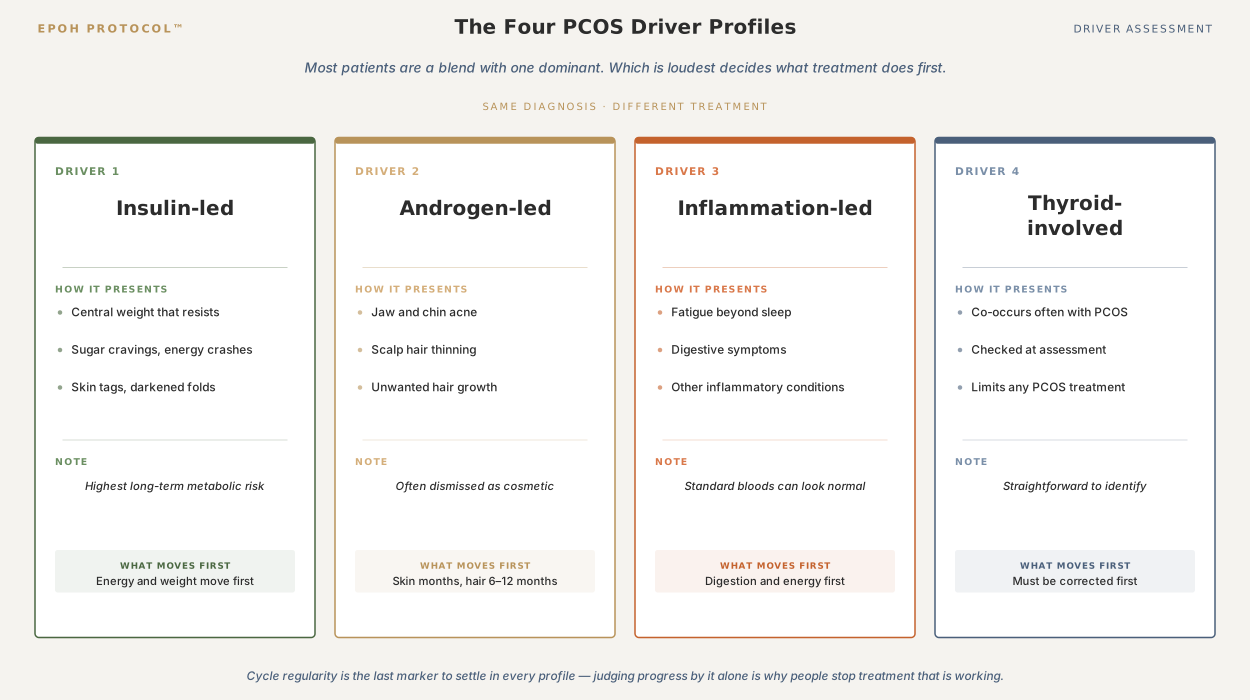
Two people with the same diagnosis frequently need different treatment, because the dominant driver differs. Establishing which is loudest is the substance of assessment.
Insulin-led. The most common pattern. Weight that resists the usual measures, particularly central; sugar cravings and post-meal energy crashes; skin tags or darkened skin in the folds. Prediabetes frequently accompanies it, and this is the pattern with the clearest long-term metabolic risk.
Androgen-led. Acne along the jaw and chin, hair thinning at the scalp, unwanted growth on the face or body. Weight may be unremarkable, which is precisely why this pattern is often missed or dismissed as cosmetic.
Inflammation-led. Fatigue disproportionate to sleep, digestive symptoms, sometimes co-existing inflammatory conditions. Standard bloods can look reassuring while the picture is clearly inflammatory.
Thyroid-involved. Hypothyroidism and PCOS co-occur often enough that thyroid function is checked at assessment as standard. Untreated, it will limit what any PCOS treatment can achieve, and it is straightforward to identify.
Most patients are a blend with one dominant. The dominant driver decides what moves first, and it decides what to expect.
What it actually costs, day to day
The clinical description understates this. What patients describe is a body that stopped responding to the things that used to work — eating carefully and gaining anyway, and being told to try harder by people who have not had to.
The visible symptoms carry their own weight. Hair growth where it is not wanted and hair loss where it is are both, quietly, among the most distressing parts of this condition, and they are routinely treated as vanity rather than symptom.
Then there is the uncertainty about fertility, often arriving years before you intended to think about it, and frequently delivered as an aside during a scan.
What PCOS connects to
PCOS is not an isolated gynaecological condition, and treating it as one misses what matters over a decade.
Metabolic. Insulin resistance progresses. The link with prediabetes and type 2 diabetes is well established, and it is the single strongest argument for treating PCOS in your twenties rather than waiting until fertility makes it urgent.
Endometrial. Cycles that do not ovulate mean the endometrium is not shed regularly. Over years, that matters, and it is a reason we do not treat prolonged absent periods as a cosmetic inconvenience.
Skin. Androgen excess drives sebaceous activity and follicular keratinisation, which is why PCOS and hidradenitis suppurativa co-occur far more often than chance. If you have both, they are not two unrelated problems and should not be treated by two people who never speak.
| Screened at assessment | Because |
|---|---|
| Fasting insulin and glucose | Insulin resistance is the most common driver and the clearest long-term risk |
| Androgen pattern and SHBG | Decides whether skin and hair symptoms are the lead problem |
| Thyroid function | Co-occurs often, and untreated it limits what any PCOS treatment can achieve |
| Inflammatory and digestive picture | Degrades insulin sensitivity and is frequently missed on standard bloods |
| Cycle and ovulation history | Distinguishes anovulatory from irregular, which changes the approach |
How we approach it
Assessment establishes the driver profile before anything is compounded: insulin and metabolic status, androgen pattern, thyroid function, digestion and inflammatory load, cycle history, and what has already been tried and what happened.
Treatment then works on the driver rather than the presenting symptom. In practice that means oral formulations targeting insulin sensitivity and the inflammatory load where those dominate, and the androgen pattern where that does. In Ayurvedic terms this is Agni Deepana and Ama Pachana — correcting digestive and metabolic function, and clearing the inflammatory load that degrades it — which is the same process described from the other side.
Dietary and activity guidance runs alongside the formulations and is complementary, not the treatment itself. We are specific about it rather than issuing a generic list, because the useful changes differ by driver: an insulin-led picture needs different attention from an inflammation-led one.
Where you are on a medication that is working — metformin, a combined pill, spironolactone — we do not ask you to stop it to begin. Reduction, if it becomes appropriate, is a conversation with your prescribing physician once the underlying picture has actually changed.
Honest expectations
Metabolic change is slow, and anyone offering fast PCOS results is selling something. What tends to move first is energy, digestion and post-meal stability — often within weeks, and often before anything visible changes.
Skin and hair follow over months, and hair is the slowest of all: scalp density and unwanted growth both track the follicular cycle, so meaningful change is a six-to-twelve-month observation, not a six-week one.
Cycle regularity is typically last. That ordering is counter-intuitive and it is the single most common reason people abandon treatment that is working — they judge by the one marker that moves last.
Where PCOS has run many years with significant metabolic involvement, the realistic goal is sustained control rather than cure. And if you are trying to conceive on a defined timeline, say so at assessment: it changes what is appropriate, and it may mean this is not the right route on its own.
| What changes | When it typically moves | Why that order |
|---|---|---|
| Energy, digestion, post-meal stability | Weeks 2–6 | Insulin sensitivity and inflammatory load respond before anything visible does |
| Acne and skin | Months 2–4 | Sebaceous activity follows androgen change, not the other way round |
| Scalp and unwanted hair | Months 6–12 | Both track the follicular cycle; nothing moves faster than the hair does |
| Weight trend | Months 3–8 | Follows insulin sensitivity rather than calorie restriction alone |
| Cycle regularity | Last, often month 6+ | Ovulation resumes only once the metabolic and androgen picture has actually shifted |
What we measure, and when we judge it
PCOS moves in a particular order: the metabolic picture shifts first, skin and hair follow, and the cycle is usually last. We track four markers from your first consultation so you can see that sequence happening, rather than judging everything by whether a period arrived.
Four markers, not the scan
Cycle regularity and interval. Metabolic markers including insulin and weight trend. Androgenic symptoms — acne, scalp hair, unwanted hair growth. Energy and mood pattern across the cycle.
We do not track follicle counts as a progress measure. The scan is how the diagnosis was reached, not how treatment is judged.
Cycle regularity is last, not first
Metabolic and energy changes usually move first. Skin and hair follow over months. Cycle regularity is typically the last thing to settle — judging progress by it alone is the most common reason people stop something that is working.
We will tell you early
If you are trying to conceive to a defined timeline, we will tell you at assessment whether this is the right route on its own — not after months. Where PCOS has run for many years with significant metabolic involvement, the goal we work towards is sustained control.

Talk to Us Directly
No forms. Message or call the clinic and a doctor’s team member will take your history.
Replies during clinic hours, Mon–Sat.