


Part of the Crohn's Disease Knowledge Library
This is the hardest question we get asked, and it is the one where clinics are most tempted to lie.
So here is the honest structure of the answer: some of what Crohn's has done to you can be undone. Some of it cannot. The difference is not a matter of effort, belief, or how good the treatment is — it is a matter of what kind of tissue we are looking at.
Anyone who tells you that all of it reverses is not being optimistic. They are being untruthful, and you should leave.
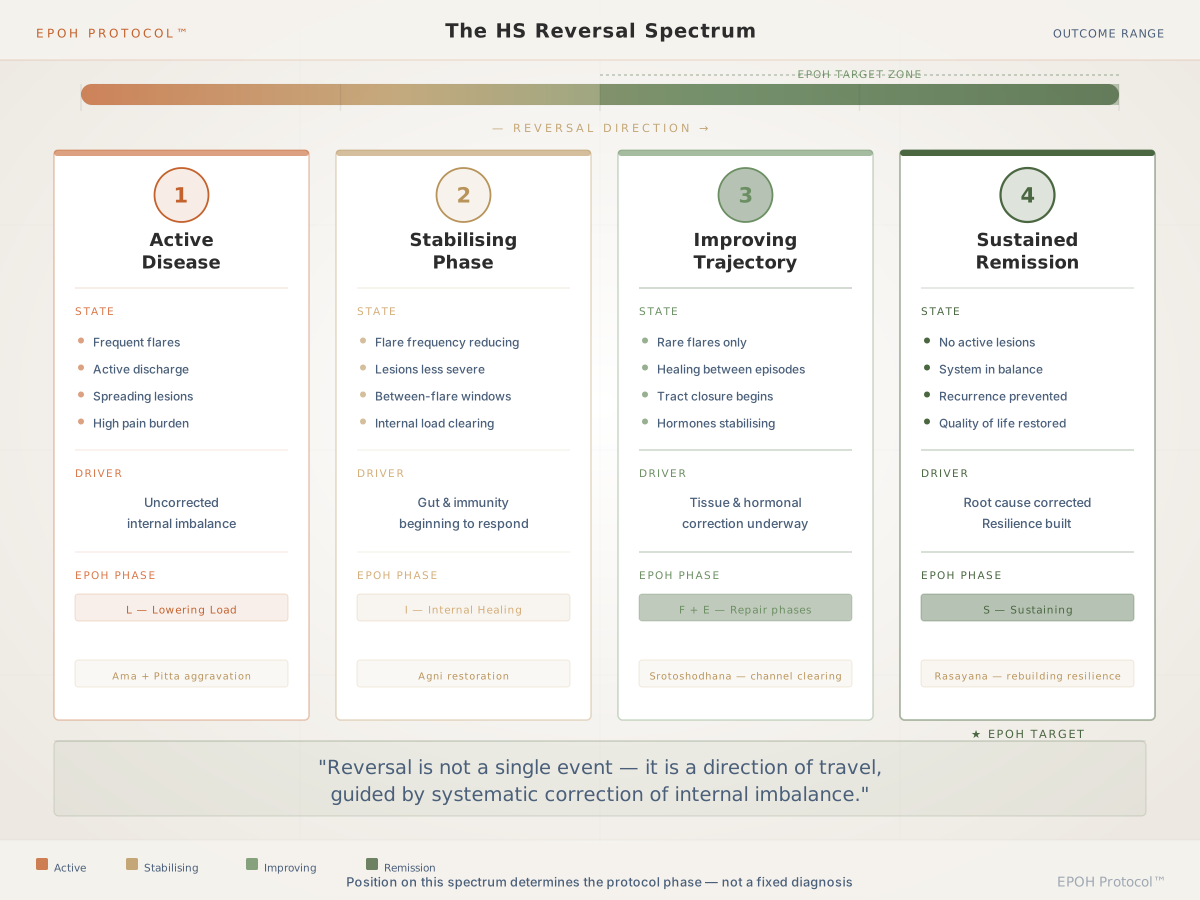
What genuinely can resolve
Active inflammation. This is the part that matters most day to day, and it is the part that is most amenable to change. Inflammation is an ongoing process, not a permanent object. It is being actively produced, moment to moment, by an immune system responding to an internal environment. Change that environment and the production can fall. Markers can come down. Ulceration can heal. Mucosa can, and does, repair.
A compromised intestinal lining. The gut epithelium is one of the fastest-renewing tissues in the human body. Given a lowered inflammatory load and the right internal conditions, it repairs. This is not an exotic claim.
A disrupted microbial population. It shifts. It is a population, not a scar.
Immune misfiring. Immune signalling is a dynamic system, not a fixed setting. Recalibration is possible, which is precisely the thing that suppression never attempts.
An inflammatory stricture. Here is the important distinction most patients are never given. Narrowing in Crohn's is not all the same thing. Where a stricture is inflammatory — the narrowing produced by swelling, oedema, and active inflammation in the bowel wall — it can soften as the inflammation resolves. Calibre can improve. Obstructive symptoms can ease.
What does not reverse — with our treatment or with anyone's
Fibrotic tissue does not reverse. Where a stricture has become fibrotic — where the inflammation has been replaced by laid-down collagen and the wall has been structurally remodelled into scar — no internal treatment reverses that. Not ours. Not any herbal formulation. Not any biologic. Scar is not inflamed tissue that can be calmed down; it is a different tissue. Reducing inflammation around it can help, and can sometimes make the difference between a manageable narrowing and one that obstructs. But the fibrotic component itself stays.
Resected bowel does not grow back. If you have had a section removed, it is gone. Nothing restores it. What can be changed is the environment the remaining bowel sits in — which matters enormously, because recurrence at the anastomosis is driven by that environment, not by the surgery having been done imperfectly.
Severe, long-standing structural damage may be only partly recoverable. Extensive fistulising disease, heavily remodelled segments, tissue that has been inflamed for many years — here the honest answer is that the degree of recovery is genuinely uncertain, and any practitioner who claims certainty is guessing.
If you take nothing else from this page: fibrosis and resection are not negotiable, and any treatment that implies otherwise is lying to you.
Where "there is no cure" actually comes from
Now the other side of the honesty, because it cuts both ways.
You were almost certainly told, at diagnosis, that Crohn's has no cure and that you will be on medication for life. That statement is usually delivered as a biological fact. It is worth understanding what it actually is.
Within the conventional model, the primary lever is suppression of immune signalling. Steroids and biologics do this, and often do it well. But suppression does not correct why the signalling misfires — so remission lasts precisely as long as suppression continues, and withdrawal reliably produces relapse. Antibiotics disrupt the microbiome, which is itself one of the drivers, so recurrence tends to return at greater intensity. Surgery removes the damaged consequence but not the environment that produced it, which is why disease returns at the join.
Look at that honestly and you can see what "there is no cure" is describing. It is a completely accurate statement about the ceiling of the suppression model. If the only tool available acts on the last step of the causal chain, then permanent dependence on that tool is the logical outcome, and "incurable" is a fair summary of it.
That is a statement about the tools, not a law about the tissue. It is not the same as saying that the drivers of the disease cannot be altered.
And — this matters — noticing that does not entitle us to promise you reversal. It gets us to a much more modest place: some things in Crohn's are being actively produced and can therefore stop being produced; some things have already been built out of scar and cannot be unbuilt. That is the whole of the honest claim.
So what do we actually work towards?
Sustained remission. Not remission that holds because something is being suppressed, but remission that holds because the drivers behind the inflammation have been corrected — a repaired intestinal lining, a restored microbial population, a lowered accumulated inflammatory load (Ama), and immune signalling that has been recalibrated rather than silenced.
The work is done through the EPOH phase sequence, entirely with oral and topical formulations compounded to your individual driver profile: Lowering the Load (Phase 1, oral, 4–8 weeks) → Internal Healing (Phase 2, oral, 8–16 weeks) → Functional Clearance (Phase 3, oral, 6–12 weeks, often concurrent with I) → External Tissue Repair (Phase 4, topical, at home) → Sustaining Remission (Phase 5, tapered oral, 6–12 months). For most patients there is no procedure, no in-clinic therapy and no clinic visit.
It is slow, and we will not pretend otherwise. Phase 1 alone is 4–8 weeks of internal work before symptom change is a reasonable expectation. Response then tends to move through Internal Shift (weeks 1–4), Reduced Frequency (months 2–4), Reduced Severity (months 4–8), and Stable Remission (months 8 and beyond) — with a Partial Improvement Plateau around weeks 3–6 that is not failure, but the signal that Phase 1 has done its work and Phase 2 should begin.
And throughout: you do not stop your medication to do this. You begin while continuing everything you are currently prescribed. Any reduction comes later, gradually, and only with your prescribing physician leading the decision.
Honest candidacy, stated in full
Not every patient responds equally. Disease duration, degree of organ involvement, and remaining biological repair capacity all influence outcomes. Patients with very advanced structural changes — established bowel damage, fibrotic stricturing — may not achieve full remission.
We do not promise a cure. We will not tell you your scarring will dissolve. If your imaging shows predominantly fibrotic disease, we will tell you plainly that what is available to you is a quieter disease and a protected remaining bowel, not a restored one — and that is a legitimate goal, but it is a different goal, and you deserve to know which one you are buying.
How you find out which category you are in
You cannot answer this question about yourself from a website, and neither can we. It requires your actual history: how long you have had the disease, what your scopes and cross-sectional imaging show, whether narrowing has been characterised as inflammatory or fibrotic, what has been resected, what your markers are doing, and what you are currently taking.
Book a video or WhatsApp consultation with the clinical team and bring those reports. We will tell you which parts of your disease we think are reversible, which parts are not, and whether it is worth your time and money to begin at all.
Formulations, if you are a candidate, are compounded to your profile and couriered to you. Remote first, with in-clinic intensives where the disease needs them.
Medical disclaimer. This article is for general information and is not a substitute for personalised medical advice. Ayurvedic treatment at EliteAyurveda™ is individualised following clinical assessment. Do not start, stop or alter any prescribed medication without consulting your treating physician.

