


Part of the Hidradenitis Suppurativa Knowledge Library
Nobody ever told you what week five was supposed to feel like.
The antibiotics came with "take these and we'll review in three months." The biologic came with "give it twelve weeks." The surgery came with a wound-healing estimate and nothing beyond it. Nobody handed you a map — this happens first, this happens after that, and this is how you will know it is working before you can see it working.
That absence does real damage. When you do not know what is meant to happen next, every ordinary fluctuation reads as failure — and HS fluctuates constantly. A flare in week six means nothing on its own; it means something completely different depending on where you sit in the sequence.
So here is the map. Not a promise. A map.
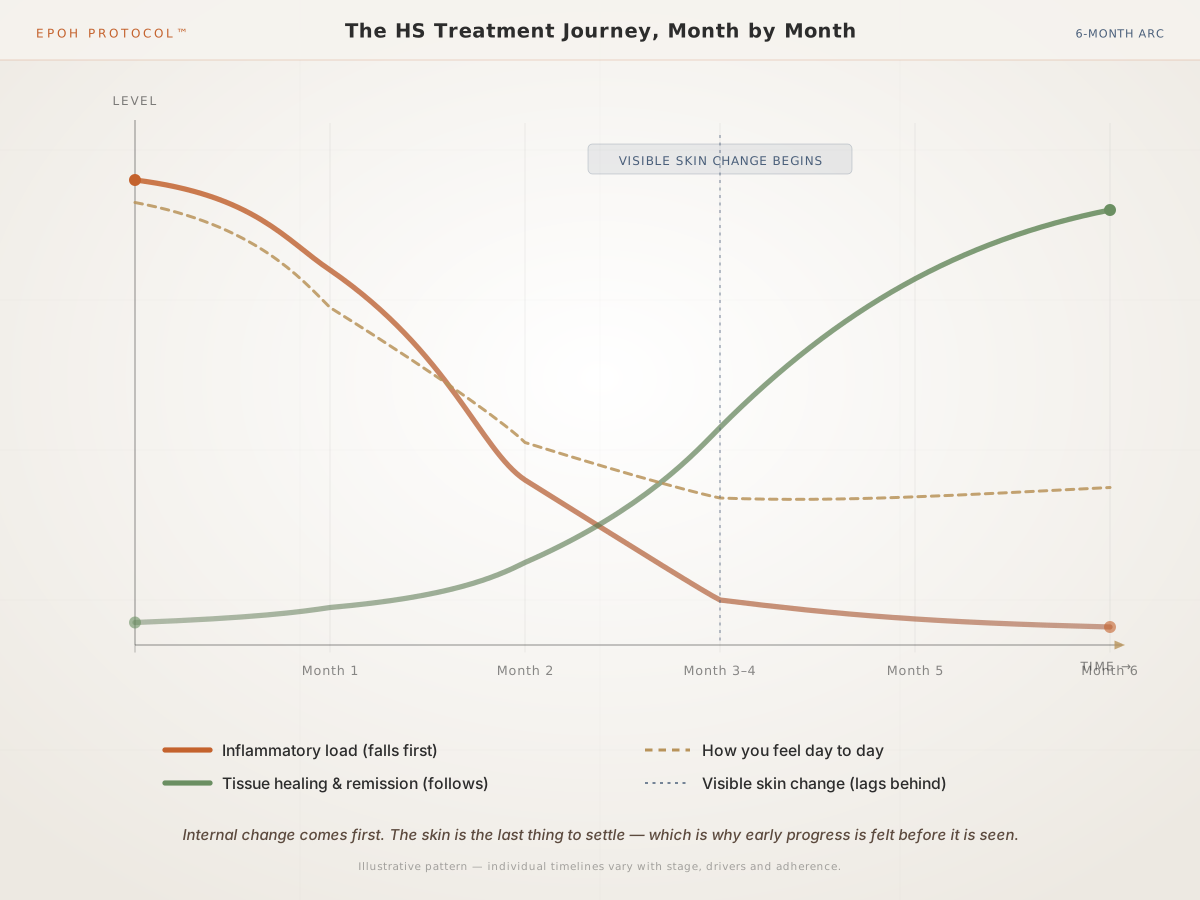
There are two clocks, and they do not tick together
The protocol clock is the EPOH phase sequence: five phases, run in order, each building the conditions the next one needs. Its durations are known in advance because the phases are designed — Phase 1 runs 4–8 weeks, Phase 2 8–16 weeks, Phase 3 6–12 weeks and usually overlapping Phase 2, Phase 4 alongside both, and Phase 5 for 6–12 months of monitoring.
The response clock is the Recovery Stage sequence: Recovery Stage 1 Internal Shift, Recovery Stage 2 Reduced Frequency, Recovery Stage 3 Reduced Severity, Recovery Stage 4 Stable Remission. Its speed is set by your biology — how much repair capacity your gut lining has left, how deeply immune dysregulation is entrenched, how many years the disease has been running.
We set the first clock. Your body sets the second. They run in parallel; they do not tick together. Completing Phase 1 does not mean you have "completed" Recovery Stage 1. Being four weeks into Phase 2 does not entitle you to Recovery Stage 2. You can be well advanced on the protocol clock and still, on the response clock, be waiting — and that is not the protocol failing. It is the protocol running ahead of the response, exactly as it is built to. If it waited for the skin, nothing would ever start.
The two timelines, side by side
| Time | The protocol — what we do | The response — what you tend to notice |
|---|---|---|
| Weeks 1–4 | Phase 1 — Lowering the Load. Oral formulations reducing accumulated inflammatory load (Ama), digestive support, immune-calming compounds. | Recovery Stage 1 — Internal Shift. Digestion, bowel regularity, sleep, energy. Skin frequently unchanged. |
| Weeks 3–6 | Phase 1 continuing. Response pattern assessed at review. | The Partial Improvement Plateau. Internal gains are real, but flares continue. This is where people stop. |
| Weeks 5–8 | Phase 1 completes. Phase 2 — Internal Healing begins. | Commonly still Recovery Stage 1. Surface change is not yet expected. |
| Months 2–4 | Phase 2 underway. Phase 3 — Functional Detox often begins concurrently. Phase 4 topical preparations introduced. | Recovery Stage 2 — Reduced Frequency. Flares arrive less often, run shorter, resolve more completely. |
| Months 4–8 | Phase 2 completes. Phase 3 continues. Phase 4 ongoing. | Recovery Stage 3 — Reduced Severity. Shallower lesions, less drainage, less pain, cleaner healing. |
| Months 8+ | Phase 5 — Sustaining Remission. Formulation tapering, resilience, 6–12 months of monitoring. | Recovery Stage 4 — Stable Remission. |
Read the right-hand column as what tends to follow, never as a schedule you are being held to. Severity and response are separate measurements: a patient can be EPOH-DSS Stage 3 — established sinus tracts, right now — and Recovery Stage 2 at the same time. Where you are is not the same question as which way you are going.
Phase 1 — weeks 1–8: bringing the load down
HS is not a skin condition with systemic complications. It is a systemic condition expressing through the skin: gut dysbiosis drives immune dysregulation, and immune dysregulation produces local tissue pathology in the Svedavaha Srotas, the sweat channels. Which is why the first thing addressed is not your skin.
Phase 1 is oral formulations taken at home — compounds that bring down accumulated inflammatory load (Ama), restore digestive fire (Agni), and quieten immune signalling. Diet supports this phase. Diet is not this phase.
What changes: digestion settles, bowel movements regularise, sleep goes deeper. The low-grade exhaustion you had stopped noticing, because it had been there for years, begins to lift.
What does not change: your skin. Usually not at all.
Visible skin change lags internal change by weeks. Recovery Stage 1 improvement is better digestion, sleep and energy, with the skin not yet moved. This is progress. It is the only kind the sequence makes available at this point, and mistaking it for nothing is how people talk themselves out of a treatment that is working.
Weeks 3–6 — the Partial Improvement Plateau
Somewhere in this window, most people meet the same wall. Digestion is better. Energy is better. And then a flare arrives anyway — same axilla, same groin, same fold as always — and the conclusion writes itself: it has stopped working.
It has not. Phase 1 reduced the accumulated inflammatory load; it did not correct the driver — the gut-lining permeability, the microbiome disruption, the misfiring immune response, the hormonal pattern underneath. Lowering a load is not the same operation as fixing what keeps generating it. That is Phase 2's job, and Phase 2 is what comes next.
So the plateau is not a warning. It is a transition signal, arriving on schedule. We name it before you reach it because being told in advance is, for a great many patients, the difference between staying and leaving.
Phase 2 — the correction (8–16 weeks)
This is the phase that does the real work, and it is the longest for a reason. Gut lining integrity, microbiome repair, immune recalibration, hormonal patterns — the driver systems do not reset in a fortnight.
What follows on the response clock is Recovery Stage 2 — Reduced Frequency, months 2–4. Note what that stage is called. Not no flares. Fewer flares, further apart, resolving more completely when they do come. Most people miss it because they were watching for the wrong thing.
Phase 3 — why clearance comes third, not first
Phase 3 is oral formulations supporting lymphatic and tissue-level clearance from within. It is not a procedure. Nothing is done to you.
And it is deliberately third. If you ever attempted a cleanse during a flare and found yourself distinctly worse a fortnight later, you already know why: mobilising internal load faster than the body can clear it drives it back into channels — Svedavaha and Raktavaha Srotas — that are obstructed already. That is not clearance, it is congestion. The timing was the problem, not the idea. Phase 3 is safe here only because Phase 1 has lowered the load and Phase 2 has restored the function to handle what gets mobilised.
Phase 4 — the topicals, and why they arrive late
Phase 4 is topical formulations — lesion resolution, sinus-tract healing, barrier restoration — running through Phase 2 and Phase 3. Applied on day one, to unchanged internal conditions, they would be cosmetic. Applied here they work, because the tissue they are asked to repair is finally being supplied by a system capable of repairing it. This is where Recovery Stage 3 — Reduced Severity typically lands, months 4–8.
Phase 5 — months 8+
Formulation tapering, resilience, 6–12 months of monitoring. Not indefinite suppression: the point is to withdraw support as the corrected system holds on its own — the opposite of what you have been offered before. On the response clock, this is Recovery Stage 4 — Stable Remission.
What runs alongside all of it
You begin while continuing your current medication. Nothing is stopped on day one. As correction takes effect, reduction is reviewed with your prescribing physician, and any tapering is gradual and structured, with discontinuation as the goal rather than the opening move.
And an honest word on outcomes, because a map that shows only the good roads is not a map. Not every patient responds equally. Disease duration, degree of organ involvement, and remaining biological repair capacity all influence what is achievable. Patients with very advanced structural change — severe fibrotic HS — may not reach full remission. A personalised evaluation is the only way to assess your specific response potential.
If you want to know which clock you are actually on, that is where it begins: an evaluation by video call or WhatsApp, and if a plan follows, formulations that reach you by courier.
Medical disclaimer. This article is for general information and is not a substitute for personalised medical advice. Ayurvedic treatment at EliteAyurveda™ is individualised following clinical assessment. Do not start, stop or alter any prescribed medication without consulting your treating physician.

