


Part of the Hidradenitis Suppurativa Knowledge Library
The operation was not the failure. That is worth saying first, because most people who end up reading an article like this one have quietly concluded that it was.
The surgery did what it was meant to do. The tract that had been discharging for two years was excised. The wound took months to close, and you did the dressings, and you got through it. Then, somewhere between eight months and three years later, a nodule appeared at the edge of the scar. Or in the fold on the other side. Nobody prepared you for that, and the silence around it is almost worse than the lesion.
There is a straightforward structural explanation, and it is not that your surgeon was wrong.
What surgery does, and does genuinely well
Once HS has produced established sinus tracts — EPOH-DSS Stage 3 (Sinus) and Stage 4 (Advanced Tunneling), broadly corresponding to Hurley II and III — you are no longer dealing only with inflammation. You are dealing with architecture: epithelialised tunnels, dense fibrosis, scar built over years into something that does not exist in healthy skin.
No protocol regenerates mature fibrotic scar into normal dermis. Active tracts can resolve and close once the drive behind them is corrected and the tissue is properly supported; that is real, and it is what external formulations exist to do. But established architectural damage is architectural, and architectural damage is exactly what surgery is for. Excision and deroofing remove it directly.
For a patient with a large, chronically discharging tract, surgery can be the most humane and most effective thing available, and it should not be delayed out of ideology. If you have an operation scheduled, nothing in this article is a reason to cancel it.
What surgery does not do
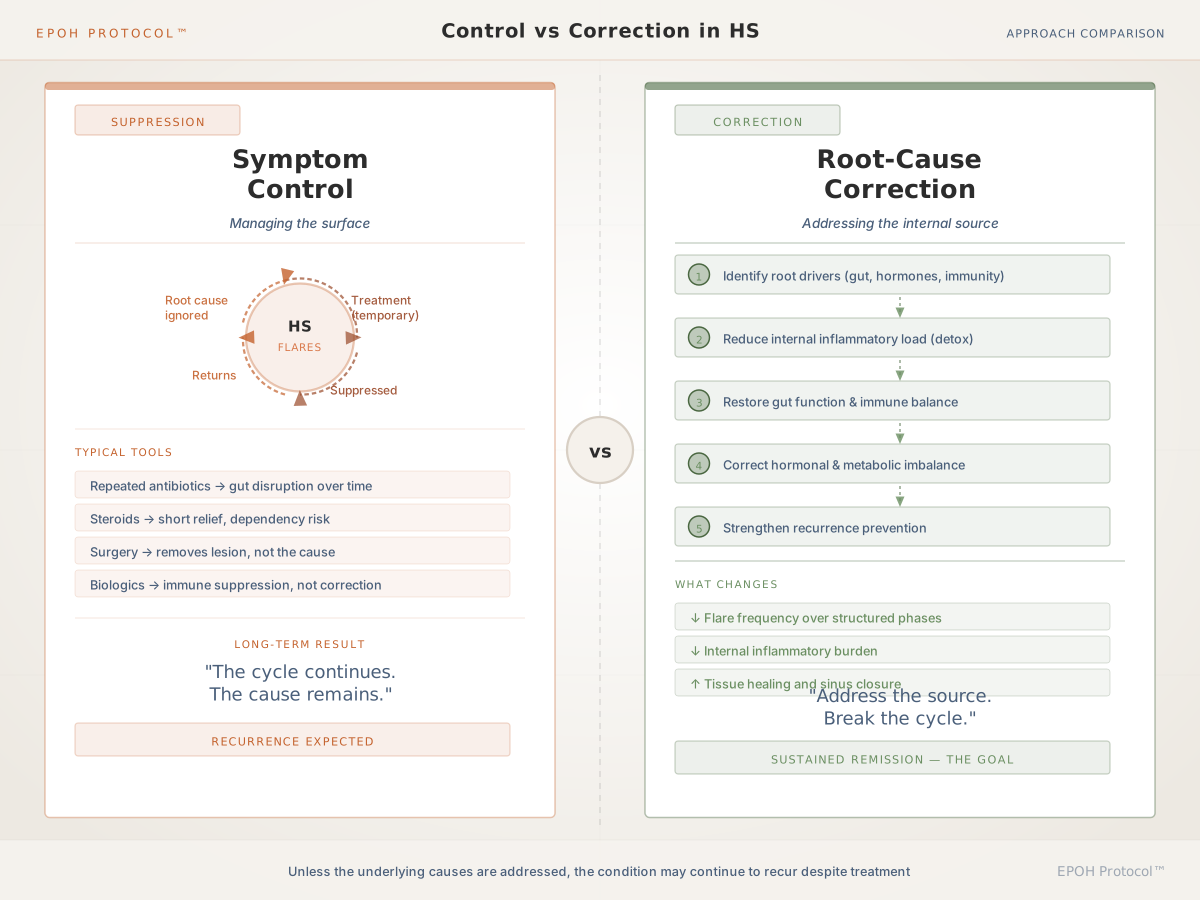
It removes the consequence. It does not touch the process.
The systemic environment that produced that tract is the same on the day of your discharge as it was on the day of your admission. The intestinal barrier is as permeable. The microbiome is as disrupted — after perioperative antibiotics, arguably more so. The innate immune activation that barrier leakage drives is running at the same raised baseline. The insulin resistance is unchanged. The androgen signal reaching every follicular unit you still have is unchanged.
And those remaining follicular units — in the same field, in the adjacent skin, in the fold on the opposite side — are still hyperkeratinising, still occluding, still rupturing into a dermis whose immune system is still primed to overreact.
HS is not a skin condition with systemic complications. It is a systemic condition expressing through the skin. Surgery operates on the site of expression. It cannot operate on the source.
Two different things both get called "recurrence"
Conflating them is why patients and surgeons so often talk past each other, each of them correct.
True local recurrence: disease at or within the margin. Sinus tracts branch, and they branch subclinically. The tunnel network extends beyond what is visible on the surface and beyond what is palpable underneath it. An excision boundary is necessarily drawn around visible and palpable disease — but the disease field is wider than the visible disease. Residual tract, or residual affected follicular units sitting right at the margin, reactivate. This is the recurrence that appears as a nodule on the edge of the scar.
New disease: fresh lesions in skin never previously involved. This is not a surgical failure at all. This is your HS doing exactly what HS does, in tissue the surgeon never touched and never claimed to treat. A clean axillary excision that holds perfectly while disease appears in the groin two years later is a successful operation and an unchanged disease, simultaneously.
Both are true. From the inside they feel identical. Only one of them is about the surgery.
Why wide excision improves the odds without changing the drive
Wide excision — generous margins, removing the whole apocrine-bearing field rather than the individual lesion — produces better results at the operated site than limited excision or deroofing. That is well established, and reported recurrence figures vary considerably with technique, anatomical site, method of closure and length of follow-up.
The reason is mechanical and it makes complete sense: the more of the disease field you remove, the less remains at the margin to reactivate.
But look at what that improvement actually is. It is a better answer to the local question — will disease return here. It is not an answer to the systemic question — will disease return at all. More target tissue has been removed. The drive hitting that tissue has not been reduced by a single unit.
Which is why a patient can have an excellent, durable result in the axilla and present two years later with inframammary or perianal disease. The surgery worked. The disease was never in the axilla; it was only appearing there.
The healing problem nobody warned you about
Wounds in HS heal badly, and that is not bad luck. A patient carrying a high systemic inflammatory load, impaired glycaemic control and a gut that is not absorbing well is being asked to close a large open wound using poor materials. Tissue repair depends entirely on the quality of what is circulating to the wound bed.
Ayurveda names this directly: Dushta Vrana, the chronically vitiated wound that will not close, because the field is vitiated and not merely the wound. Repair at the level of Mamsa dhatu cannot outpace what Rakta Dushti keeps delivering to it. That is an argument for correcting the internal environment around surgery — not instead of it.
Where Phase 4 sits, and why the ordering is the point
EPOH's Phase 4 is External Care: topical formulations for lesion resolution, sinus-tract healing and barrier restoration, applied at home. Notice where it falls in the sequence. It is not first. It runs after, and alongside, Phase 2 (Internal Healing) and Phase 3 (Functional Detox — oral formulations supporting clearance from within).
That ordering is not housekeeping. It is the mechanism.
| Order of work | What you get |
|---|---|
| Surface first: topicals alone, or excision alone | Real improvement at the treated site. Then recurrence at the margin and new lesions in adjacent skin, because the field is still generating disease. |
| Internal first, surface second: L, then I and F, then E | Surface repair carried out on a field that is no longer producing new lesions. Healing with something to hold on to. |
A topical applied to skin that is still receiving inflammatory signal from within is doing repair work against a live load. It can soothe. It cannot hold. The same formulation applied once internal conditions have already shifted works with the tissue instead of against the system feeding it. Phase 4 works because L, I and F came first.
If you have already had surgery
The tissue that was removed is gone, and it does not need to come back. What can change is the environment that decides whether the next follicle occludes.
That is Phase 1 — Lowering the Load (4–8 weeks): oral formulations reducing accumulated inflammatory load (Ama) and restoring digestive capacity (Agni). Then Phase 2 — Internal Healing (8–16 weeks): gut lining integrity, microbiome repair, immune recalibration, hormonal patterns. Both taken at home, compounded to your driver profile.
One warning, because post-surgical patients are particularly prone to it: do not begin with a cleanse. Phase 3 sits third for a reason. Mobilising accumulated internal load before L and I are stable releases more than the body can clear, and the skin gets worse. If you tried a detox regime in the past and flared, the timing was the problem, not the idea.
Progress is then tracked on two separate scales, and both can be true at once. You can remain EPOH-DSS Stage 3 (Sinus) structurally — scar and tunnels are structural — while moving through Recovery Stage 1 (Internal Shift, weeks 1–4) and Recovery Stage 2 (Reduced Frequency, months 2–4). Structure and drive are different measurements, and only one of them is being asked to change.
Not every patient responds equally. Disease duration, degree of organ involvement, and remaining biological repair capacity all influence outcomes. Patients with very advanced structural changes (severe fibrotic HS) may not achieve full remission. A personalised evaluation is the only way to assess your specific response potential. Nor is any of this a reason to alter existing medication on your own: EPOH begins alongside what you are already taking, with any reduction reviewed and structured with your prescribing physician.
The question worth asking before the next operation
Not "will this surgery work?" It may well work, at that site, and it may be the right thing to do. The better question is: what is being done, in parallel, about the process that will decide whether you need the operation after it?
That is a driver-profile evaluation, done by video or WhatsApp consultation. Personalised formulations are dispatched by courier and taken at home.
Medical disclaimer. This article is for general information and is not a substitute for personalised medical advice. Ayurvedic treatment at EliteAyurveda™ is individualised following clinical assessment. Do not start, stop or alter any prescribed medication without consulting your treating physician.

