


Part of the Pemphigus & Bullous Disorders Knowledge Library
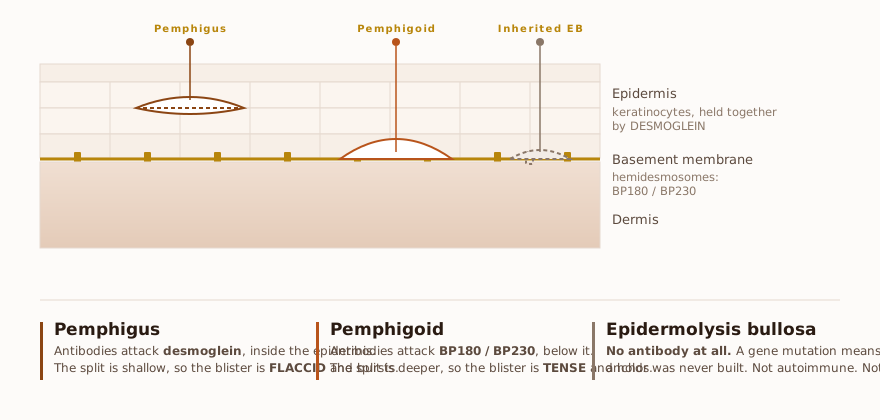
Your report says "linear IgG at the basement membrane zone". Here is what that sentence means.
Direct immunofluorescence (DIF) is the test that decides whether you have a blistering autoimmune disease and, if so, which one. Everything else — how the blister looks, whether it is tense or flaccid, your age, where it started — is a clue. DIF is the answer. It is worth understanding the report you have been handed, because the details determine what is done to you for the next several years.
Why the biopsy is taken twice, and why the site matters more than anything
A proper work-up takes two samples:
- Lesional skin — for routine histology (H&E). This shows where the skin has split. In pemphigus vulgaris the split is just above the basal layer, with keratinocytes falling apart from each other (acantholysis). In pemphigus foliaceus it is high up, near the granular layer. In pemphigoid the whole epidermis lifts off cleanly, and the space beneath is usually crowded with eosinophils.
- Perilesional skin — for DIF. This must be taken from normal-looking skin immediately next to a lesion, not from inside a blister. This is the single most common technical failure in the whole diagnostic chain. Inside a blister, the immune deposits and the tissue architecture are degraded, and the test can come back falsely negative. If your DIF was taken from the roof or floor of a blister, a negative result tells you very little.
There is a second trap. The DIF sample must not go into formalin. Formalin destroys the antigens the test relies on. It travels in Michel's transport medium or saline. If your laboratory put the immunofluorescence sample into formalin, that test is void — no matter what the report says. It is worth asking.
Reading the DIF pattern
DIF works by putting fluorescent tags on your own antibodies where they are stuck in the tissue. Where they sit is the diagnosis.
| DIF finding | What it means |
|---|---|
| IgG (often with C3) between the keratinocytes — described as a net, lattice, fishnet or chicken-wire pattern | Pemphigus — the antibody is stuck to the desmosomes holding cells to each other |
| Linear IgG and/or C3 along the basement membrane zone | The pemphigoid group — the antibody is stuck at the layer anchoring epidermis to dermis |
| Granular IgA in the dermal papillae | Dermatitis herpetiformis — the gluten-driven blistering disease |
| Linear IgA along the basement membrane | Linear IgA bullous dermatosis |
C3 alone, in a linear pattern, is enough to support pemphigoid. That surprises people. It is not a weaker result.
The problem the report may not have solved: pemphigoid or EBA?
Bullous pemphigoid and epidermolysis bullosa acquisita (EBA) both show linear IgG at the basement membrane zone. On a basic DIF they look the same. They are not the same disease, and they do not respond the same way.
Two techniques separate them:
- Salt-split skin. The sample is soaked in salt solution, which splits the skin at the lamina lucida. Then you look at which side the antibody sits on. Bullous pemphigoid binds the epidermal side — the roof. EBA (and anti-p200 pemphigoid) binds the dermal side — the floor.
- Serration pattern analysis on high-resolution DIF. The fluorescent line is not perfectly smooth; it has a saw-tooth shape. A "u-serrated" pattern indicates pemphigoid; an "n-serrated" pattern indicates EBA (antibodies against collagen VII).
If your report says only "linear IgG at the BMZ" and nobody has done either of these, and your disease is not behaving as expected, this is a reasonable and specific thing to ask for.
Note what EBA is not. EBA is autoimmune. Inherited epidermolysis bullosa is not. Inherited EB is a genetic mutation — keratin 5/14, laminin-332, collagen VII — with no autoantibody at all. It is not reversible by any treatment, ours included, and we will never tell you otherwise.
Indirect immunofluorescence and ELISA: the blood tests
DIF looks at your skin. The blood tests look for antibody in circulation.
- Indirect immunofluorescence (IIF) puts your serum onto a substrate — monkey oesophagus for pemphigus, salt-split human skin for pemphigoid — and reports a titre.
- ELISA measures specific antibodies by name: anti-desmoglein 1, anti-desmoglein 3, anti-BP180 (the NC16A domain), anti-BP230. Some laboratories run a multi-antigen panel that reports several at once.
These numbers matter for two reasons.
First, they confirm the antigen and therefore the sub-type. Anti-desmoglein 3 alone points to mucosal pemphigus vulgaris; the appearance of anti-desmoglein 1 later can herald the disease spreading from mouth to skin.
Second, they track disease activity over time. Anti-BP180 in particular tends to move with how active pemphigoid is. Anti-desmoglein 3 can linger in the blood after the mouth has healed, which means a persisting titre is not automatically a relapse.
A titre is a trend, not a verdict. One value is nearly useless. Three values across six months is data. Ask for the numbers and the dates, and keep them yourself — not in a hospital file you cannot see.
What a negative DIF does and does not mean
A negative DIF does not always exclude the disease. It can be negative because:
- the sample came from the wrong site (inside the blister, or too far from a lesion),
- the sample was fixed in the wrong medium,
- you were already on a potent topical or systemic steroid, which reduces the deposits,
- or the sample was too small or handled badly.
If the clinical picture strongly suggests an autoimmune blistering disease and the DIF is negative, the correct response is often to repeat it properly, not to abandon the diagnosis. Ask.
What we do with your report — and what we do not
We do not diagnose you. We read the report you already have, because it tells us which disease we are supporting and what the realistic ceiling is.
It also gives us the only objective numbers in this whole field. That matters, because it makes us falsifiable. Bring us:
- the DIF report and the H&E report,
- every ELISA value with its date,
- your full drug list — name, dose, duration, including steroids, rituximab dates, azathioprine, mycophenolate, dapsone, doxycycline,
- your recent liver function, kidney function, blood counts and glucose.
You do not stop or change any of those drugs to work with us. Any change to your prescription is made by the doctor who prescribed it.
Where EPOH fits
EPOH is entirely formulation-based: oral compounds and topical preparations, couriered to you and taken at home. For most patients there is no procedure, no in-clinic therapy and no clinic visit.
It runs in one fixed sequence, and the sequence is the medicine: Phase 1, Lowering Inflammatory Load; Phase 2, Internal Healing & Gut Repair; Phase 3, Functional Detox & Immune Balancing; Phase 4, External Care & Local Reversal, the topical preparations you apply at home; Phase 5, Sustaining Remission.
The order is not decorative. Phase 3 run before L and I are stable mobilises internal load faster than the system can clear it — and the condition worsens. That is why so many people who started with a "cleanse" or a "detox" got worse and blamed the medicine. The approach was not wrong. The timing was.
The honest limits
We cannot tell you that our formulations lower your anti-desmoglein or anti-BP180 titre. There is no randomised trial saying so, and if we claimed it we would be inventing it. What we can do is measure it anyway, before and during, because it is the only number in this disease that is not a matter of opinion.
The timeline we hold you to, and you hold us to: the first four to eight weeks are internal work and visible skin change is not expected. From months two to four the disease should begin to change. Stable remission is assessed from month eight. We do not promise a cure. We aim at sustained remission, alongside your dermatologist.
If your titres and your lesion counts are both flat at month four, that is the answer, and we will say so.
Medical disclaimer. This article is for general information and is not a substitute for personalised medical advice. Ayurvedic treatment at EliteAyurveda™ is individualised following clinical assessment. Do not start, stop or alter any prescribed medication without consulting your treating physician.

