


Part of the Pemphigus & Bullous Disorders Knowledge Library
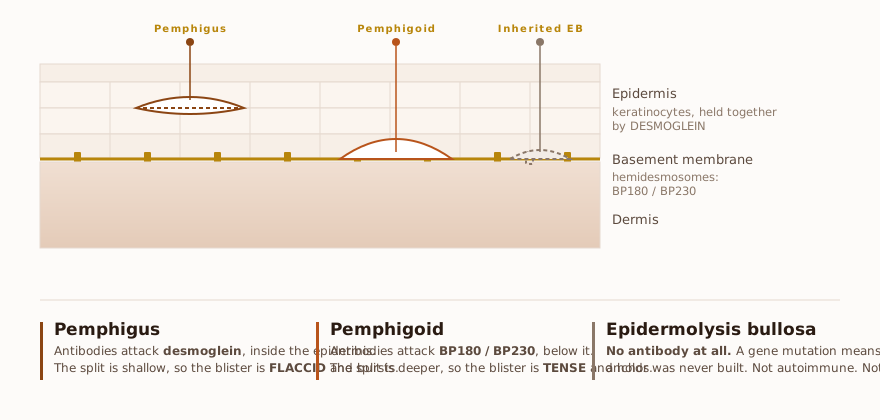
Two diseases, one symptom, and a difference that decides everything
If you are reading this at 2am with a biopsy report in your hand, hold on to this first: pemphigus and pemphigoid are not two words for the same illness. They sound alike. They both make blisters. Almost nothing else about them is the same — not the layer that splits, not the protein under attack, not the age group, not the risk, not the treatment.
The one-line version: pemphigus splits the skin from within. Pemphigoid lifts the skin off its foundation.
Everything below follows from that.
Pemphigus: the split is inside the epidermis
The epidermis is a wall of keratinocytes riveted to each other by desmosomes. In pemphigus, the immune system makes autoantibodies against the proteins that form those rivets — desmoglein 3 and desmoglein 1.
- Pemphigus vulgaris (PV) — antibodies against desmoglein 3, often joined later by desmoglein 1. Mucosa first. The opening sign is very often the mouth: erosions on the inner cheeks, palate, gums, throat. People are treated for "mouth ulcers", "thrush" or "gum infection" for months before anyone takes a biopsy. Untreated, PV is serious and can be life-threatening.
- Pemphigus foliaceus (PF) — antibodies against desmoglein 1 alone. Superficial. Scaly, crusted, flaking lesions, typically scalp, face, upper chest and back. It spares the mucosa entirely.
Because the split is inside the epidermis, the blister roof is only a few cell layers thick. It is flaccid — soft, floppy, easily broken. Most people with pemphigus never see an intact blister. They see raw, weeping erosions where blisters used to be, and they wonder why nobody believes them when they say "blisters". Nikolsky sign is positive: gentle sliding pressure on nearby skin shears the top layers away.
Pemphigoid: the split is beneath the epidermis
Underneath the epidermis lies the basement membrane zone, the anchoring layer fastening the epidermis to the dermis below. Hemidesmosomes are the fasteners. In pemphigoid, the autoantibodies target BP180 (collagen XVII) and BP230 — hemidesmosome proteins.
The whole epidermis is lifted off intact. That gives a blister with a full-thickness roof: tense, dome-shaped, filled with clear or blood-tinged fluid, and it persists for days rather than shredding on contact. Nikolsky is usually negative.
Bullous pemphigoid typically appears in people in their seventies and eighties. It is usually non-scarring — the skin closes without a lasting mark, though pigment change is common. And it has a feature pemphigus does not: intense itch, often for months before a single blister appears. That prodrome is routinely called eczema, scabies, or "old dry skin".
Two variants change the stakes entirely:
- Mucous membrane (cicatricial) pemphigoid does scar. It attacks the conjunctiva and the mouth, and scarring of the eye surface can threaten sight. Treat any eye symptom in this disease as urgent.
- Pemphigoid gestationis occurs in pregnancy.
Side by side
| Pemphigus | Pemphigoid | |
|---|---|---|
| Level of split | Intraepidermal — inside the epidermis | Subepidermal — below the epidermis |
| Target antigen | Desmoglein 3 (PV), desmoglein 1 (PF) | BP180 / collagen XVII, BP230 |
| Structure attacked | Desmosomes (cell to cell) | Hemidesmosomes (cell to foundation) |
| Blister | Flaccid, ruptures fast, leaves raw erosions | Tense, persists, thick roof |
| Nikolsky sign | Positive | Usually negative |
| Typical age | Middle age onwards | Seventies to eighties |
| Mucosa | PV: often the first site. PF: spared | BP: sometimes. Mucous membrane pemphigoid: defining, and scars |
| Dominant symptom | Pain, raw erosions | Itch — often months before blisters |
| Scarring | Erosions usually close without scars | Usually non-scarring; mucous membrane type scars |
| Direct immunofluorescence | IgG and C3 between the cells — a net or lattice | Linear IgG and C3 along the basement membrane |
The one that is neither
Epidermolysis bullosa (EB) also blisters, and it is neither of these. EB is inherited — a mutation in a structural gene (keratin 5 or 14, laminin-332, collagen VII). There is no autoantibody. There is nothing for immunosuppression to suppress. EB is not autoimmune, it is not reversible by any treatment, and any practitioner — Ayurvedic or otherwise — who offers to reverse it is either mistaken or lying to you. We say this on a page selling Ayurvedic care because it is true and because you deserve to know it before you spend anything.
The exception is epidermolysis bullosa acquisita (EBA), which is autoimmune — antibodies against collagen VII — and which looks like pemphigoid on a basic report. Telling them apart needs a specific test, covered in our article on reading your immunofluorescence report.
How the diagnosis is actually made
Not by looking. Blister character, Nikolsky, age and site all point. A skin biopsy with direct immunofluorescence (DIF) decides. DIF is the definitive test. Alongside it, blood ELISA for anti-desmoglein 1, anti-desmoglein 3 and anti-BP180 gives antibody titres that track how active the disease is over time.
If you do not have a DIF result, you do not have a diagnosis. You have an opinion. Ask for one — and ask that the sample for DIF be taken from normal-looking skin next to a lesion, not from inside a blister, because a sample taken from the blister itself can come back falsely negative.
Why the distinction changes what happens to you
In conventional care, this distinction is the entire plan.
Moderate-to-severe pemphigus vulgaris is treated hard, because it is dangerous and because oral and oesophageal erosions destroy the ability to eat. Current guidance places rituximab, with a steroid course, as first-line in that group.
Bullous pemphigoid in an eighty-year-old is often controlled with a potent topical corticosteroid, with steroid-sparing drugs added — precisely because high-dose oral steroids in a frail, elderly person can do more damage than the disease.
Mucous membrane pemphigoid gets urgent ophthalmology input, because the endpoint is loss of sight.
Same phrase — "blistering disease" — three completely different risk calculations. Your dermatologist makes those calls. Not us. And you do not stop or reduce any prescribed drug — steroid, rituximab, azathioprine, mycophenolate, dapsone, doxycycline — on our account. Changes to your prescription are made by the doctor who wrote it.
Where EPOH fits, and why the order matters
EPOH is entirely formulation-based: oral compounds and topical preparations, couriered to you and taken at home. For most patients there is no procedure, no in-clinic therapy and no clinic visit.
It runs in a fixed sequence, and the sequence is the medicine:
- Phase 1 — Lowering Inflammatory Load. Bring down the systemic inflammatory burden the antibody response is running on.
- Phase 2 — Internal Healing & Gut Repair. Repair the internal terrain and the barrier.
- Phase 3 — Functional Detox & Immune Balancing. Only once L and I are stable.
- Phase 4 — External Care & Local Reversal. Topical preparations you apply at home, aimed at erosions and the surface.
- Phase 5 — Sustaining Remission. The long tail, where relapse is either headed off or not.
The counter-intuitive part is the part that matters most. If Phase 3 is run before L and I are stable, it mobilises internal load faster than the system can clear it — and the condition gets worse. This is exactly why people who began with a "cleanse" or a "detox" flared, then concluded that Ayurveda had harmed them. The approach was not wrong. The timing was.
Your diagnosis changes the weighting inside that sequence. Mucosa-dominant pemphigus vulgaris means Phase 4 topicals can never carry the work — the disease is in a place surface treatment cannot usefully reach, and the internal phases matter proportionally more. Itch-dominant pemphigoid gives Phase 1 a different job. Same architecture, different emphasis.
The timeline, stated plainly
The first four to eight weeks are internal work. You should not expect visible change on your skin in that window — and any clinic promising you will see it is setting you up to quit in week five. Between months two and four, the disease should begin to change: fewer new lesions, faster closure of erosions, less itch. Stable remission is assessed from month eight onwards.
We do not promise a cure. What we work towards is sustained remission, alongside your dermatologist, never instead of them. If by month four nothing has moved on any measurable axis — new blister count, healing time, itch score, antibody titre trend — that is information, and it deserves an honest conversation rather than another invoice.
What to do this week
- Establish which disease you actually have. Get the DIF report into your own hands.
- Get the ELISA values with dates, so you have a trend and not a snapshot.
- If you are an older adult with brutal itch and no blisters yet, read our article on the pemphigoid prodrome before you accept another prescription for eczema cream.
Medical disclaimer. This article is for general information and is not a substitute for personalised medical advice. Ayurvedic treatment at EliteAyurveda™ is individualised following clinical assessment. Do not start, stop or alter any prescribed medication without consulting your treating physician.

