


Part of the Pemphigus & Bullous Disorders Knowledge Library
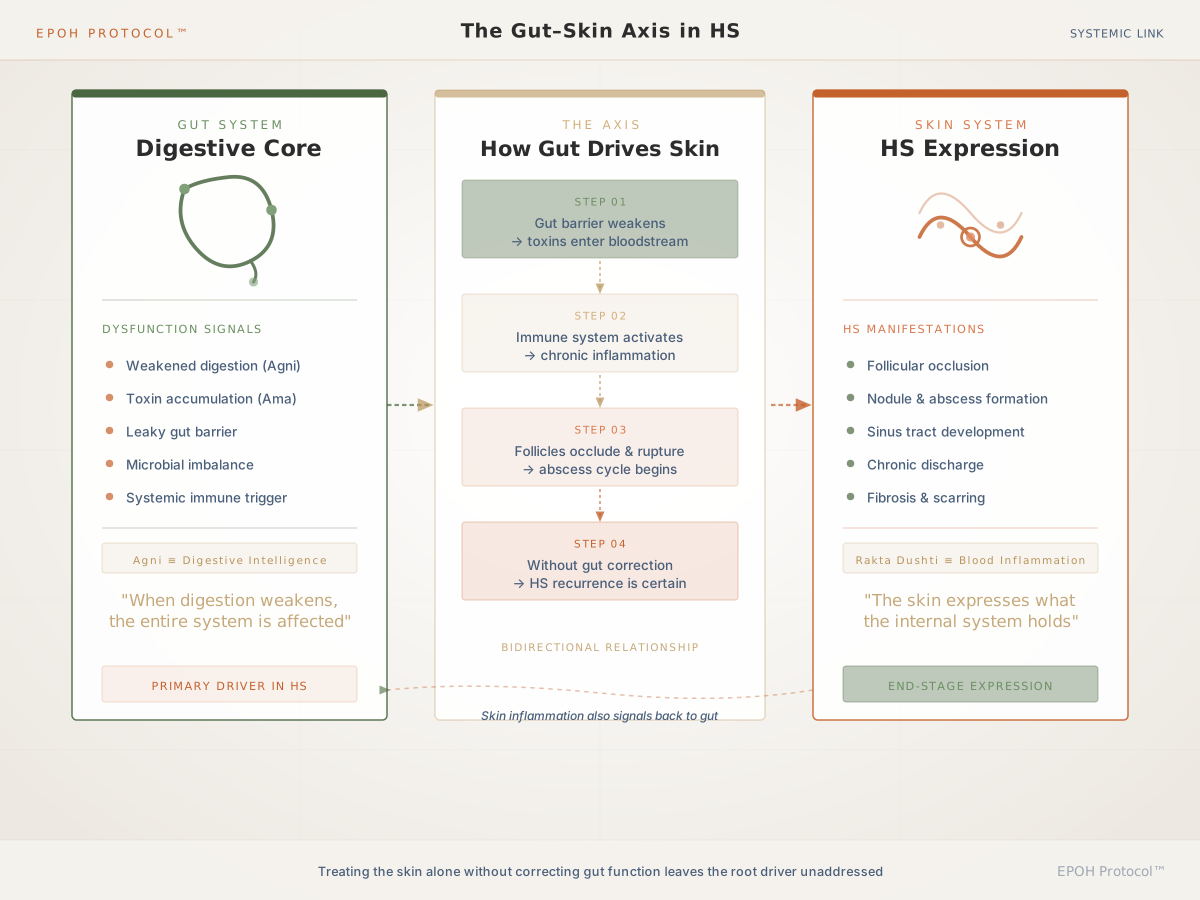
The gut barrier and blistering autoimmunity: what is proven, what is plausible, and what is being oversold to you
Start with the one thing that is not in dispute.
There is exactly one blistering skin disease where the gut link is settled science: dermatitis herpetiformis. It is the skin manifestation of coeliac disease. The trigger is dietary gluten. The antibody is IgA against transglutaminase. On direct immunofluorescence it shows granular IgA in the dermal papillae. Remove gluten completely and the rash resolves; reintroduce it and the rash returns.
That disease proves the principle. A protein crossing an inflamed intestinal barrier can drive an antibody response that produces blisters in skin, at a site far from the gut.
Now the honest part, which most clinics selling "gut healing" will not tell you:
Dermatitis herpetiformis does not prove that pemphigus or pemphigoid works the same way. It proves that such a mechanism is possible in skin. It does not establish that it is operating in your disease. Anyone who tells you the gut link in pemphigus is proven is going beyond the evidence, and you should reduce your trust in everything else they say.
The mechanism, described properly
Your intestine is lined by a single layer of cells. Between those cells are tight junctions — protein complexes (occludin, the claudins, ZO-1) that act as a controllable gate deciding what crosses from the gut lumen into the body.
Zonulin — identified as pre-haptoglobin-2 — is the best-known human regulator of that gate. When it is released, tight junctions loosen. Known triggers of zonulin release include gliadin (a wheat protein) and bacterial exposure at the intestinal surface.
The proposed chain runs like this:
- Tight junctions loosen.
- Contents of the gut lumen — food proteins, bacterial fragments such as lipopolysaccharide — reach the mucosal immune tissue in quantities and forms they were never meant to reach it in.
- The innate immune system is activated. T cells are recruited. B cells get help.
- In a genetically susceptible person, tolerance is lost — the immune system starts to treat a self-protein as foreign.
- Autoantibodies are produced. In pemphigus, against desmoglein 1 and 3. In pemphigoid, against BP180 and BP230.
This is often summarised as a three-part requirement: a susceptible genome, an environmental trigger, and a permeable barrier. Remove any one of the three, the argument goes, and the autoimmune process is less likely to establish itself.
The genetics half of the argument
Pemphigus has well-documented HLA class II associations — certain HLA-DRB1 and HLA-DQB1 types are far more common in people who develop it. But here is the informative part: the overwhelming majority of people carrying those genes never develop pemphigus. The genes load the gun. They do not fire it.
Something else has to happen. The gut hypothesis is a candidate for what that something is. It is not the only candidate, and it is not confirmed.
What is actually known in pemphigus and pemphigoid
Differences in the gut microbiome have been described in people with pemphigus and in people with pemphigoid, compared with healthy controls. That is real published work, and it is worth knowing.
It is also almost impossible to interpret, for one blunt reason: the people studied are being treated. Corticosteroids alter the gut lining and the microbiome. Immunosuppressants alter both. Antibiotics — routinely given for infected erosions — alter both, drastically. So a difference measured in a treated patient may be caused by the disease, by the drugs, by the illness itself, or by all three.
We do not know whether increased gut permeability causes blistering autoimmunity, contributes to it, or is a consequence of the disease and its treatment. That is the truthful state of the field in 2026. We are writing it on our own website because you should be able to tell the difference between a clinic that has a mechanism and a clinic that has a slogan.
The zonulin test you should probably not pay for
You will be offered a blood "zonulin level" by wellness laboratories and by some clinics, as a measurement of your "leaky gut".
The commercially available zonulin ELISA kits have been shown to cross-react with other proteins — properdin among them — meaning that the number they return may not be measuring zonulin at all. This is a live and legitimate controversy in the literature, not a fringe objection.
We do not base your protocol on a zonulin test, and we would advise you not to buy one. If a clinic prices a treatment plan off that number, ask them whether they know about the cross-reactivity problem. Their answer will tell you a lot.
So why work on the gut at all?
Because the argument does not depend on the test, and it does not depend on the hypothesis being proven.
- A very large proportion of the body's immune tissue sits in and around the intestine. It is where immune tolerance is trained, and where it can be lost.
- Your barrier is measurably damaged by the treatment you are already on — long-term corticosteroids, immunosuppressants, NSAIDs for pain, antibiotics for infected skin. That harm is not hypothetical.
- Nutrition fails in this disease. Oral and oesophageal erosions in pemphigus vulgaris make eating painful; people lose weight and lose the raw material for tissue repair.
- Unlike your HLA type, the barrier is modifiable.
- And the claim is falsifiable. If working on your gut does nothing for your disease, it will show — in your blister count, your healing times, your itch score, your antibody titre trend. We will not be able to hide it, and we will not try to.
Where this sits in the sequence — and the mistake almost everyone makes
EPOH is entirely formulation-based: oral compounds and topical preparations, couriered to you and taken at home. For most patients there is no procedure, no in-clinic therapy and no clinic visit.
The sequence is fixed, and the sequence is the medicine:
- Phase 1 — Lowering Inflammatory Load
- Phase 2 — Internal Healing & Gut Repair
- Phase 3 — Functional Detox & Immune Balancing
- Phase 4 — External Care & Local Reversal
- Phase 5 — Sustaining Remission
Gut repair is Phase 2. It is deliberately second, not first. Phase 1 comes before it because attempting to rebuild a barrier inside a system running at maximum inflammatory output is like re-plastering a wall in the rain. The inflammation that is damaging the barrier has to come down before repair of the barrier can hold.
And then the rule that matters more than any other on this page:
Phase 3 — Functional Detox & Immune Balancing — applied before L and I are stable, mobilises internal load faster than the system can clear it, and the condition gets worse.
This is the mechanism behind an experience thousands of people have had and never had explained to them. They went to a practitioner. They were started on a "cleanse", a "detox", a purge — something framed as removing before anything had been stabilised or repaired. Within weeks they flared, badly. They concluded that Ayurveda had made their blistering disease worse, and they never went back.
They were right that they got worse. They were wrong about why. The approach was not the problem. The timing was.
What we will not tell you about diet
If you have dermatitis herpetiformis, gluten is not a lifestyle question — it is the disease, and strict avoidance is the treatment, confirmed by proper coeliac testing.
If you have pemphigus or pemphigoid, there is no good evidence that a gluten-free diet changes your disease, and we are not going to tell you that it does. We are also not going to sell you an elimination diet built on a food-sensitivity panel of doubtful validity. If we recommend a dietary change, we will tell you what it is for and how we will know whether it worked.
The timeline and the limits
The first four to eight weeks are internal work, and visible change on your skin is not expected in that window. From months two to four, the disease should begin to change. Stable remission is assessed from month eight onwards.
We do not promise a cure. We aim at sustained remission, alongside your dermatologist. You do not stop or reduce your steroids, rituximab, azathioprine or any other prescribed drug — any change is made by the doctor who prescribed it.
And the sentence we would most like you to remember from this page: we do not know that the gut is driving your blistering disease. We think it is a rational target, we have reasons, and we have agreed with you in advance how we will find out whether we were wrong.
Medical disclaimer. This article is for general information and is not a substitute for personalised medical advice. Ayurvedic treatment at EliteAyurveda™ is individualised following clinical assessment. Do not start, stop or alter any prescribed medication without consulting your treating physician.

