


Part of the Crohn's Disease Knowledge Library
Most people arrive here having already read the promises. What almost nobody has given them is a timeline — an honest, phase-by-phase account of what happens, in what order, and what it feels like from the inside.
This is that account. It is not a results promise. It is a map of the road.
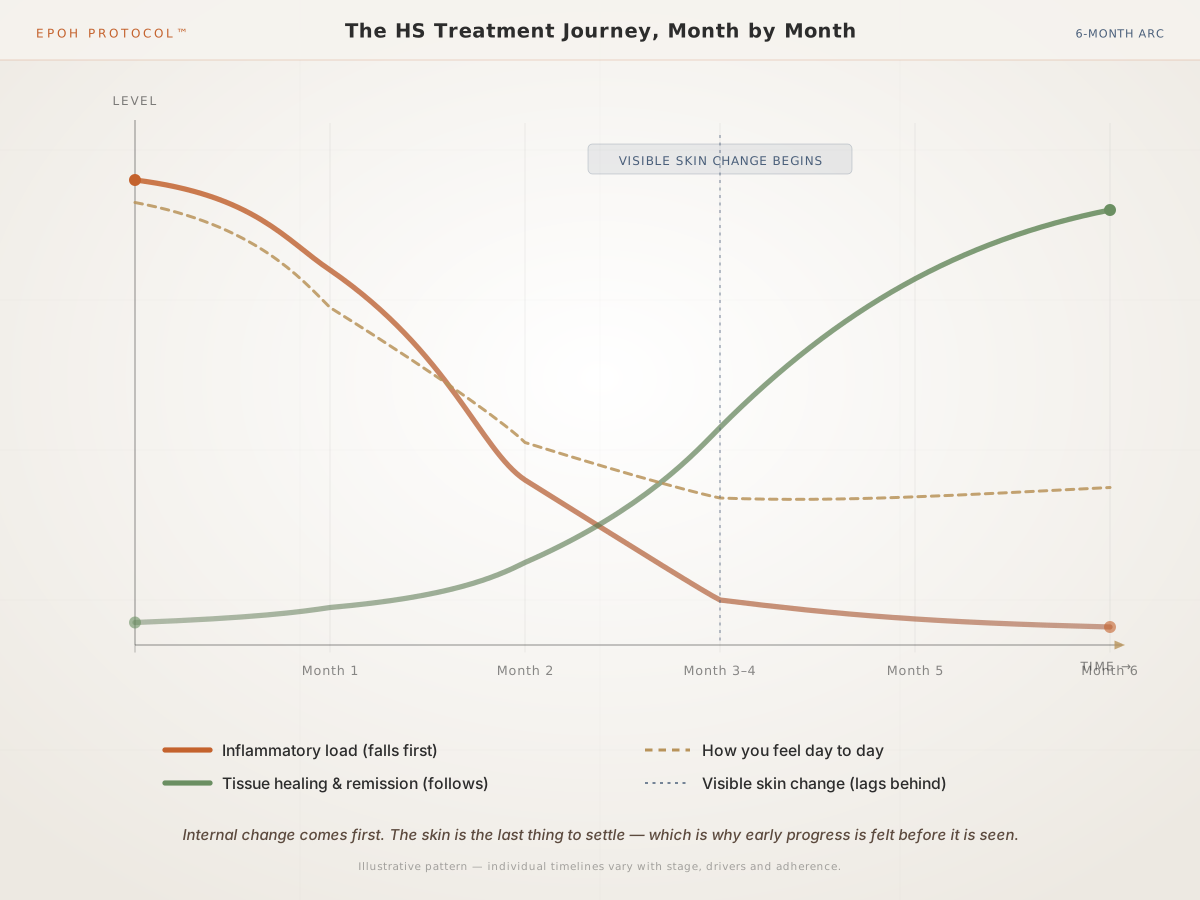
Two maps running at the same time
Crohn's treatment under the EPOH protocol runs on two timelines, and confusing them is the most common reason people lose faith halfway through.
The first is the treatment sequence — what we do. Five phases, in a clinically fixed sequence. The second is the Recovery Stages — what you experience as the treatment lands. These do not move at the same speed, and they are not meant to.
When someone tells us "nothing is working", they almost always mean their bowel symptoms have not changed. But bowel symptoms are rarely the first thing to move. Understanding why is the difference between staying the course and abandoning it three weeks early.
Before anything begins: you do not stop your medication
Treatment starts while you continue everything you are currently taking. Your biologic, your steroid, your immunosuppressant, your mesalamine — all of it continues exactly as prescribed. Reduction, if it becomes appropriate at all, comes later, gradually, and always in conversation with the physician who prescribed it. We do not take you off anything.
Phase 1 — Lowering the Load (weeks 1 to 8)
Treatment does not begin at the gut. It begins with the inflammatory burden the gut is drowning in.
Phase 1 is oral Inflammatory Load Reduction formulations — compounded to your driver profile, couriered to you, taken at home. Their job is narrow and specific: bring the accumulated inflammatory load down so the gut lining has a survivable environment in which to repair.
Even in a gut condition, load reduction precedes gut restoration. That is not a stylistic preference. Attempt lining repair while systemic inflammatory load is still high and you are rebuilding a wall in a flood.
What tends to move in this window: appetite steadying, less bloating, less post-meal heaviness, deeper sleep, the particular brain fog of active Crohn's beginning to thin. Urgency and stool frequency may look exactly as they did.
Recovery Stage 1 — Internal Shift (weeks 1 to 4)
That last sentence deserves its own heading, because it is where people misread their own progress.
Recovery Stage 1 is the Internal Shift. Digestion, sleep and energy improve. Bowel symptoms may not have changed at all. This is progress.
It is progress because those systems are the first honest signal that inflammatory load is coming down. The bowel — the most damaged, most chronically inflamed tissue you own — reports last, not first. Judging month one by stool frequency is like judging a healing burn by whether the scar has faded.
We ask you to track sleep, energy, appetite, post-meal comfort and mental clarity from day one, precisely so you can see the movement that is actually happening.
The Partial Improvement Plateau — weeks 3 to 6
This is the most important section in this article.
Somewhere between week three and week six, most patients hit a wall that feels like this: "I felt better for a while. Now I have plateaued. I still flared last week. It has stopped working."
It has not stopped working. This plateau is expected, it is predictable, and it is the signal we are waiting for.
Here is what is actually happening. Phase 1 has done the job it was built to do — the load is coming down, and the gains available from lowering load have now been collected. But the gut lining has not yet been repaired, the microbiome has not yet been rebuilt, and the immune response has not yet been recalibrated. Those are a different body of work, and that work has not started yet.
The plateau is not failure. It is a handover point: it tells us Phase 1 has done its part and Phase 2 should begin.
We name this out loud because the patients who drop out almost all drop out here — at exactly the moment the treatment is telling us it is ready for the next step. Nobody warned them, so a normal, predicted feature of the recovery curve read to them as a dead end.
You are now warned. When it happens, message us. It is a phase-change conversation, not a crisis.
Phase 2 — Internal Healing (8 to 16 weeks)
Phase 2 is where the gut itself is addressed. Oral Internal Correction formulations work on three fronts at once: integrity of the gut lining, repair of the microbial environment, and recalibration of the immune response that has been attacking your own bowel.
This is the longest, slowest phase and the least dramatic to live through. Epithelial repair is not fast biology in anyone, let alone in tissue inflamed for years.
What tends to change: flares that arrive with less violence, end sooner, and resolve more completely instead of leaving you permanently at a lower baseline. Blood, if you have been passing it, often becomes less consistent before it becomes absent.
Recovery Stage 2 — Reduced Frequency (months 2 to 4)
This is the first stage where the disease itself, and not just your general physiology, visibly changes shape.
Flares become less frequent, shorter, and cleaner in how they resolve. You may still have them. The difference is that the gaps widen and recovery from each one gets faster and more complete. That is the curve beginning to bend.
Phase 3 — Functional Clearance (6 to 12 weeks, usually alongside Phase 2)
Phase 3 is oral formulation only. For most patients there is no procedure involved, no in-clinic therapy and no clinic visit. These are compounds that support your body's own clearance pathways so that the inflammatory material mobilised by healing tissue can actually leave.
Sequence matters here more than anywhere else in the protocol. Run Phase 3 before Phase 1 and Phase 2 are stable and you mobilise internal load faster than the system can clear it — which makes the patient worse, not better. This is the mistake that turns a well-meant plan into a flare. It is why we will not compress your timeline because you are impatient, and why we will decline to run Phase 3 early even if you ask us to.
Phase 4 — External Care (topical, ongoing through Phase 2 and Phase 3)
External Tissue Repair formulations are topical preparations you apply yourself, at home, on the schedule we give you. They matter most in perianal disease, fissures, fistulising involvement, and the skin and joint symptoms that ride alongside Crohn's.
They are couriered with your oral compounds. There is nothing to attend, nothing to book, nowhere to travel.
Recovery Stage 3 — Reduced Severity (months 4 to 8)
Same triggers. Diminished response.
The meal that used to cost you three days now costs you an afternoon. The stress week that once produced a hospital-adjacent flare produces a rough couple of days. Your body is still reacting — it is simply no longer over-reacting.
This is the window in which medication-reduction conversations become appropriate. Not medication-stopping conversations, and not conversations we have without your specialist. When your markers, your symptom record and your clinical picture all agree, we will support you in opening a tapering discussion with your prescribing physician, who remains in charge of that decision throughout.
Phase 5 and Recovery Stage 4 — Stable Remission (months 8 onward)
Sustaining Remission is the phase people forget to plan for, and it is the one that decides whether any of this holds.
Oral formulations are tapered rather than stopped abruptly. Active monitoring continues for six to twelve months. The work shifts from treating disease to defending a remission: watching your markers, watching whichever driver was loudest in your profile, and catching drift early.
Recovery Stage 4 is extended periods without active disease. Monitoring replaces management. That is the destination, and it is a real one.
What we measure
Not vibes. Inflammatory markers (CRP, ESR, faecal calprotectin where you can get it), haemoglobin and iron studies, albumin, weight trajectory, and any scoping or imaging your gastroenterologist already holds. Alongside those, a structured symptom log: stool frequency and form, urgency, blood, pain, fatigue, sleep, appetite.
The bloods tell us what the disease is doing. The log tells us what the plateau is doing. We need both.
The honest limit
We will not sell you an outcome your anatomy cannot deliver.
Patients with very advanced structural change — established fibrotic stricturing, extensive bowel damage, previously resected bowel — may not reach full remission. Fibrosis is scar, and scar is not inflammation; formulations reduce inflammatory disease activity, they do not dissolve a fibrotic stricture. What often remains achievable is a lighter symptom burden, fewer flares, better nutritional status and a slower disease course. That is worth having. It is not the same thing as remission, and we will tell you which conversation we think we are having with you at the consultation, before you commit to anything.
Your next step
Everything above happens without you travelling anywhere.
The first step is a video consultation — your history, your disease course, your prior treatments, your current medication and your driver profile. From that, formulations are compounded specifically for you and couriered to your door, in India or internationally. Follow-ups happen by video or WhatsApp.
For most patients there is no procedure, no in-clinic therapy and no clinic visit.
Book the consultation, bring your reports, and bring your questions. We would rather spend the first hour telling you the truth about the road than spend the first month watching you discover it alone at week four.
Medical disclaimer. This article is for general information and is not a substitute for personalised medical advice. Ayurvedic treatment at EliteAyurveda™ is individualised following clinical assessment. Do not start, stop or alter any prescribed medication without consulting your treating physician.

