


Part of the Pemphigus & Bullous Disorders Knowledge Library
What This Page Is
You have a diagnosis with a long name, a prescription that frightens you, and a leaflet that does not describe your life. This page sets out the first ninety days of EPOH for autoimmune blistering disease — pemphigus and pemphigoid — in the order things actually happen. That includes the dull parts, the parts that feel like failure, and the long stretch where nothing visible happens at all.
Read it before you start rather than during. People abandon this protocol for a predictable reason: they began it expecting a different first month than the one it has.
Two things before anything else.
EPOH is supportive care that runs alongside your dermatologist. It does not replace conventional treatment and it does not become a replacement at any point in these ninety days. If you have widespread disease, mucous membrane involvement, or any eye symptom at all, conventional treatment is not optional, and everything below is secondary until that is in hand.
And we do not promise a cure. Pemphigus and pemphigoid are autoimmune diseases; nobody honest will tell you otherwise. What we work toward is sustained remission — fewer new blisters, less itch, erosions that close faster, a system under less load. Some people get there. Some do not, and we will say so when it happens.
What EPOH Is, Mechanically
It is entirely formulation-based: oral compounds and home-applied topical preparations, couriered to you, taken at home.
There is no procedure. For most patients there is no in-clinic therapy. There is no clinic visit for most patients — not at intake, not at review, not at the end. Nothing in this protocol requires your body to be in a room with us, which for an elderly pemphigoid patient with fragile skin is not a minor convenience but a real reduction in risk.
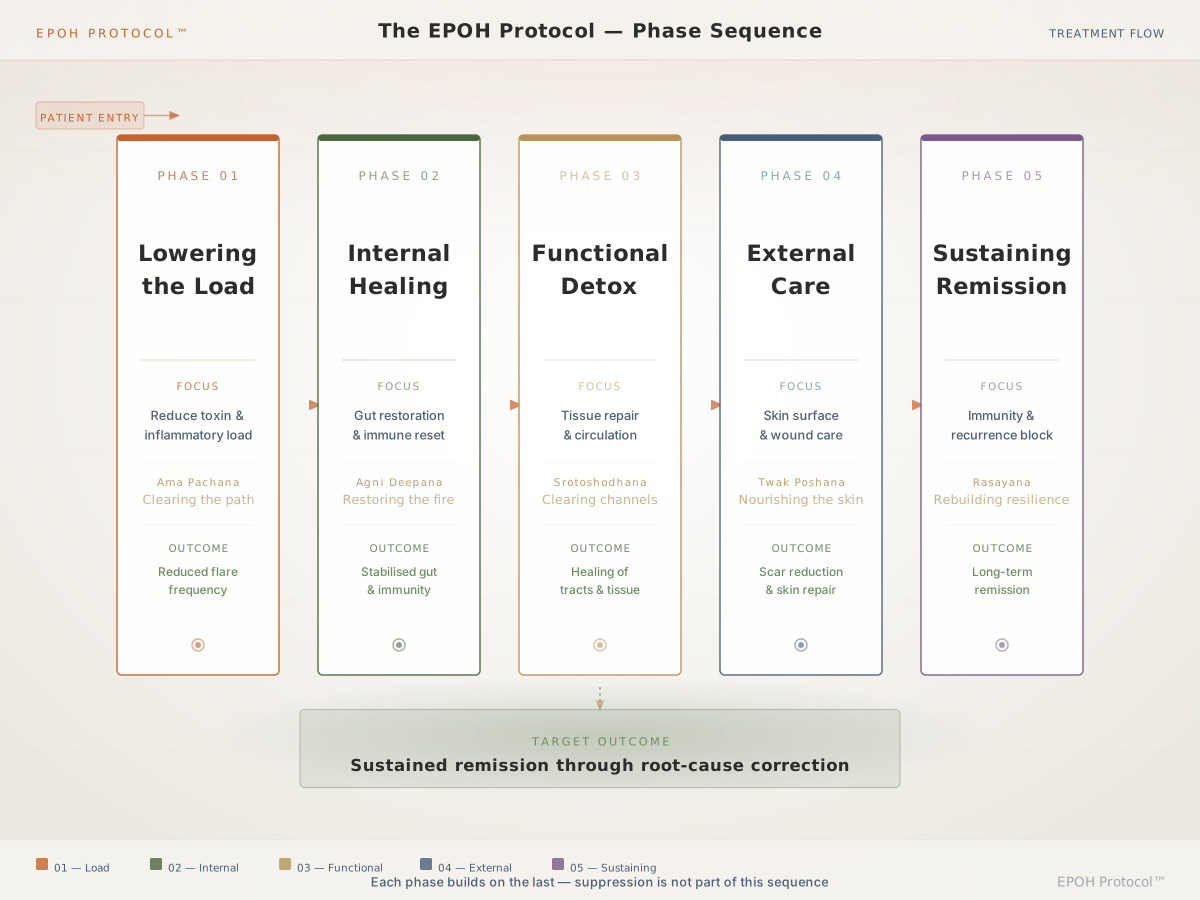
The formulations move through five phases in a fixed order.
L — Lowering Inflammatory Load. Reducing the inflammatory burden the misdirected immune response is operating inside.
I — Internal Healing and Gut Repair. Rebuilding the internal terrain that has to carry the clearing work later.
F — Functional Detox. Mobilising and clearing accumulated load.
E — External Care. Home-applied topicals for the skin surface, intact blisters, and open erosions.
S — Sustaining Remission. A low-intensity maintenance set once the disease is quiet.
The order matters more than anything else on this page.
Why Clearance Does Not Come First
Every instinct says the opposite. If there is accumulated load, clear it out, then rebuild.
That instinct is backwards here, and acting on it makes blistering disease worse.
Phase 3 mobilises load. Run it before L and I are stable and you have asked the body to shift more than it can currently clear. The mobilised burden circulates instead of leaving. In an immune system that is already misdirected — already producing antibodies against the adhesion proteins that hold your skin together — that circulating burden does not sit quietly. It feeds the process it was meant to relieve.
This explains a pattern that took years to read correctly. People arriving after detox-first regimens, done alone or elsewhere in good faith, were frequently worse than before they started. The obvious conclusion was that clearance work is simply wrong in autoimmune blistering disease. That conclusion was wrong. The clearance work was not the error. The timing was. It is the third phase, not the first.
Which means that for the first several weeks you will take formulations whose entire purpose is to make the later work survivable, and you will not be able to see them doing it. That is the design. It is not a stalling tactic.
Days 1 to 14: Assessment, Then the First Box
Assessment is remote, and it is longer than you expect.
We want the biopsy report and the direct immunofluorescence result — DIF is the test that actually establishes an autoimmune blistering diagnosis, and a clinical impression is not a substitute for it. We want any ELISA titres your dermatologist has run: BP180 and BP230 for pemphigoid, desmoglein 1 and desmoglein 3 for pemphigus. If you do not have these, get them before starting. A six-month protocol built on a guess about which disease you have is worthless.
We also want the unglamorous history. Every drug you take. The steroid dose, and how long you have been on it. What your gut has been doing for the last decade. What your sleep is. What was happening in the six months before the first lesion appeared.
Then a box arrives. Inside it: the Phase 1 oral set, and — if you have open skin — an External Care topical from day one, because erosions do not wait for a phase to finish.
What you should feel in week one: not much. Some people notice sleep or digestion shifting. Many notice nothing at all.
Weeks 2 to 8: The Internal Stretch
This is the part nobody wants to hear.
For roughly the first four to eight weeks, the work is internal and no visible change in the skin is expected. New blisters will continue to appear. Your itch may not move. The mirror will show you what it showed you in week one.
That is not the protocol failing. It is the protocol doing the only thing that makes the rest of it possible.
What we ask you to watch is not the mirror but the diary — an actual written record, kept daily. New blister count. Itch on a zero to ten scale. How many days a marked erosion takes to close.
For pemphigoid especially, the itch is the leading indicator. It often precedes blisters by months at the onset of the disease, which is why so many people are treated for eczema or scabies before anyone reaches a biopsy, and it frequently moves before the blisters do on the way back down as well.
If anything is going to move first, it will be one of those numbers, and it will move by an amount you will not notice without the written record. That is the entire reason we insist on the diary.
Weeks 3 to 6: The Point Where People Quit
There is a specific window where this protocol loses people, and it is predictable enough that we can give you the dates.
Weeks one and two carry the relief of having a plan. By week three that relief has worn off, the plan has produced nothing you can see, and a new thought arrives: I have been taken in.
We would rather you meet that thought here, on this page, than alone at two in the morning in week five. It is not an irrational thought. Given the evidence available to you in week five — no visible change — it is the correct inference. The only reason not to act on it is that no visible change at week five is exactly what the design predicts, and it is equally true of the people this will help and the people it will not.
What would legitimately concern us at week six is a different question, and the difference matters. Not "am I better yet" — nobody is asking you to be better yet. The question is "is anything moving at all". Itch trend. New blisters per week. Erosion healing time. If every one of those is flat or worse at week six on good adherence, that is information, and we act on it rather than counselling patience.
Weeks 8 to 12: The First Real Read
Somewhere around week eight to twelve, the disease begins — if it is going to — to change. Months two to four is the honest window in which surface change appears in people who respond.
The order of improvement is usually this. Itch settles first. Then the rate of new blister formation slows. Then erosions start closing faster than they were. Total lesion burden — the number of things visible on your skin at any given moment — is the last thing to move, because it is a stock rather than a flow, and it draws down slowly even after new production has fallen.
People misread this constantly. They see the same number of lesions at week ten as at week eight and conclude nothing has happened, when what has actually happened is that those are six old lesions healing rather than six new ones arriving. Only the diary separates those two worlds.
Week twelve is a decision gate, not a milestone. Three permitted outcomes: continue, modify, or stop. We will say stop if that is what the numbers show.
What Does Not Happen in Ninety Days
Remission is not assessed at ninety days. Sustained remission is judged from month eight onward, and anyone offering you a verdict at three months is selling something. A relapsing disease is quiet often enough that three quiet weeks mean very little.
Your steroids are also not tapered by us — not at ninety days, not ever. Your dermatologist owns every decision about prednisolone, rituximab, azathioprine, mycophenolate, or dapsone. We do not adjust them, we do not advise you to adjust them, and if you reduce a dose on your own you risk adrenal insufficiency and a rebound flare, which in pemphigus can be dangerous. If our work makes your disease quiet enough that your dermatologist chooses to raise the subject of a taper, that is the outcome we want. The decision remains entirely theirs.
What Ends the Ninety Days Early
Contact your dermatologist, or emergency care, the same day if blistering spreads rapidly across new areas; if an erosion looks infected, with spreading redness, pus, odour, fever, or pain out of proportion; if you develop mouth or throat erosions that stop you eating or drinking; or if you have any eye symptom at all.
That last one is worth its own sentence. Grittiness, redness, or a foreign-body sensation in someone with a blistering disease can mean mucous membrane pemphigoid affecting the conjunctiva. That scars, and conjunctival scarring threatens sight. It is an ophthalmology emergency today, not a thing to raise at your next review.
Nothing in a courier box is an alternative to any of the above.
The Honest Summary
Two weeks of assessment. Six weeks of taking things that do nothing you can see. A window around weeks three to six where you will want to stop. A first real read between weeks eight and twelve, where the leading indicators move before the mirror does. And a gate at week twelve where "this is not working" is a permitted answer.
That is the whole of the first ninety days. If it sounds like less than you were hoping for, you are reading it correctly, and you are better off knowing now than in month five.
Medical disclaimer. This article is for general information and is not a substitute for personalised medical advice. Ayurvedic treatment at EliteAyurveda™ is individualised following clinical assessment. Do not start, stop or alter any prescribed medication without consulting your treating physician.

