


Part of the Crohn's Disease Knowledge Library
Two patients, same diagnosis, similar scope findings.
The first is in their mid-twenties. Symptoms began after a severe gut infection abroad; every flare since has followed a course of antibiotics or a bad meal. Weight is falling. Bloating, urgency, and a gut that has never been the same since that one week.
The second is in their forties. Flares track quarter-end at work with an accuracy that would be funny if it were not ruinous. Sleep has been broken for years. There is psoriasis in the background, and a father with rheumatoid arthritis.
Same disease name. Completely different engines. If both received the same formulation, at least one of them is being treated for someone else's disease.
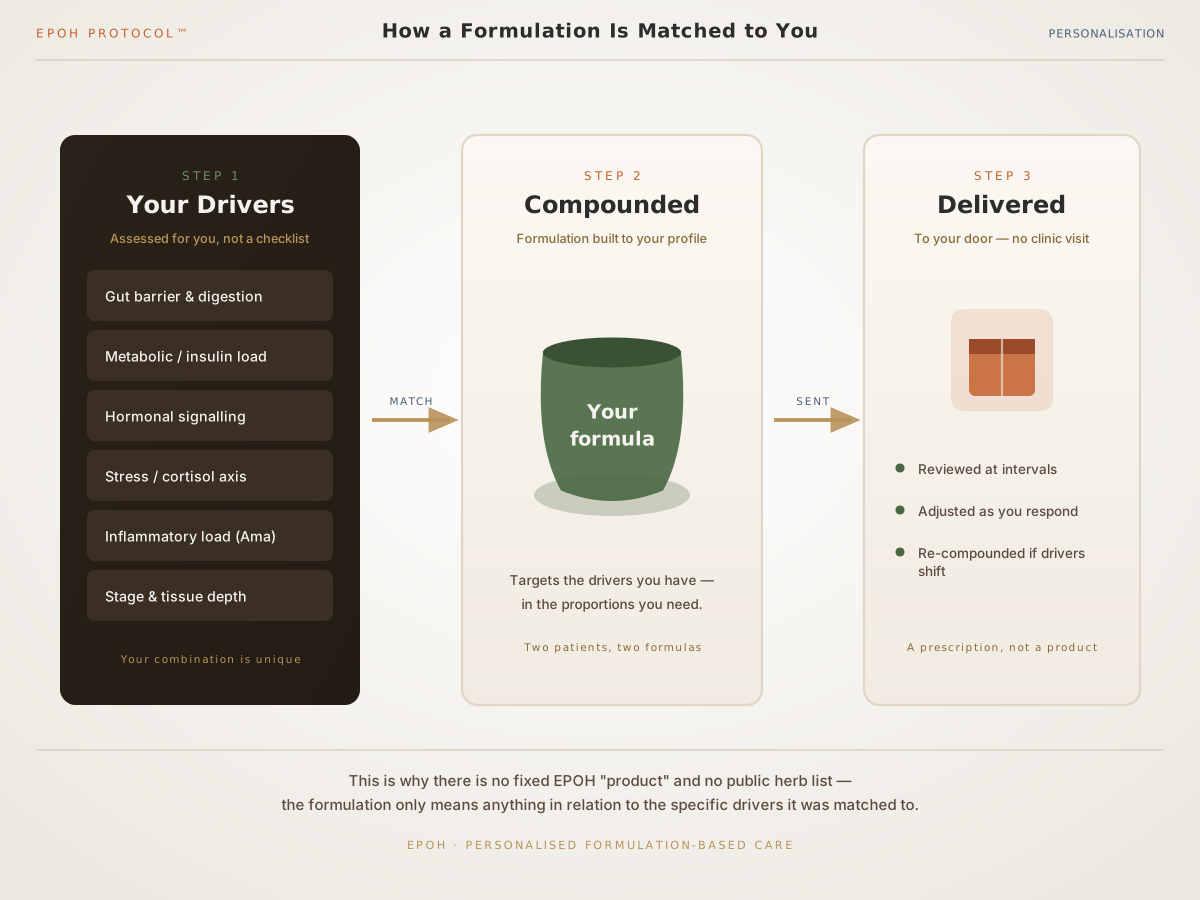
That is the whole argument for driver-profile compounding, and it is also the reason this website will never publish a herb list.
What a "driver" is
A driver is not your diagnosis and it is not your symptoms. It is the mechanism that keeps the disease running. Two people can have identical inflammation in identical segments of bowel for entirely different reasons, and the reason determines what the compound has to do.
The five drivers
Gut
The most obvious one, and often overestimated because it is visible. Signals: onset after infection or antibiotics, food-triggered flares, marked bloating, evidence of disturbed gut flora, malabsorption, food intolerances that keep multiplying.
When the gut driver dominates, the compound weights heavily toward lining integrity and microbial environment.
Immune
An immune system that has lost the ability to tell your own tissue from a threat. Signals: family history of autoimmune disease, other autoimmune conditions running alongside, joint or skin involvement, flares that arrive with no dietary provocation at all, steroid-responsive disease.
Here the compound weights toward immune recalibration, because starving the gut driver of triggers will not help a system that is attacking without one.
Metabolic
Signals: insulin resistance, fatty liver, difficulty with weight in either direction, poor energy regulation, disordered lipid profile.
A metabolic driver quietly raises the inflammatory floor. Ignore it and every other phase of treatment works uphill.
Hormonal
Signals: flares that track the menstrual cycle, thyroid disease, symptoms that changed markedly after pregnancy or perimenopause, adrenal exhaustion patterns.
Hormonal signalling and gut inflammation talk to each other constantly. When this driver is loud, timing and dosing change, not just composition.
Stress and cortisol
The one patients apologise for mentioning, and the one that is most often dominant. Signals: flares that track deadlines and conflict rather than food, chronically broken sleep, gut symptoms that ease on holiday and return within days of getting back, a nervous system that has been in a state of alert for years.
This is a physiological driver, not a psychological excuse. Sustained cortisol dysregulation reshapes gut permeability and immune behaviour directly.
Most patients have two or three drivers active, with one dominant. The profile is a weighting, not a label.
How your profile is built
From the consultation — your history, disease course, prior treatments and how each ended, symptom pattern, and the pattern around the symptoms — combined with your reports and, once treatment begins, your symptom log.
It is not a quiz and there is no score. It is a clinical assessment, and it is why the consultation asks about your job and your sleep when you expected to be asked only about your bowel.
From profile to compound
Your formulation is determined along two axes at once.
Axis one: which phase you are in. That decides the category.
- Phase 1 — Lowering the Load: oral Inflammatory Load Reduction formulations.
- Phase 2 — Internal Healing: oral Internal Correction formulations.
- Phase 3 — Functional Clearance: oral formulations supporting internal clearance. Not a procedure.
- Phase 4 — External Care: topical External Tissue Repair preparations, applied at home.
- Phase 5 — Sustaining Remission: tapered oral Remission Maintenance formulations.
Axis two: which drivers are loudest. That decides the composition — what goes in, in what ratio, how it is processed, at what dose, and at what time relative to food and to the medication you are already taking.
So two patients both in Phase 1 receive two different Phase 1 compounds. The phase is shared. The compound is not.
Why we do not publish a herb list
Patients ask, constantly and reasonably: what is in it?
Here is the honest answer to why there is no ingredient list on this site.
There is no fixed recipe to publish. A published list would announce a formula. Announcing a formula would tell you something untrue — that a single fixed preparation is the Crohn's treatment, when the entire clinical logic is that it is not. Whatever we listed would be wrong for most people reading it.
A named ingredient invites self-prescription. Someone reads a plant name, buys it from a marketplace at an arbitrary dose and purity, and takes it alongside a biologic and an immunosuppressant with no idea what it does to their liver enzymes or their drug levels. We are not willing to be the origin of that.
The same plant material does different things at different ratios, different processing and different pairings. Composition is not a shopping list; it is proportion, preparation and combination. Two compounds sharing every ingredient can do opposite things.
Phase changes what is appropriate. Material that is right in Phase 2 can be actively wrong in Phase 1. Sequence is not decoration — running clearance before load and healing are stable mobilises internal load faster than the system can clear it, and makes people worse. An ingredient list flattens all of that into a bag of names.
Your compound changes anyway. What is right for you in month two is not what is right in month seven. A static list could not describe your own treatment, let alone anybody else's.
So we publish the category and the phase — what the compound belongs to and what it is doing — and we disclose the specifics to you, directly, as our patient. You will always know what you are taking, why, at what dose, and how it interacts with your existing medication. Your practitioner will tell you at every phase change. We disclose to patients. We do not publish recipes to the internet.
Your compound is not static
Formulations are re-compounded at phase transitions, and adjusted in between when your response asks for it — a marker that moves the wrong way, a flare pattern that shifts, a plateau that arrives on schedule, a medication your gastroenterologist changes.
This is why the follow-up cadence exists, and why we would rather you message us early than wait for the next scheduled call.
What this means for you, practically
- There is no off-the-shelf Crohn's pack, and nothing you can buy from us without a consultation.
- Your existing medication is factored into the compound, not ignored by it. You keep taking it.
- Adjustments require a message, not a flight.
- If your profile shifts, so does your formulation.
Your next step
Book a video consultation. We build the driver profile, and your formulations are compounded to it and couriered to your door, in India or internationally. Follow-ups run by video or WhatsApp.
For most patients there is no procedure, no in-clinic therapy and no clinic visit.
Medical disclaimer. This article is for general information and is not a substitute for personalised medical advice. Ayurvedic treatment at EliteAyurveda™ is individualised following clinical assessment. Do not start, stop or alter any prescribed medication without consulting your treating physician.

