


Part of the Crohn's Disease Knowledge Library
You have a gastroenterologist for your bowel. A dermatologist for the lesions on your shins or in your armpits. A rheumatologist for the joints. Possibly an ophthalmologist for the eye that went red and light-sensitive last winter.
Four specialists. Four sets of notes. One disease.
The extraintestinal manifestations of Crohn's are not complications that wandered off-target. They are the clearest evidence available that Crohn's was never a local bowel problem in the first place. Understanding this changes what you should expect from a treatment model, because a systemic disease treated only where it is loudest will keep speaking somewhere else.
What "extraintestinal" actually means
It means the same immune process, expressed in a different tissue. Some of these manifestations track closely with bowel activity, rising and falling with your gut. Others run on their own schedule and can appear when your colonoscopy looks reassuring. That second group is the one that convinces people, because a skin ulcer that flares while the bowel is quiet cannot be explained as a bowel problem with side effects.
Skin
Erythema nodosum. Tender, raised, warm red nodules, most often on the shins. They are painful to touch, they do not ulcerate, and they typically heal like a deep bruise. Erythema nodosum usually parallels bowel activity, which makes it a reasonably honest external readout of what your gut is doing.
Pyoderma gangrenosum. This is the one that gets mishandled. It starts as a pustule or nodule and breaks down into an ulcer with a violaceous, undermined, overhanging edge. Two things you must know. First, it frequently runs independently of bowel activity, so a quiet gut does not protect you. Second, it demonstrates pathergy: injury to the skin, including surgical debridement, can make it dramatically worse. If a clinician who does not know your diagnosis proposes to cut it back, tell them it may be pyoderma gangrenosum and ask for a dermatology opinion first.
Oral involvement. Recurrent aphthous ulceration is common. Some patients get a cobblestoned or fissured buccal mucosa, and lip swelling with granulomatous change is a recognised, under-diagnosed presentation.
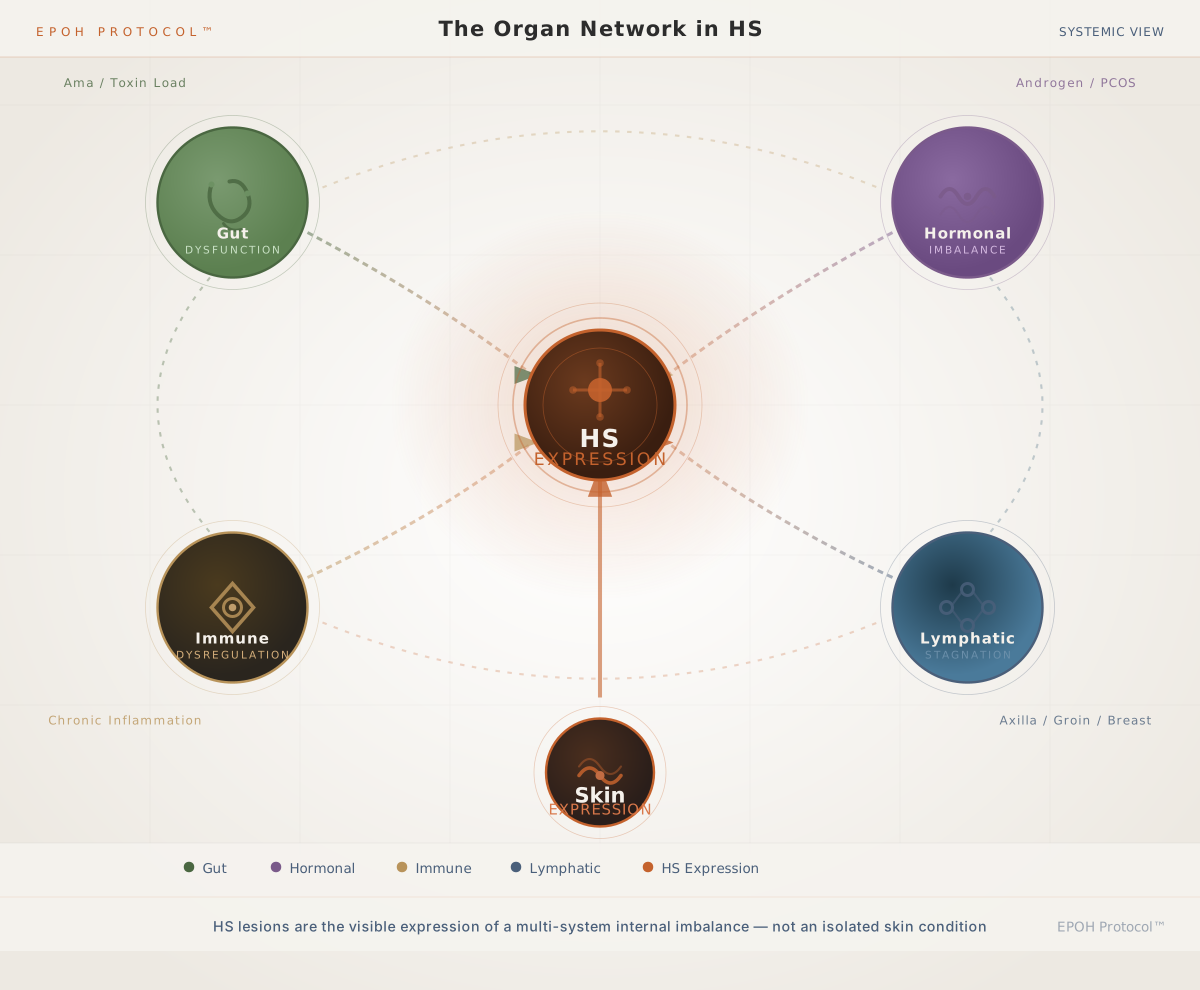
Hidradenitis suppurativa. Painful nodules, abscesses, draining sinus tracts and rope-like scarring in the armpits, groin, under the breasts and between the buttocks. It co-occurs with Crohn's far more often than chance allows, and the reason is biological rather than coincidental: both involve dysregulated innate immune signalling, both centre on follicular occlusion and sinus tract formation, both are strongly aggravated by smoking, and both respond to overlapping immune pathways.
There is a genuine diagnostic trap here. Perianal Crohn's with fistulae and perianal hidradenitis suppurativa can look nearly identical from the outside, and the distinction matters enormously for treatment. If you have both diagnoses, or one diagnosis and a suspicion of the other, that needs to be said out loud at assessment. EliteAyurveda™ treats hidradenitis suppurativa with the same driver-based protocol described below, which is not a marketing coincidence. It is the same underlying model of systemic immune and barrier failure expressed in a different tissue.
Joints
The arthropathies of Crohn's fall into recognisable groups.
Peripheral, oligoarticular type. A few large joints, typically knees and ankles, often asymmetric, flaring in step with bowel activity and settling as the gut settles.
Peripheral, polyarticular type. Many joints, often small ones in the hands, more symmetric, more persistent, and largely independent of what the bowel is doing. Patients in bowel remission are routinely told their joint pain is unrelated. It is not.
Axial disease. Sacroiliitis and ankylosing spondylitis, associated with HLA-B27. The tell is the character of the back pain, and it is worth learning: inflammatory back pain is worse with rest, worse in the second half of the night, comes with morning stiffness lasting longer than half an hour, and improves with movement. Mechanical back pain does the opposite. If your back is stiffest when you wake and loosens as you move, that is not a mattress problem.
Axial disease can progress structurally while the bowel is quiet, which is precisely why "my gut is fine now" is not a reason to ignore it.
Eyes
Episcleritis. Aching redness, often patchy, generally not sight-threatening, and it tends to track with bowel activity.
Uveitis or iritis. Genuine eye pain, sensitivity to light, blurred vision, sometimes a small or irregular pupil. This one is different in kind: it is sight-threatening and it needs same-day ophthalmology. Do not wait to see whether it settles. Do not treat it as a bad conjunctivitis. If you have Crohn's and a painful, light-sensitive eye, that is an emergency department or an urgent ophthalmology appointment today.
The rest of the systemic picture
Also on the list: primary sclerosing cholangitis affecting the bile ducts; anaemia from blood loss, from iron deficiency, and from B12 deficiency when the terminal ileum is involved or resected; metabolic bone loss driven by inflammation, malabsorption and steroid exposure; kidney stones; and an increased risk of venous thromboembolism during an active flare, which is the reason a swollen calf or sudden breathlessness in a flare is never something to sit on.
Why this is the strongest argument that Crohn's is systemic
The mechanism runs in one direction, and it starts at the barrier.
The intestinal epithelium fails. Bacterial and dietary antigen crosses into tissue that was never meant to see it. The immune system activates, and that activation is not confined to the gut wall: immune cells primed in gut-associated lymphoid tissue enter the circulation and home to skin, to synovium, to the uveal tract. Circulating inflammatory mediators do the rest.
The bowel is where the disease is loudest. It is not where the disease is contained.
Which means a treatment model that addresses only the bowel is treating the noise.
What a systemic disease demands of a treatment model
The EPOH protocol assesses five drivers in every case: gut health, immune regulation, hormonal balance, metabolic function, and stress and cortisol. In Crohn's, gut barrier failure and immune dysregulation are primary. The extraintestinal manifestations are what the immune driver looks like when it is expressed outside the abdomen.
Treatment follows the EPOH phase sequence, and the order is clinically non-negotiable:
- Phase 1, Lowering the Load (roughly 4 to 8 weeks): oral formulations reducing accumulated inflammatory load (Ama).
- Phase 2, Internal Healing (roughly 8 to 16 weeks): oral formulations for gut lining integrity, microbiome repair and immune recalibration. This is where the barrier failure that feeds every extraintestinal lesion is actually addressed.
- Phase 3, Functional Clearance (roughly 6 to 12 weeks, often concurrent with Phase 2): oral formulations supporting internal clearance. Running this before L and I are stable mobilises load faster than the system can clear it and makes patients worse.
- Phase 4, External Tissue Repair (topical, applied by you at home, running through the I and F phases): this is what addresses the skin lesion itself, and it is deliberately positioned as support rather than solution. A skin manifestation driven by systemic immune load will not resolve topically alone, and any clinic telling you otherwise is treating the shin and ignoring the ileum.
- Phase 5, Sustaining Remission (roughly 6 to 12 months): tapered oral formulations, with monitoring.
Formulations are compounded to your individual driver profile; there is no fixed recipe. For most patients there is no procedure and no clinic visit. Consultation is by video or WhatsApp, and formulations are couriered to you.
Keep taking your prescribed medication. Several of these manifestations, particularly uveitis and pyoderma gangrenosum, are actively held in check by conventional agents, and stopping abruptly is dangerous. EPOH begins alongside your existing treatment; any reduction is gradual, structured, and made in review with your prescribing physician.
Where there is advanced structural change, whether fibrotic stricturing in the bowel or established joint fusion, full remission may not be achievable. We would rather say that at the start.
If your Crohn's is speaking in more than one place
If you have been carrying a skin diagnosis and a joint diagnosis and a bowel diagnosis as though they were three unrelated pieces of bad luck, they are not.
Return to the Crohn's Disease hub for the rest of this cluster, or book a consultation by video or WhatsApp. If hidradenitis suppurativa is part of your picture, say so at assessment: it changes the driver profile, and it is a condition we treat. Formulations are couriered to your home; for most patients no clinic visit is required.
Medical disclaimer. This article is for general information and is not a substitute for personalised medical advice. Ayurvedic treatment at EliteAyurveda™ is individualised following clinical assessment. Do not start, stop or alter any prescribed medication without consulting your treating physician.

