


Part of the Crohn's Disease Knowledge Library
Somewhere in your endoscopy report there is a line that probably confused you more than it explained. Segmental involvement. Skip lesions. Cobblestoning in the terminal ileum with normal intervening mucosa. Translated into plain language: one stretch of your bowel is ulcerated and raw, and the stretch immediately beside it looks untouched.
If you have spent nights running back through everything you ate, trying to work out what you did to earn the bad patch, that report is quietly telling you something you were probably never told out loud. Whatever is damaging your gut is not arriving through your gut.
What the pattern actually is
Crohn's inflames the digestive tract discontinuously. It can appear anywhere from mouth to anus, it favours the terminal ileum and the ileocaecal junction, and it does not advance as a single front. It appears as islands. Between the islands, tissue can be genuinely normal — normal on the camera, normal under the microscope.
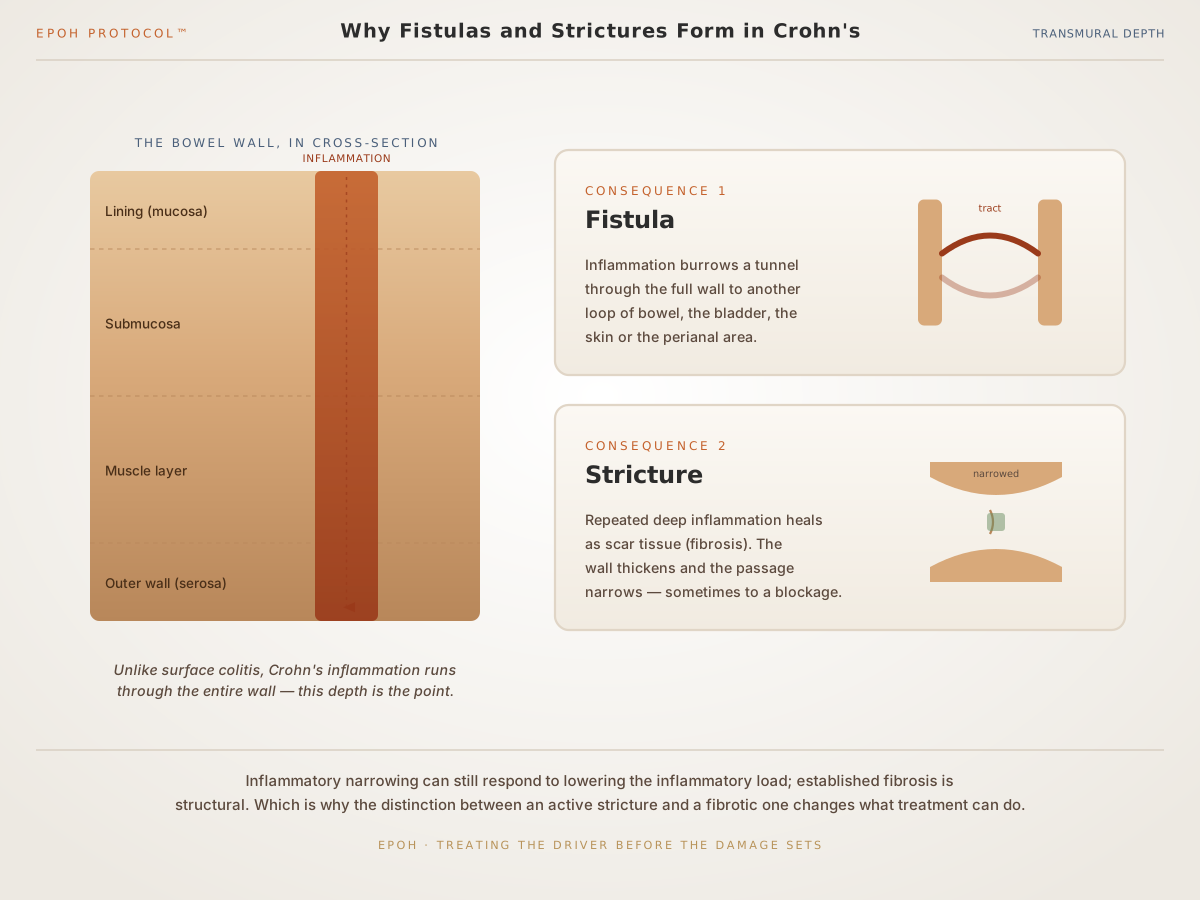
The second feature is depth. Crohn's inflammation is transmural: it runs through the full thickness of the bowel wall rather than sitting on the inner lining. Mucosa, submucosa, muscle layer, outer serosa — all of it can be involved at once.
This is what separates Crohn's from ulcerative colitis mechanically. Ulcerative colitis is continuous and superficial: it starts at the rectum, moves upward without gaps, and largely stays in the surface lining. Crohn's is patchy and full-thickness — which is precisely why Crohn's produces fistulas, abscesses and strictures, and ulcerative colitis mostly does not.
The question almost nobody asks you to sit with
Why not everywhere?
If your bowel were being injured by something in contact with its surface — a food, an irritant, a "wrong" diet, stool sitting too long, acid, spice — then the injury would have to be continuous. Everything that touches the ulcerated segment also touches the healthy segment one centimetre further along. The same stream of food, bile, enzymes and bacteria passes over both, in the same order, at the same time.
Contact injury cannot skip.
So contact is not the mechanism. The damage is not being painted onto the inside of the tube. It is being delivered from within the wall — by immune cells that have lost their sense of proportion, by inflammatory signalling that no longer switches off, by a barrier that has stopped separating the gut contents from the immune system underneath it. And it lands wherever the tissue is least able to withstand it.
Skip lesions are the fingerprint of a systemic process expressing itself at locally vulnerable sites. The disease is everywhere. The damage is only where the tissue gives way first.
Why your gut chose those particular places
The sites Crohn's favours are not random. They share characteristics.
Immune density. The terminal ileum is among the most immunologically busy stretches of tissue in the body. It is dense with organised lymphoid tissue whose job is to sample gut contents and decide, continuously, what is food and what is threat. When immune regulation is failing, the tissue doing the most immune work absorbs the most damage.
Bacterial load and barrier stress. Microbial density rises sharply as you move down the small bowel into the caecum. A barrier that is already leaking fails first where the pressure on it is greatest.
Blood supply and mechanical stress. Junctions, narrow points and bends carry more mechanical load and sit at watershed zones of blood supply. Tissue with less reserve breaks down earlier.
Previous injury. Segments that have been inflamed before, or resected and rejoined before, are structurally weaker and immunologically primed — which is why post-surgical recurrence so often appears exactly at the new join.
Depth is the other half of the story
Because the inflammation is full-thickness, it does not stay a lining problem. It behaves like a wound tunnelling through a wall:
- It can burrow outward, creating a tract to another loop of bowel, to the bladder, to the vagina, or to the skin — a fistula.
- It can wall itself off into a collection of pus — an abscess.
- It can heal the way any deep wound heals: with scar. Scar in a tube narrows the tube — a stricture.
Every serious structural complication of Crohn's is downstream of these two facts: it is patchy, and it is deep.
What the pattern rules out — and what it points at
It rules out the idea that Crohn's is a food-contact injury, which is why elimination diets alone rarely hold the line. Food can absolutely provoke an already inflamed segment. Food is not the reason the segment became inflamed. And it rules out the idea that this is a local disease of one damaged piece of bowel — a local problem does not have a distribution logic.
What it points at is a body-wide failure across two systems that are functionally one: the gut barrier and the immune response sitting behind it. In the EPOH framework we assess five drivers — gut health, hormonal balance, immune regulation, metabolic function, and stress and cortisol — and in Crohn's, gut barrier failure and immune dysregulation are consistently primary. The other three are rarely absent, but they are usually amplifiers rather than originators.
Why the treatments you have already tried have not held
This is a structural observation, not a criticism of the doctors who prescribed them. Each of these does exactly what it is designed to do.
Antibiotics reduce bacterial load and can genuinely calm an acute flare. They also disrupt the microbial community that is itself one of the drivers of barrier integrity. The relief is real; the ground underneath it is often left less stable.
Steroids and biologics suppress the inflammatory signalling doing the damage. They are frequently necessary and sometimes lifesaving. But suppressing a misfiring signal is not the same as correcting why it misfires. Withdraw the suppression while the driver is untouched, and the signal returns — the experience most people with Crohn's describe as "it always comes back."
Surgery removes the consequence, not the environment that produced it. Hence recurrence at the anastomosis: a new vulnerable site, same disease, same logic.
Treating the driver, not the patch
EPOH runs on a fixed clinical sequence, and the order is not negotiable.
L — Lowering the Load (4–8 weeks). Oral Inflammatory Load Reduction formulations reduce the accumulated inflammatory load (Ama) that keeps immune signalling in a permanently triggered state. Even in a gut condition, this comes first. Attempting to rebuild a barrier while systemic inflammatory load is still high is building on wet ground.
I — Internal Healing (8–16 weeks). Oral Internal Correction formulations work on gut lining integrity, microbiome repair and immune recalibration. This is where skip lesions are actually addressed — not patch by patch, but by restoring the barrier and the immune tolerance that made the patches possible.
F — Functional Detox (6–12 weeks, often overlapping with I). Oral Functional Clearance formulations support internal clearance. This is a formulation phase, not a procedure. Run before L and I are stable, it mobilises load faster than the system can clear it and makes people worse — which is exactly why the sequence is fixed.
E — External Care (ongoing through I and F). Topical External Tissue Repair formulations, applied by you, at home.
S — Sustaining Remission (6–12 months). Remission Maintenance formulations, tapered, with monitoring.
Every formulation is compounded to your individual driver profile. There is no fixed recipe, which is why no honest clinician can hand you a constituent list before assessing you. For most patients there is no procedure and no clinic visit. Consultation is by video or WhatsApp; formulations are couriered to your door.
What honest progress looks like
Recovery Stage 1, the Internal Shift, falls in weeks 1–4 — and it is mostly internal. Energy, appetite, sleep and inflammatory markers often move before the bowel does. Then, somewhere in weeks 3–6, most people hit the Partial Improvement Plateau, where progress appears to stall. This is the point where patients quit. It is not failure. It is the signal that Phase 1 has done its work and Phase 2 needs to begin.
Reduced Frequency follows across months 2–4. Reduced Severity across months 4–8. Stable Remission from month 8 onward.
And the honest caveat: if you already have advanced structural change — established fibrotic stricturing, extensive prior resection, severe fixed damage — full remission may not be achievable. Inflammation can be reversed. Scar cannot.
You do not stop your current medication to begin this. You begin while continuing it, and any reduction is reviewed with your prescribing physician and tapered gradually, on evidence.
Where to go from here
The patchiness of your disease is not a mystery to be solved with a stricter diet. It is a clue, and it points inward.
Read the rest of the Crohn's disease hub for how this same logic explains fistulas, strictures, fatigue and malabsorption. If you want your own case assessed, a consultation can be booked by video or WhatsApp, your driver profile mapped, and your formulations couriered to you. You will not need to travel, and you will not need to enter a clinic.
Medical disclaimer. This article is for general information and is not a substitute for personalised medical advice. Ayurvedic treatment at EliteAyurveda™ is individualised following clinical assessment. Do not start, stop or alter any prescribed medication without consulting your treating physician.

