


Part of the Pemphigus & Bullous Disorders Knowledge Library
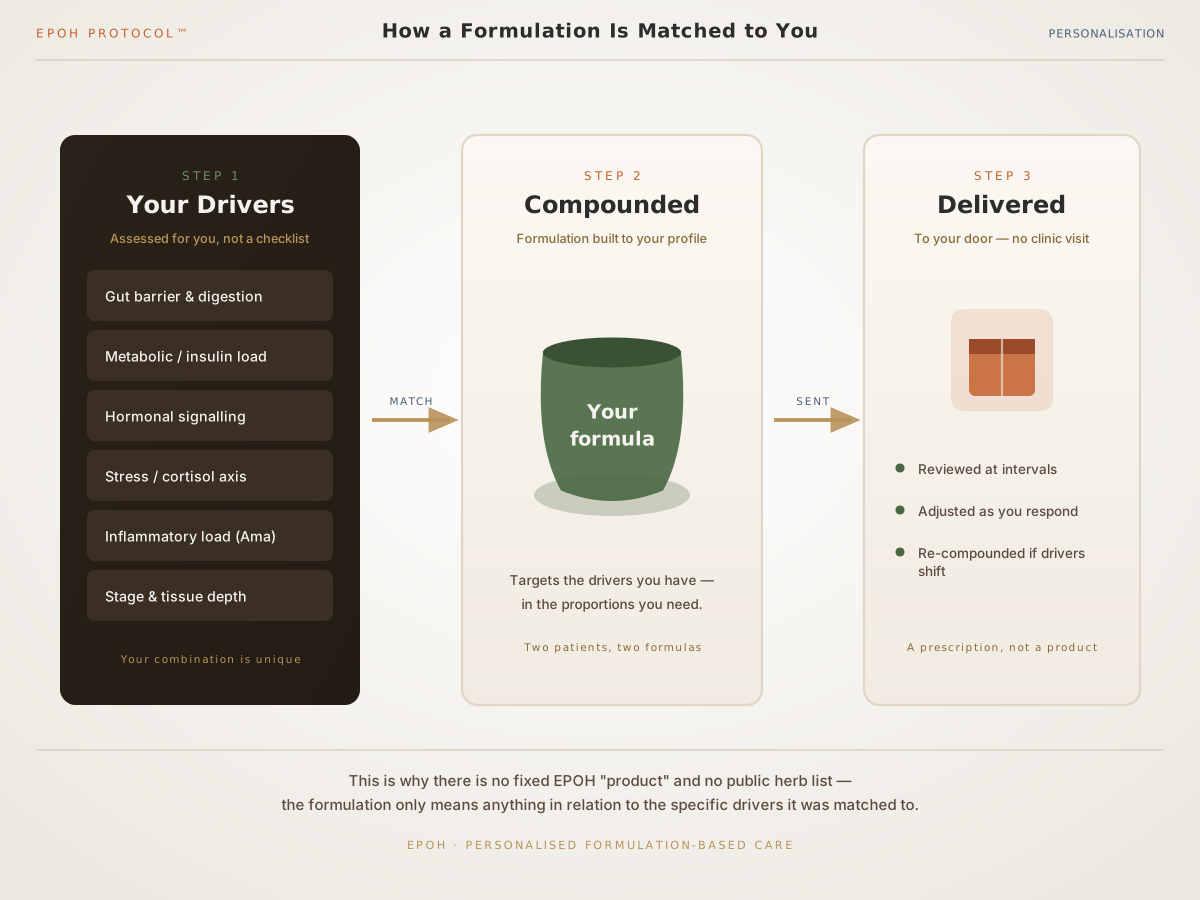
What Arrives
A box. Inside it: oral compounds, and topical preparations that you apply yourself, at home.
That is the entirety of EPOH. There is no procedure attached to it. There is no in-clinic therapy, no treatment room, and no clinic visit for most patients.
For an autoimmune blistering disease, that is not a small point. Pemphigoid is largely a disease of the elderly, often frail, often with skin that tears under the friction of simply being moved. Pemphigus vulgaris frequently starts in the mouth, and a person who cannot eat without pain does not need to be travelling. A protocol that requires attendance imposes a real cost on exactly the patients least able to bear it. This one does not require it, because there is nothing to attend.
The Categories
The formulations are organised by the EPOH phase they serve. What you receive changes as the phase changes. What you take in month six is not what you took in month one.
Phase 1 — Lowering Inflammatory Load. Oral compounds whose task is to bring down the inflammatory burden the misdirected immune response is operating inside. This is the opening phase, and it is invisible from the outside. Nothing about your skin is expected to change while it does its work.
Phase 2 — Internal Healing and Gut Repair. Oral compounds directed at the internal terrain: digestion, gut integrity, absorption, and the system that will have to carry the clearance work in the next phase. Skip this and what follows does harm.
Phase 3 — Functional Detox. Clearance-support compounds, oral, introduced only once L and I are stable. Run early, this phase mobilises load faster than the body can clear it, and it makes blistering disease worse. That is the single most important sentence in this article, and it is the explanation for why people who arrive here after a detox-first regimen are so often in a flare. The approach was not wrong. The sequence was.
Phase 4 — External Care. Home-applied topicals: erosion care, barrier support for the fragile skin around healing lesions, management of the post-blister pigmentation that pemphigoid leaves behind. Anyone with open skin receives these from day one, whatever internal phase they are in, because open skin does not wait.
Phase 5 — Sustaining Remission. A low-intensity maintenance set. Fewer compounds, lower doses, begun only once the disease has been quiet long enough for the word to mean anything — which is month eight at the earliest.
Now the Question You Actually Came For
You want to know what is in them.
We do not publish the herbs. Not on this page, and not anywhere on this site. You are entitled to find that irritating, and if it makes you trust us less, that is a reasonable response to a real cost. So here is the case, and you can weigh it yourself.
One: there is no fixed recipe, so any published list would misrepresent what you will receive. The set is built against your disease, your phase, your comorbidities and the drugs you are already on, and it is revised as you move through the sequence. Publishing "the formulation" would imply a static product that does not exist. What was printed on this page would not be what is in your box.
Two: a named herb is an invitation to self-medicate, and in this disease that is dangerous. Publish a name and people will source it themselves and take it unsupervised — at the wrong phase, in the wrong dose, alongside an immunosuppressant with a narrow margin. Clearance-support compounds taken by someone whose inflammatory load has not first been brought down will not help them. They will make them worse. That is not a hypothetical; it is the most common way people arrive here already damaged.
Three: single-herb thinking is the wrong model of what this is. The question "which herb treats pemphigoid" has the same structure as "which vitamin treats heart disease". It assumes the intervention is a substance. The intervention is a sequence.
Four: a published recipe is a published product. We make and sell the formulations, so there is a commercial dimension to this as well, and it would be odd to pretend otherwise.
What We Will Tell You
Here is the distinction that matters, and it is not a small one.
We do not publish the composition. We do not withhold it from your doctor.
If your dermatologist, your pharmacist, or any other treating clinician wants the full composition of what you are taking in order to check for interactions, ask us and we will provide it to them. That is not a favour and it is not conditional on anything. A prescriber cannot reason safely about your liver enzymes, or about how an immunosuppressant is behaving, from an incomplete list — and if the incompleteness is our doing, then any harm that follows is our doing too.
So: tell your dermatologist you are taking this. Bring the list of what you take and when. Ask them what they want to monitor.
What These Are Not
They are not a replacement for your treatment. Not at any stage, not at month eight, not ever. Steroids, rituximab, azathioprine, mycophenolate, dapsone — these continue exactly as prescribed, and every decision about them belongs to the doctor who prescribed them. We do not taper anyone. We will not advise you to reduce a dose. Sudden steroid withdrawal risks adrenal insufficiency and a rebound flare, and a rebound flare in pemphigus is not a minor event.
They are not free of effects. A compound with no effect is not a medicine, and a compound with an effect can have an unwanted one. Nausea, loose stools, and changes in appetite happen. Tell us, and tell your dermatologist. Anyone selling you a treatment they describe as incapable of causing any adverse effect is telling you it does nothing, and has not noticed that they said so.
And they are not a cure. We do not promise one, and there is not one — for pemphigus or pemphigoid, from us or from anybody. What is on the table is sustained remission: fewer new blisters, less itch, faster healing, a disease under less pressure. It can relapse. We will not tell you it cannot.
The Honest Position
You are being asked to take compounds whose composition is not printed on the page, from a clinic you will never physically visit, for a disease that can be serious, while continuing everything your dermatologist has prescribed.
Stated plainly, that is an unusual thing to agree to, and you should feel the weight of it rather than have it smoothed over.
What we can offer against that weight is narrow and specific. The composition goes to your treating doctor on request. The protocol never asks you to stop anything. The decision gates are published in advance — week six, week twelve, month four — and the point at which we tell you it is not working is defined before you start rather than deferred indefinitely.
If that is not enough, then it is not enough, and you should not start.
Medical disclaimer. This article is for general information and is not a substitute for personalised medical advice. Ayurvedic treatment at EliteAyurveda™ is individualised following clinical assessment. Do not start, stop or alter any prescribed medication without consulting your treating physician.

