


Part of the Pemphigus & Bullous Disorders Knowledge Library
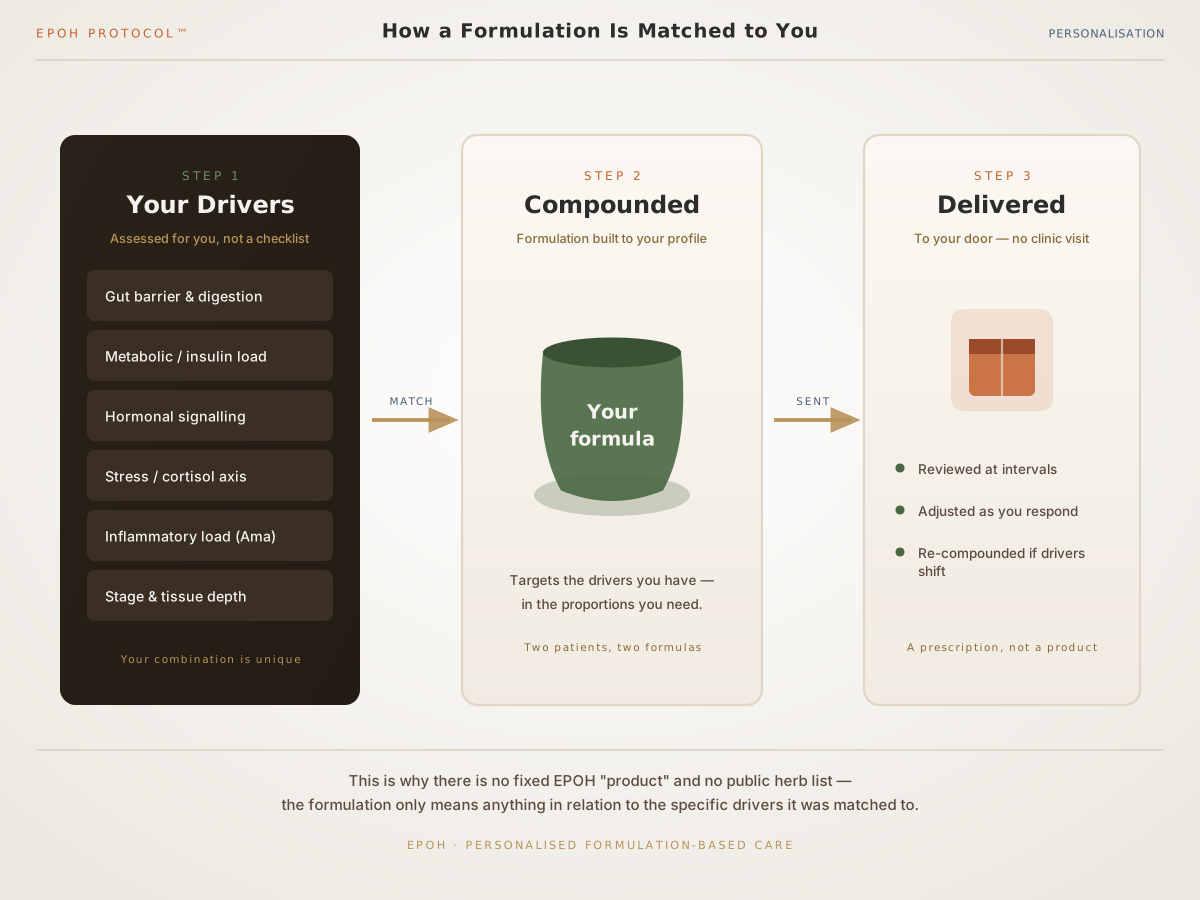
"Why won't you tell me which herbs you use?"
It is a fair question, asked by exactly the kind of patient we want — someone who reads, checks, and does not take a claim on trust.
There is a self-serving answer and there are clinical answers. We are going to give you the self-serving one first, because you would assume it anyway, and because a clinic that hides its commercial interest behind clinical language should not be trusted with your immune system.
The self-serving reason, stated plainly
These formulations took years to develop, and selling them is how the clinic stays open. We are not going to publish them. That is a commercial reason. It is a real one, and it is part of the answer.
Anyone who tells you their reasons for withholding a formula are purely clinical is not being straight with you. There. Now the rest.
1. A list of herbs is not a protocol
This is the substantive point, and it is not a dodge.
The active ingredient in EPOH is the sequence. It runs in five phases:
- Phase 1 — Lowering Inflammatory Load
- Phase 2 — Internal Healing & Gut Repair
- Phase 3 — Functional Detox & Immune Balancing
- Phase 4 — External Care & Local Reversal (topical preparations you apply at home)
- Phase 5 — Sustaining Remission
Now consider what a published ingredient list would actually do. Someone with pemphigus, frightened and out of money, would read it, buy the compounds online, and — like almost everybody — start with the ones aimed at detox, because that is what people believe Ayurveda is for.
And here is what happens then: Phase 3, applied before Phase 1 and Phase 2 are stable, mobilises internal load faster than the system can clear it — and the condition gets worse.
That is not a theoretical harm we invented to protect a trade secret. It is the single most common way people with blistering disease are hurt by Ayurveda. It is the mechanism behind the story we hear constantly: "I started an Ayurvedic cleanse and within a month I was flaring badly." Those people were right that they got worse. The timing was wrong, not the approach.
A published list is an instruction manual for exactly that mistake. We will not write one.
2. The formulations are not static, so a list would be wrong for most readers
They are selected and adjusted by phase and by presentation. Mucosa-dominant pemphigus vulgaris in a forty-five-year-old on rituximab is not the same clinical problem as itch-dominant bullous pemphigoid in an eighty-year-old with Parkinson's disease and a drawer full of other drugs.
A fixed list on a public page would be inaccurate for most of the people reading it, and dangerously so for some.
3. Self-medicating next to immunosuppression is genuinely dangerous
Herbal compounds are not inert. "It's natural, so it's safe" is false, and we will not say it.
Compounds taken by mouth can affect the liver enzyme pathways that also metabolise azathioprine, methotrexate or mycophenolate, and can add load to a liver already working hard. You are on drugs that require blood monitoring for a reason.
And there is a specific trap in this disease: some botanical products sold for "immunity" are immunostimulating — which, in an antibody-mediated autoimmune disease where your immune system is already attacking your own desmosomes or hemidesmosomes, is the exact wrong direction. A shopping list, bought online, taken alongside immunosuppression, with nobody checking your liver function, is a bad plan. We are not going to help you make it.
4. The open Ayurvedic market has an adulteration problem, and we are not going to pretend otherwise
Heavy metal contamination — lead, mercury, arsenic — has been repeatedly documented in over-the-counter Ayurvedic products bought from unregulated sellers. That is a real and shameful failing in our own field, and we would rather state it on our own website than have you discover it in a hospital.
Handing you a shopping list, in that market, is not transparency. It is offloading a risk we would be responsible for.
What we will tell you — and this is the part that should matter
If disclosure means "the information you need in order to judge whether this is working and whether it is safe", then you get it:
- Which phase each formulation belongs to and what it is intended to do.
- How to take it — dose, timing, duration.
- What to watch for, including possible adverse effects, and what would make us stop it. We do not pretend our formulations are free of adverse effects. Nothing effective is.
- The endpoints we are judging it against, agreed before you pay: new lesions per week, time for an erosion to close, itch out of ten, mucosal pain and what you can eat, antibody titre trend on repeat ELISA.
- When we will judge it: the first four to eight weeks are internal work and visible skin change is not expected then; from months two to four the disease should begin to change; stable remission is assessed from month eight. If nothing has moved on any axis by month four, that is a signal, not a reason to sell you more.
- What we will not claim: we do not promise a cure. We aim at sustained remission, as an adjunct.
- And composition, where the clinician treating you needs it. No doctor managing your disease should be blind to what you are taking. Tell your dermatologist you are on Ayurvedic oral formulations and topical preparations — that is not optional. A request from your treating physician for composition detail, in order to assess interactions, is a legitimate clinical request and is treated as one, clinician to clinician.
What EPOH is, physically
Entirely formulation-based: oral compounds and topical preparations, couriered to you and taken at home. For most patients there is no procedure, no in-clinic therapy and no clinic visit. You take what arrives, you apply what arrives, and you can stop on any day.
The rule that never changes
We do not alter your prescription. Steroids, rituximab, azathioprine, mycophenolate, dapsone, doxycycline, topical steroid — you continue all of them. Any change is made by the doctor who prescribed it. Abrupt steroid withdrawal after prolonged use risks adrenal crisis; reducing immunosuppression in active pemphigus risks a severe flare of a disease that can be life-threatening. That decision is never ours and never yours alone.
And the exit, because you are entitled to it
If full disclosure of composition before you start is a requirement for you, we are not the right clinic, and you should not enrol.
That is a legitimate requirement to hold. Plenty of thoughtful people hold it. We would rather you walked away with your money than stayed on the strength of a promise we did not make.
Better questions to ask any clinic
An ingredient list, honestly, answers none of the questions that will decide whether you get better. These do:
- What are you measuring, and when?
- At what point will you tell me it is not working?
- What will you refuse to treat?
- Does my dermatologist stay in charge, and do all my prescriptions continue?
Ask us. Ask the next clinic. Compare the answers — not the ingredient lists.
Medical disclaimer. This article is for general information and is not a substitute for personalised medical advice. Ayurvedic treatment at EliteAyurveda™ is individualised following clinical assessment. Do not start, stop or alter any prescribed medication without consulting your treating physician.

