


Part of the Crohn's Disease Knowledge Library
You have decided, or you are close to deciding. What you want now is not more persuasion. It is a concrete picture of the opening window.
First, what "90 days" means here
Ninety days is a window, not a deadline. We are not telling you that you will be in remission by day ninety, and you should mistrust anyone who does.
What we can tell you with precision is what happens inside that window: which phase of treatment runs, what tends to shift and in what order, what will worry you, and what we will be measuring while it does.
Crohn's took years to reach the state it is in. The first ninety days are where the ground is prepared. They are not the whole treatment, and they are not the verdict on it.
Day zero: the consultation, and what you keep taking
It begins with a video consultation: your history, your disease course, every treatment you have already tried and how it ended, your current prescriptions, your symptom pattern, and a driver-profile assessment. From that, formulations are compounded for you and couriered to your door.
You continue your current medication. All of it, exactly as prescribed. Starting treatment with us does not mean stopping anything, and we will never ask you to. If a reduction becomes appropriate later, it happens gradually and with the physician who prescribed it — not on our word and not on your own.
Weeks 1 to 4: Phase 1, and the Internal Shift
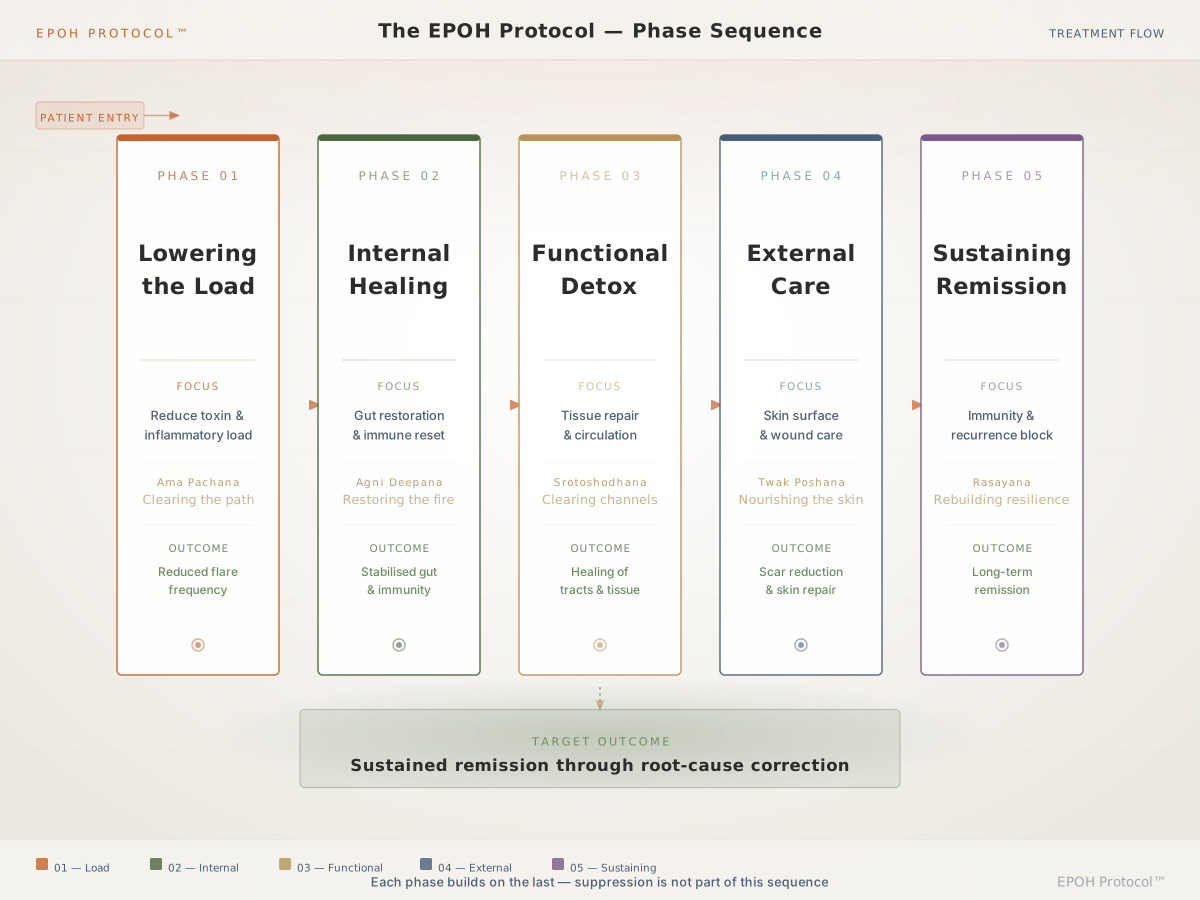
Phase 1 — Lowering the Load — runs four to eight weeks. Oral Inflammatory Load Reduction formulations, compounded to your driver profile, taken at home on a schedule tied to your meals.
Even though Crohn's is a gut disease, we do not start at the gut. Phase 1 brings down the accumulated inflammatory burden first, because gut lining repair attempted against a high inflammatory load does not hold.
Running across the same weeks is Recovery Stage 1 — the Internal Shift, weeks one to four. And here is the part almost nobody is told, the part that decides whether you stay:
Digestion, sleep and energy usually shift before bowel symptoms do. Your stool frequency, urgency and blood may look unchanged in week three. That is not the treatment failing. That is the expected order of recovery.
What tends to move first:
- Digestion — less bloating, less post-meal heaviness, appetite steadying, eating feeling less like an event you have to survive.
- Sleep — deeper, less broken, fewer 4am wakes.
- Energy — the dragging fatigue of active inflammation starting to lift.
- Mental clarity — the fog thinning.
These are not consolation prizes. They are the earliest honest readings on your inflammatory load, because they are the systems that answer fastest when it comes down. Your bowel is the most damaged tissue in the picture. It reports last.
That is exactly why we ask you to log all of it from day one — sleep, energy, appetite, post-meal comfort, mood — alongside stool frequency, form, urgency, blood and pain. If you track only the bowel, you will conclude nothing is happening at precisely the moment something is.
Weeks 3 to 6: the Partial Improvement Plateau
Expect this. Genuinely, expect it.
Somewhere in weeks three to six, the early improvement flattens. You feel better than you did a month ago, but no better than you did last week. And you flare anyway. The story writes itself in your head: it worked for a bit, then it stopped.
It has not stopped. This is the Partial Improvement Plateau, and it is a structural feature of the recovery curve, not a fault in it.
The mechanism is simple. Phase 1 lowers inflammatory load, and the gains available from lowering load have now been banked. But your gut lining is still damaged, your microbiome is still disordered, and your immune response is still miscalibrated — and none of those are Phase 1's job. They belong to Phase 2, which has not started yet.
So the plateau is not a stall. It is a handover signal: Phase 1 has done its work, and Phase 2 should begin.
The patients who quit, quit here. Not because treatment failed them, but because nobody told them this bend in the curve existed. When you reach it, message us. It is a phase-change conversation, and it is one we are expecting to have.
Weeks 6 to 12: Phase 2 begins
Phase 2 — Internal Healing — runs eight to sixteen weeks, so it will extend well past your ninetieth day. Your compound changes: oral Internal Correction formulations, re-compounded against your profile and against how you have actually responded so far.
Three jobs, simultaneously: gut lining integrity, microbiome repair, immune recalibration.
This is slow, unglamorous biology. Epithelium does not regenerate on a marketing schedule. What patients describe through this window is usually not a dramatic switch but a change in the shape of the disease — flares that resolve completely instead of dropping them to a new, lower baseline; a bad day costing a day rather than a week.
If, by the end of the first ninety days, you are moving into Recovery Stage 2 — Reduced Frequency, months two to four — that is a coherent trajectory. If you are not, that is also information, and it is information we act on rather than wait out.
Where Phase 3 and Phase 4 sit
Phase 3 — Functional Clearance (six to twelve weeks) is oral formulation supporting your body's own clearance pathways, and it usually runs concurrently with Phase 2, not before it. It is not a procedure. Nothing is administered to you. There is nothing to attend.
We will not bring it forward to speed things up, and here is why: run clearance before load and healing are stable and you mobilise internal load faster than your system can clear it — which makes Crohn's worse, not better. The sequence is clinical, not administrative.
Phase 4 — External Care is topical formulations you apply at home, running through Phase 2 and Phase 3. They matter most in perianal disease, fissures and fistulising involvement, and in the skin and joint symptoms that travel with Crohn's. They arrive in the same courier as your oral compounds.
What you will actually be doing, day to day
- Taking oral formulations on a fixed schedule around meals.
- Applying topical preparations at home if your presentation calls for them.
- Keeping every existing prescription exactly as it is.
- Keeping the symptom log.
- Following the dietary framework set for your profile, not a generic internet list.
- Video or WhatsApp follow-ups at defined points, and whenever something changes.
What we are watching
Inflammatory markers (CRP, ESR, faecal calprotectin where available), haemoglobin and iron studies, albumin, weight trajectory — and your log. Where your gastroenterologist already holds scoping or imaging, we read it and we ask for it.
Marker movement and symptom movement do not always agree in the opening window. When they disagree, we take it seriously; it usually means the compound needs adjusting, and adjusting it is a message away, not a re-referral.
The honest limit
If you have advanced structural change — established fibrotic stricturing, extensive prior damage, resected bowel — the first ninety days may look different, and full remission may not be available to you. Fibrotic scar is not inflammation, and formulations do not dissolve it. What often does remain achievable is a lighter symptom burden, fewer and milder flares, better nutrition, and a slower disease course. We will tell you which of those conversations we think we are having with you at the consultation, before you spend anything.
What day ninety actually is
Not a finish line. A checkpoint — the point at which we have real data on how your body answers, and enough of it to shape the next phase properly.
To begin, book a video consultation. Bring your reports and your current prescriptions. Formulations are compounded to your profile and couriered to your door, in India or internationally. Follow-ups run by video or WhatsApp.
For most patients there is no procedure, no in-clinic therapy and no clinic visit.
Medical disclaimer. This article is for general information and is not a substitute for personalised medical advice. Ayurvedic treatment at EliteAyurveda™ is individualised following clinical assessment. Do not start, stop or alter any prescribed medication without consulting your treating physician.

