


Part of the Hidradenitis Suppurativa Knowledge Library
The first course felt like proof of something. Ten days of doxycycline, the ache went out of the axilla, and for a few weeks you had your life back. Then it returned, so the course got longer. Then it was twelve weeks of clindamycin and rifampicin, which also worked, and then also stopped working.
Somewhere around the fourth or fifth cycle you noticed the thing nobody says out loud: each course seems to buy less time than the one before it, and the flare that follows is worse than the flare that preceded it.
You are not imagining that. It is the predictable output of the mechanism, and understanding why tells you something important about what HS actually is.
Say the true thing first: they work
Long-course tetracyclines and the clindamycin–rifampicin combination genuinely reduce lesion count, drainage and pain for a great many patients with HS. Anyone who tells you antibiotics do nothing for this disease is not being straight with you. In an acute crisis, in a genuinely infected and systemically unwell patient, they matter enormously and they are the right call.
But there is a tell hiding inside that benefit, and it is the most useful clue here.
Part of why tetracyclines help has nothing to do with killing bacteria. Doxycycline and its relatives are also anti-inflammatory drugs. They inhibit matrix metalloproteinases and dampen neutrophil function, independently of any antibacterial action at all. When a drug prescribed to reduce bacterial load turns out to be helping substantially by reducing inflammation, it is telling you what the disease is actually made of.
HS is not primarily an infection
Follow the sequence inside a single lesion:
- The follicular unit hyperkeratinises.
- It occludes.
- It dilates under pressure.
- It ruptures, spilling keratin, hair fragments and follicular contents into the dermis.
- The innate immune system encounters that material and mounts an enormous inflammatory response.
- Bacteria colonise the resulting lesion.
Step six is last. Bacteria arrive in a lesion that inflammation has already opened for them. They are not the initiating event, and treating them as though they were is precisely why the relief never lasts.
Your own history is the evidence:
- Lesions are frequently culture-negative. A sterile swab from an abscess that is visibly raging is not a laboratory error. It is the diagnosis.
- Abscesses drain and re-form in the same site with no organism ever identified.
- HS is not transmissible. Nobody has ever caught it from you.
- The disease responds, sometimes dramatically, to drugs that block TNF or IL-17 and have no antibacterial activity whatsoever. If HS were fundamentally an infection, suppressing the immune response would make it catastrophically worse. It does not. It helps.
Biofilm within established tracts is real, and it is one honest reason antibiotics underperform in advanced disease. But biofilm is a consequence of having a tunnel. It is not the reason the tunnel formed.
What repeated courses do to the driver you cannot see
Long-course, broad-spectrum antibiotics do not act only on your skin. They act, powerfully, on the gut microbiome. They reduce microbial diversity. They deplete the commensal species that ferment dietary fibre into short-chain fatty acids, butyrate above all.
That loss costs you two things at once:
- Barrier integrity. Butyrate is the primary fuel of the colonocytes lining your gut. Starve them, and tight-junction integrity degrades. Intestinal permeability rises.
- The immune brake. Butyrate is a key signal for regulatory T cells, the arm of the immune system whose entire function is to stop inflammatory responses. Deplete it, and the brake weakens.
The consequence follows directly. A more permeable barrier admits bacterial endotoxin and incompletely processed food antigens into circulation, continuously. Innate immune tone rises. Pattern-recognition receptors stay engaged. IL-1, TNF and IL-17 signalling settles at a raised baseline.
That is precisely the mechanism driving HS in the first place. So each course does two opposite things simultaneously:
| What the course changes | Direction | Timescale |
|---|---|---|
| Bacterial load in the lesion | Down — genuinely helpful | Weeks |
| Local inflammation (tetracycline effect) | Down — genuinely helpful | Weeks |
| Gut microbial diversity | Down | Cumulative, across years |
| Short-chain fatty acid production | Down | Cumulative |
| Intestinal permeability | Up | Cumulative |
| Circulating innate immune activation | Up | Cumulative |
| Likelihood the next follicle occludes and ruptures | Unchanged, or increased | Cumulative |
The benefit is counted in weeks. The cost is counted in years. And because that cost lands directly on a primary driver of the disease, the pattern becomes inevitable: temporary reduction, recurrence at greater intensity, escalating courses. Every cycle starts from a slightly worse internal baseline than the last one did.
None of this is a criticism of the prescriber. The drug is doing exactly what it was designed to do. The difficulty is that its target — bacteria in the lesion — sits downstream of the disease, while its collateral effect lands squarely on the driver upstream of it.
The older description of the same thing
Agni is digestive capacity. Repeated antibiotic courses weaken it. Weakened Agni means incomplete transformation, and incomplete transformation produces Ama: accumulated inflammatory load that circulates rather than clearing.
Ama reaching the blood produces Rakta Dushti. Vitiated Pitta and Kapha obstruct the Svedavaha Srotas and the Raktavaha Srotas, and that obstruction is where the lesion appears — Pidaka, deep pustular inflammation, and in time Dushta Vrana, the chronic wound that will not close. Pitta supplies the heat and the pus, Kapha the induration, Vata the pain.
Kushtha, the classical category, was never a skin diagnosis. It was a systemic diagnosis that happens to surface.
Phase 1 and Phase 2: repaying the debt
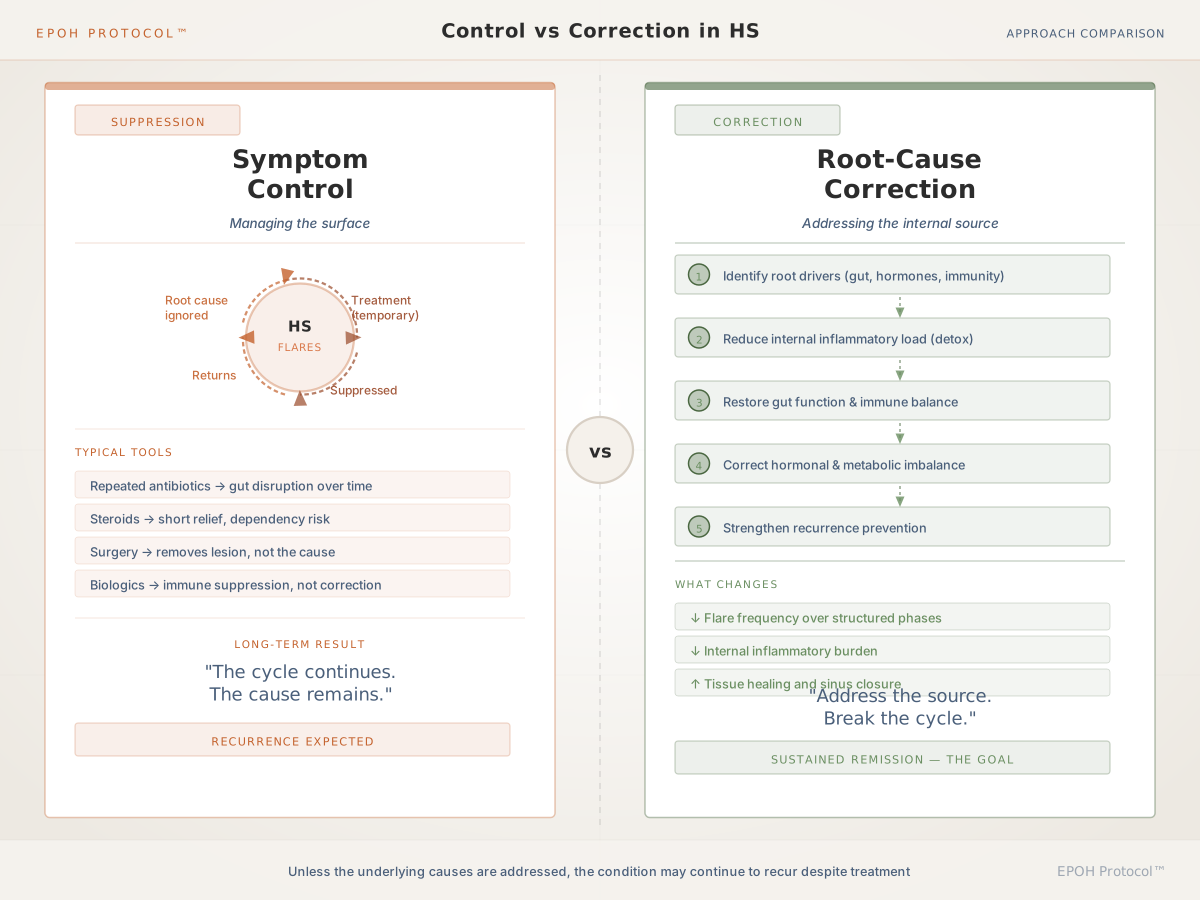
The antibiotic years leave a specific, identifiable deficit. Correcting it is the first two phases of EPOH.
Phase 1 — Lowering the Load (4–8 weeks). Oral formulations reducing accumulated inflammatory load (Ama), supporting digestive capacity, and calming immune reactivity. Taken at home. Diet is complementary to this phase, not the phase itself.
Phase 2 — Internal Healing (8–16 weeks). The primary correction phase, and the one that matters most here: gut lining integrity, microbiome repair, immune recalibration, hormonal patterns. This is where the microbiome damage is actually addressed, and it is slow, because rebuilding a microbial ecosystem and an epithelial barrier is slow.
Expect a different rhythm, and prepare for it. Antibiotics trained you to expect change within days, and internal correction does not move at that speed. It will feel wrong at first. Expect four to eight weeks of internal work before visible surface change.
And expect the Partial Improvement Plateau, around weeks three to six: a well-recognised point where things improve, and then flares continue anyway, and it reads exactly like the antibiotic pattern repeating itself. It is not. It is the signal that Phase 1 has done its work and Phase 2 should begin. It is also the commonest point at which patients walk away.
Do not stop your antibiotics on your own. EPOH begins while you continue your current medication. As internal correction takes effect, the medication is reviewed with your prescribing physician, and any reduction is gradual and structured — with discontinuation as the goal, not the starting point.
One further sequencing warning: do not attempt a cleanse first. Phase 3 (Functional Detox) sits third deliberately. Mobilising accumulated load before L and I are stable releases more than the body can clear, and the skin gets worse. If that has happened to you before, the timing was the problem, not the idea.
Not every patient responds equally. Disease duration, degree of organ involvement, and remaining biological repair capacity all influence outcomes. Patients with very advanced structural changes (severe fibrotic HS) may not achieve full remission. A personalised evaluation is the only way to assess your specific response potential.
The question the next course cannot answer
Another antibiotic course will very likely help again, and — if the pattern holds — for a shorter time than the last one did. The real question is what is being done, in parallel, about the internal environment that decides whether the next follicle occludes at all.
That is a driver-profile evaluation, done by video or WhatsApp consultation. Personalised formulations are dispatched by courier and taken at home.
Medical disclaimer. This article is for general information and is not a substitute for personalised medical advice. Ayurvedic treatment at EliteAyurveda™ is individualised following clinical assessment. Do not start, stop or alter any prescribed medication without consulting your treating physician.

