


Part of the Hidradenitis Suppurativa Knowledge Library
You know the exact spot. It has been there for years. It goes quiet for a few weeks and then, without much warning, it drains again — the same site, the same channel, the same fluid on the same shirt. Antibiotics quieten it. It returns. You have been told, probably more than once, that the only thing left is to cut it out.
Before you decide anything about that, it is worth understanding what that channel actually is, and why almost everything applied to its surface has failed to close it. The honest answer is not a comfortable one. But it explains the last several years of your life.
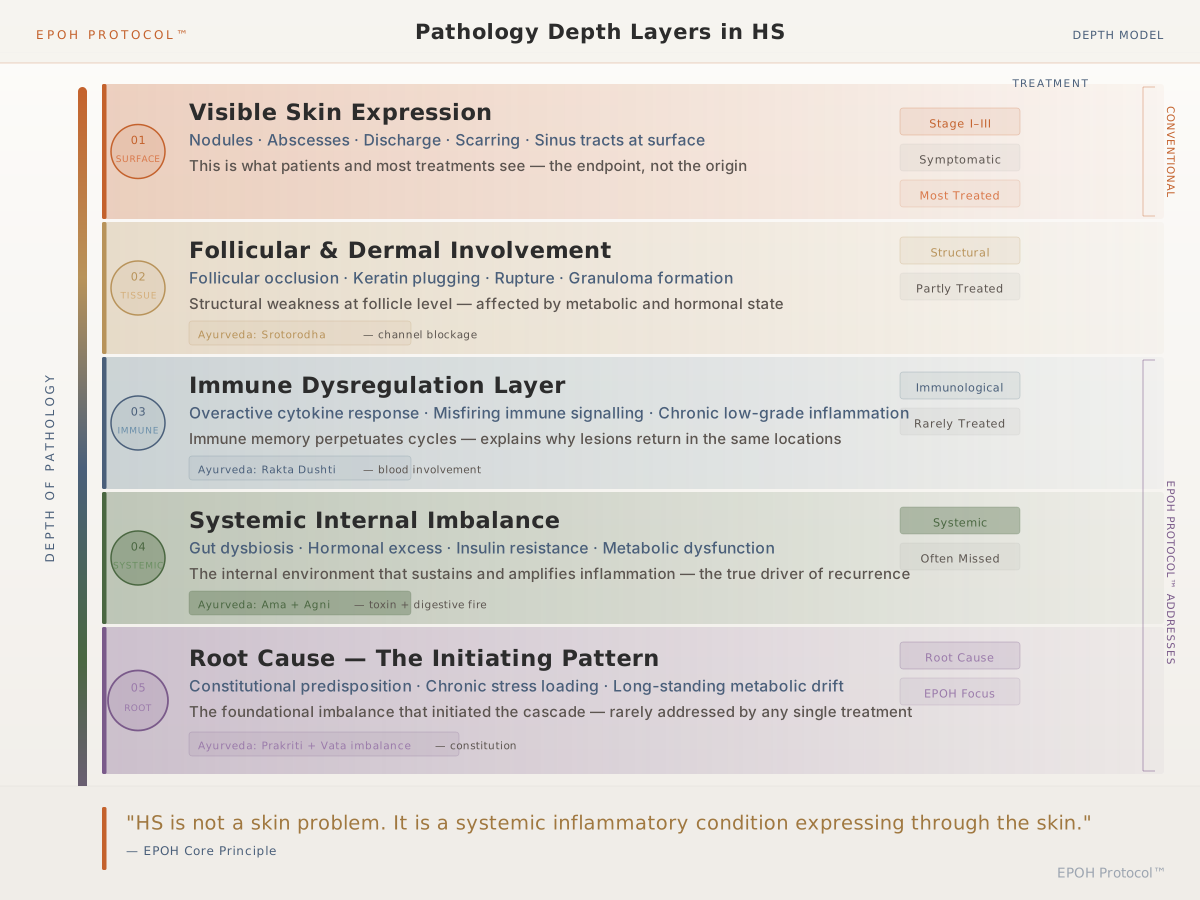
How a nodule becomes a tunnel
It begins with occlusion. A follicular unit in an apocrine-bearing region — axilla, groin, inframammary fold, gluteal cleft — plugs and swells. It is deep, firm, painful, and it has no head. It is not a boil and it is not a hygiene failure. Ayurveda describes this lesion as Pidaka: deep pustular inflammation arising in obstructed channels. This is EPOH-DSS Stage 1 — Early Nodular, and it is the most reversible point in the entire condition.
Then it ruptures — inwards. This is the pivotal event in HS and the one almost nobody explains. The occluded unit does not burst outward through the skin. It ruptures into the dermis, spilling keratin, bacteria and cellular debris into tissue that has no mechanism for holding them. The immune response that follows is not proportionate to an infection; it is proportionate to a foreign body. Heat, redness, swelling, pus. This is EPOH-DSS Stage 2 — Inflammatory, and it is the critical intervention window: the last stage at which the pathology is still inflammatory rather than structural.
Then the body improvises. It cannot resorb what has been spilled, so it builds a channel: a path of least resistance from the deep collection to the surface, so the contents can leave. That channel is a sinus tract. It drains, it recurs at the same site, and it is now a fixed feature of the region. This is EPOH-DSS Stage 3 — Sinus.
Why the tract does not close: epithelialisation
Here is the part that should change how you read every treatment you have tried.
A tract that stays open long enough does not remain a wound. Keratinocytes migrate along its walls and line it. The channel acquires an epithelial lining — the same tissue that covers your skin, now running down the inside of a tunnel.
At that point it stops being an injury and becomes a structure.
This matters because of one blunt biological fact: a wound closes, and a lined channel does not. Healing requires raw tissue surfaces to meet and fuse. Epithelium does not fuse to epithelium — it is the tissue whose whole function is to form a boundary, not to dissolve one. Your body is not failing to heal that tract. Your body has finished with that tract. It has reclassified a defect as anatomy.
That is the honest reason surface treatment stalls at EPOH-DSS Stage 3 and EPOH-DSS Stage 4. Anti-inflammatories reduce the inflammation around a tract; they cannot un-line it. Antibiotics reduce the bacterial load inside it; they cannot close it. Neither is a failure of the drug. Both are being asked to resolve an inflammatory lesion that is no longer only an inflammatory lesion.
Fibrosis, and why late HS resists everything
Every cycle of rupture, drainage and partial repair lays down collagen. Over years, the region turns fibrotic — thickened, hardened, tethered.
Scar tissue is not neutral filler. It is stiff, poorly vascularised, and it distorts everything around it. In the vocabulary of the condition: the Svedavaha Srotas and Raktavaha Srotas of that region — the sweat and blood channels — are now permanently worse at clearing. In modern terms: perfusion falls, drainage falls, and so does delivery of anything circulating in the blood to that tissue.
Two consequences follow.
The first is that obstructed, poorly draining tissue is more likely to generate the next lesion, not less. Fibrosis is not the end of the process; it is an accelerant for it. Tracts multiply, then interconnect. This is EPOH-DSS Stage 4 — Advanced Tunneling: multiple communicating tunnels, continuous discharge, fibrotic thickened skin, sometimes restricted movement.
The second is that fibrotic tissue receives less of anything you give it — not only conventional agents, but anything that must reach the tissue through a blood supply fibrosis has already degraded. It is why advanced HS turns refractory across the board, and why we are candid about what late correction can achieve.
What internal correction can and cannot do here
| Internal correction can | Internal correction cannot |
|---|---|
| Halt the production of new nodules — the process that keeps extending the network | Un-line an epithelialised tract by reducing inflammation alone |
| Reduce inflammatory activity in and around existing tracts: less discharge, less pain, shorter flares | Return established scar tissue to normal skin |
| Restore the tissue terrain — perfusion, drainage, channel clearance — so that healing becomes possible at all | Fully resolve an extensive, mature fibrotic tunnel network in every patient |
| Close some tracts: the shorter, less mature, less completely epithelialised ones | Undo structural change that has already been laid down |
The left-hand column matters more than it first appears. Every tract you now have was once a nodule. At EPOH-DSS Stage 3 and EPOH-DSS Stage 4, the most consequential thing internal correction does is not to close old tunnels — it is to stop new nodules forming, so the network stops extending. Halting the production line alters the trajectory of the condition more decisively than anything applied to its surface.
In HS the dominant pattern is gut dysbiosis feeding immune dysregulation, which then localises in the apocrine-bearing skin, with hormonal and metabolic drivers layered on top in many patients. HS is not a skin condition with systemic complications; it is a systemic condition expressing through the skin. That is not a slogan — it is the reason a tract in your groin keeps refilling.
Where surgery honestly fits
Structural approaches are sometimes appropriate at EPOH-DSS Stage 4 — for a mature tunnel network that is not going to resolve, that discharges continuously, that limits how you move and how you live.
But this is also exactly why previous surgery did not hold. Surgery removes lesions and the structures they built. It cannot alter the systemic environment that produced them. New lesions form, often in adjacent tissue, and the internal process continues in fresh ground.
The sequencing conclusion is unavoidable: internal correction must precede any structural approach. Operate on an uncorrected internal terrain and the same process regenerates the same lesions — and you will have paid the full cost of surgery for a temporary result. If a structural intervention belongs in your path, it belongs on top of a corrected terrain, not instead of one.
Why Phase 4 works only where it sits
Phase 4 — External Care — is the phase that acts on the tract itself: topical formulations for lesion resolution, sinus-tract healing and barrier restoration, with oral support for tissue-level repair.
It is also the phase patients want first, because it is the only one that acts where the problem is visible. It does not work first. Phase 4 works because Phases L, I and F have already shifted the terrain: the inflammatory load driving the lesion has been lowered (Phase 1), the gut and immune drivers generating it have been corrected (Phase 2), and the obstructed channels of that region can clear again (Phase 3). Applied to an uncorrected terrain, external care is limited and temporary — it is treating the exit wound of a process that is still firing.
The timelines are honest rather than encouraging. Phase 4 runs through Phases I and F and intensifies as internal correction takes hold. Tract-level change is late-arc work — Recovery Stage 3 (Reduced Severity, months four to eight) and Recovery Stage 4 (Stable Remission, months eight onward). Not weeks. Anyone offering you weeks for a structure this old is not describing your tissue.
Not every patient responds equally. Disease duration, degree of organ involvement, and remaining biological repair capacity all influence outcomes, and patients with very advanced structural changes — severe fibrotic HS — may not achieve full remission. A personalised evaluation is the only way to assess your specific response potential.
If you are at EPOH-DSS Stage 3 or EPOH-DSS Stage 4, the useful question is no longer whether the surface can be treated. It is what is still driving the next lesion, and what remains reversible in your case. That is what an evaluation establishes — by video or WhatsApp, with formulations compounded to your driver profile and dispatched by courier.
Medical disclaimer. This article is for general information and is not a substitute for personalised medical advice. Ayurvedic treatment at EliteAyurveda™ is individualised following clinical assessment. Do not start, stop or alter any prescribed medication without consulting your treating physician.

