


Part of the Hidradenitis Suppurativa Knowledge Library
It usually happens in the evening.
For three or four weeks something had been quietly different. Your digestion had settled. You were sleeping through more of the night. That grey exhaustion you had stopped calling fatigue — because it had simply become the texture of being you — had lifted enough that you noticed its absence. You had not said anything to anyone. You had been superstitious about it.
Then you reach up, or you sit down wrong, and there it is. The same fold. The same heat. The same hard, deep, familiar pain, arriving exactly as it always has.
And the thought is immediate and total: it has stopped working. Or worse — it was never working, and I let myself believe something again.
This is the Partial Improvement Plateau, it falls between weeks three and six, and it is the single point at which patients abandon treatment that was working. If you are reading this in the middle of it, the next four minutes matter.
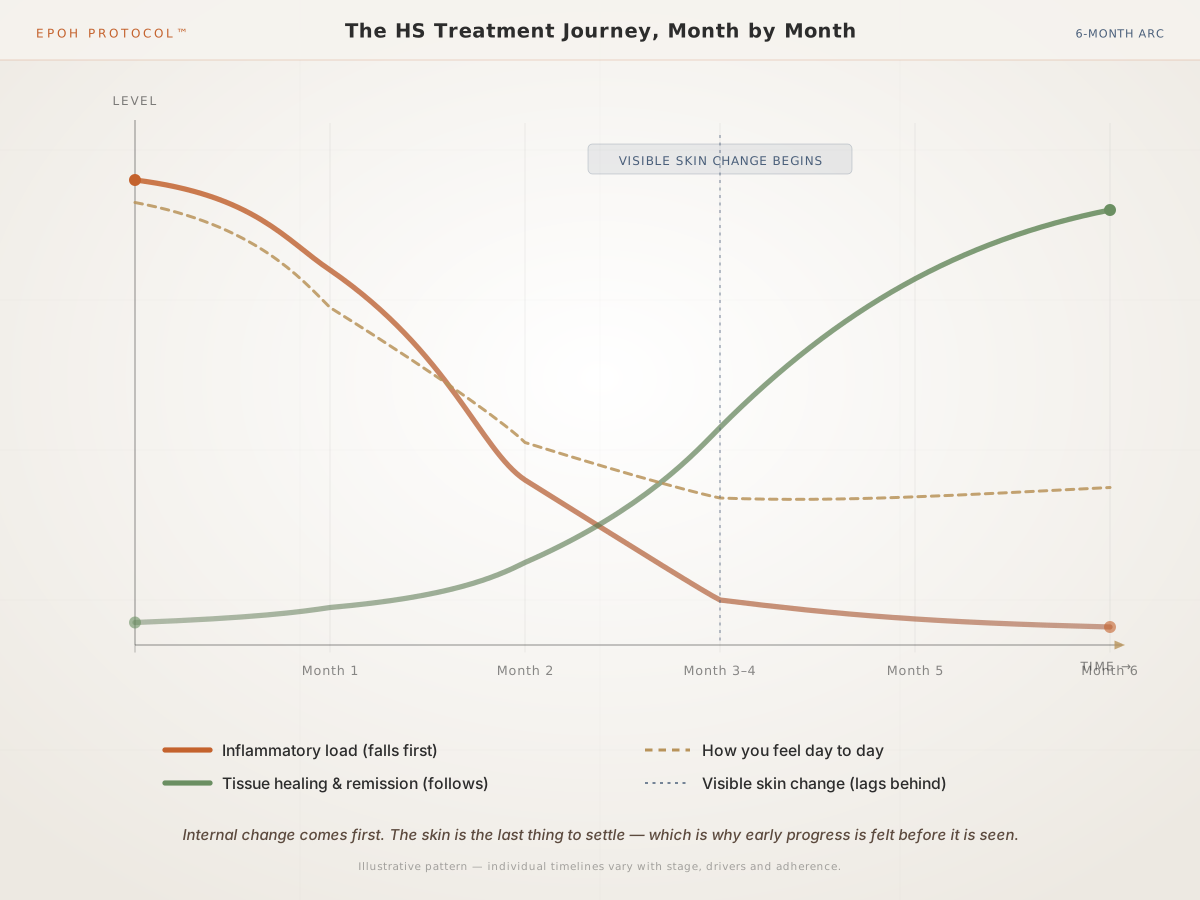
What you are actually looking at
Two separate things are true at once, and holding both is the whole trick.
Phase 1 worked. It was designed to bring down accumulated inflammatory load (Ama) and restore digestive capacity (Agni), and the evidence that it did so is precisely what you noticed: digestion, sleep, energy. Those are the Recovery Stage 1 markers. They are not a placebo and they are not a consolation prize. They are the readout of the driver system moving.
And your driver has not been corrected yet. Because that was never Phase 1's job.
The gut-lining permeability is still there. The disrupted microbiome is still disrupted. The immune system is still misfiring in the way it has misfired for years, and the hormonal pattern underneath it is unchanged. Lowering a load is not the same operation as fixing what keeps generating it. You have been bailing out the boat. Nobody has patched the hull.
Patching the hull is Phase 2 — Internal Healing: gut lining integrity, microbiome repair, immune recalibration, hormonal patterns. It runs 8–16 weeks, it is the longest phase in the protocol, and it is the one that actually changes the disease. And it is what comes next.
So the flare that just arrived is not evidence of failure. It is evidence that you have reached the point in the sequence where the correction phase is supposed to begin.
The plateau is not a warning sign. It is a transition signal. It is the protocol telling us, on schedule, that Phase 1 has finished its work and Phase 2 should be timed.
Why this is predictable rather than a surprise
The plateau is not bad luck. It is produced by the design of the sequence, which is why it can be named in advance and why you are being told about it here rather than discovering it alone.
Load reduction comes first because clearance and correction are unsafe on top of an unreduced load. Correction comes second because it takes months and needs a quieter system to work in. Which means there is necessarily a window in which the load has come down but the driver is untouched — and in that window, flares continue, because the thing producing flares has not yet been addressed. Weeks three to six is that window. Everybody passes through it. It is scheduled.
Why your instinct to quit is well-trained — and wrong here
Here is the part that deserves respect rather than a lecture.
Your pattern recognition is not faulty. It is excellent, and it has been trained by real experience. In every treatment you have had, "improvement, then a flare" genuinely was the end of the story:
- Antibiotics reduced bacterial load, and then the microbiome — itself a primary driver — was disrupted by the very thing that helped, and it came back, often harder.
- Steroids and biologics suppressed immune signalling without correcting why the immune system was misfiring. They held it while suppression continued, and the flare that broke through was the honest signal that suppression was reaching its limit.
- Surgery removed lesions but could not alter the systemic environment that produced them, so new ones appeared, frequently in the adjacent fold.
- Hormonal medication addressed hormonal symptoms without correcting the gut–hormonal relationship underneath them, and symptoms returned when it stopped.
In all four, an early flare through a period of improvement meant the ceiling had been reached. Your instinct to walk away at that moment was correct — then.
It is misfiring now because this is structurally a different event. Those were treatments in which the plateau was an endpoint. This is a sequence in which the plateau is a midpoint, and the phase that addresses what you are feeling has not been given to you yet.
What to do — and what not to do
Do not stop. Stopping at week four means you took the phase that reduces load and skipped the phase that corrects the driver. You will conclude the protocol did not work, and you will have tested only its first fifth.
Do not escalate on your own. Do not double the formulations, do not add supplements you read about, do not stack anything on top. The phases are dosed and sequenced against each other; adding to them privately makes your response uninterpretable at review, which removes the one instrument we have for timing your transition correctly.
Do not start a detox, a cleanse, a fast, or a purgative course. This is the one that does actual harm, and the impulse is completely understandable — you can feel that something is stuck, and it feels obvious to try to flush it out. But Phase 3 — Functional Clearance — is third in the sequence for a reason. Mobilising internal load before Phase 1 and Phase 2 are stable pushes it faster than the body can clear it, back into channels — Svedavaha and Raktavaha Srotas — that are obstructed already. That is not clearance. That is congestion, and the condition worsens. If you have tried a cleanse during a flare in the past and got distinctly worse, you have already run this experiment: the timing was the problem, not the idea.
Do report the pattern at review. Specifically, not vaguely. Not "about the same" but: how many flares, how long each ran, whether they resolved completely or left a hard residue, what the pain was at its worst, whether there was drainage, and what happened to your digestion, sleep and energy across the same weeks. That is the material from which the phase transition is timed. A plateau reported clearly moves you into Phase 2. A plateau reported as "I think it's not working" moves you nowhere.
The honest ending
Almost every plateau at weeks three to six is a transition signal. Not every one is.
For a minority of patients, a plateau that does not resolve once Phase 2 is properly underway is telling us something real — that a driver was under-weighted at evaluation, that adherence has been more broken than reported, or that in very advanced fibrotic disease the remaining biological repair capacity is genuinely limited. Disease duration and degree of organ involvement matter, and some patients with severe structural change will not achieve full remission.
That is not a caveat bolted onto the end. It is the reason review exists at all: to distinguish a plateau that is a scheduled transition from a plateau that is information. Both are worth knowing. Only one of them means what you are currently afraid it means — and you cannot tell which you have by quitting at week four.
If you are in the middle of this and unsure which one you are looking at, that is exactly the conversation to have at review — by video call or WhatsApp — before you decide anything on your own.
Medical disclaimer. This article is for general information and is not a substitute for personalised medical advice. Ayurvedic treatment at EliteAyurveda™ is individualised following clinical assessment. Do not start, stop or alter any prescribed medication without consulting your treating physician.

