


Part of the Hidradenitis Suppurativa Knowledge Library
You have probably been told both. A dermatologist said autoimmune. A rheumatologist said it isn't. A support forum insists that it is. The leaflet in the box of your biologic implies something in between, and nobody explained why the answer would matter to you.
It matters more than almost anything else you will be told about this disease, because the answer determines what question your treatment is trying to answer. And if the question is wrong, no amount of precision in the answer will help you.
The distinction, without the jargon
| Autoimmune | Autoinflammatory | |
|---|---|---|
| Arm of the immune system | Adaptive: B cells, T cells, antibodies | Innate: neutrophils, macrophages, the inflammasome |
| Defining feature | A specific self-antigen is targeted; autoantibodies or antigen-specific T cells can usually be identified | No self-antigen target; typically no defining autoantibody |
| The core fault | Loss of tolerance. The system has learned the wrong target. | A lowered threshold. The system fires too readily and will not switch off. |
| Typical examples | Rheumatoid arthritis, type 1 diabetes, coeliac disease | Familial Mediterranean fever; the PASH and PAPASH syndromes |
| The right question | What is it attacking? | What keeps setting it off? |
Autoimmunity is a targeting error: specific, precise, misdirected. Autoinflammation is a threshold error: non-specific, fast, stuck on. One is a guided missile aimed at the wrong building. The other is a smoke alarm that will not stop sounding.
Where HS actually sits
The dominant mechanism in HS is autoinflammatory.
There is no HS autoantibody. The cytokine picture in lesional skin is innate-dominant: IL-1β, TNF-α and IL-17, with IL-23 sitting upstream of the IL-17 axis. The cellular infiltrate is neutrophil-rich. The syndromic company HS keeps — PASH, PAPASH, the wider neutrophilic dermatosis family — is autoinflammatory company. And HS responds to agents that block innate cytokine signalling, which is exactly what the model predicts it should do.
Be honest about the nuance, though, because oversimplification is its own kind of dishonesty. HS is not purely innate. Established lesions and mature tunnels contain B cells and plasma cells; adaptive machinery gets recruited into any chronically inflamed tissue, and in long-standing HS it is certainly present. The point is not that adaptive immunity is absent. The point is that it is not the initiating event. HS is best read as an autoinflammatory disease with secondary adaptive involvement.
Why this changes the treatment question entirely
Here is the whole argument, and it is short.
*If HS were autoimmune, your immune system would be wrong.* It would be attacking self-tissue it ought to have tolerated. The correct response to a system that is wrong is to blunt it or re-educate it — and in that world, long-term suppression is a perfectly defensible endpoint in its own right.
Because HS is autoinflammatory, your immune system is not wrong. It is responding. Disproportionately, yes. Destructively, certainly. But it is responding to something that is genuinely there and genuinely persistent. An innate alarm does not fire at nothing.
So if it will not stop firing, the operative question is not only how hard do we suppress the alarm. It is:
What keeps sending the signal?
That single reframing is the entire difference between suppression and correction.
So what keeps sending the signal?
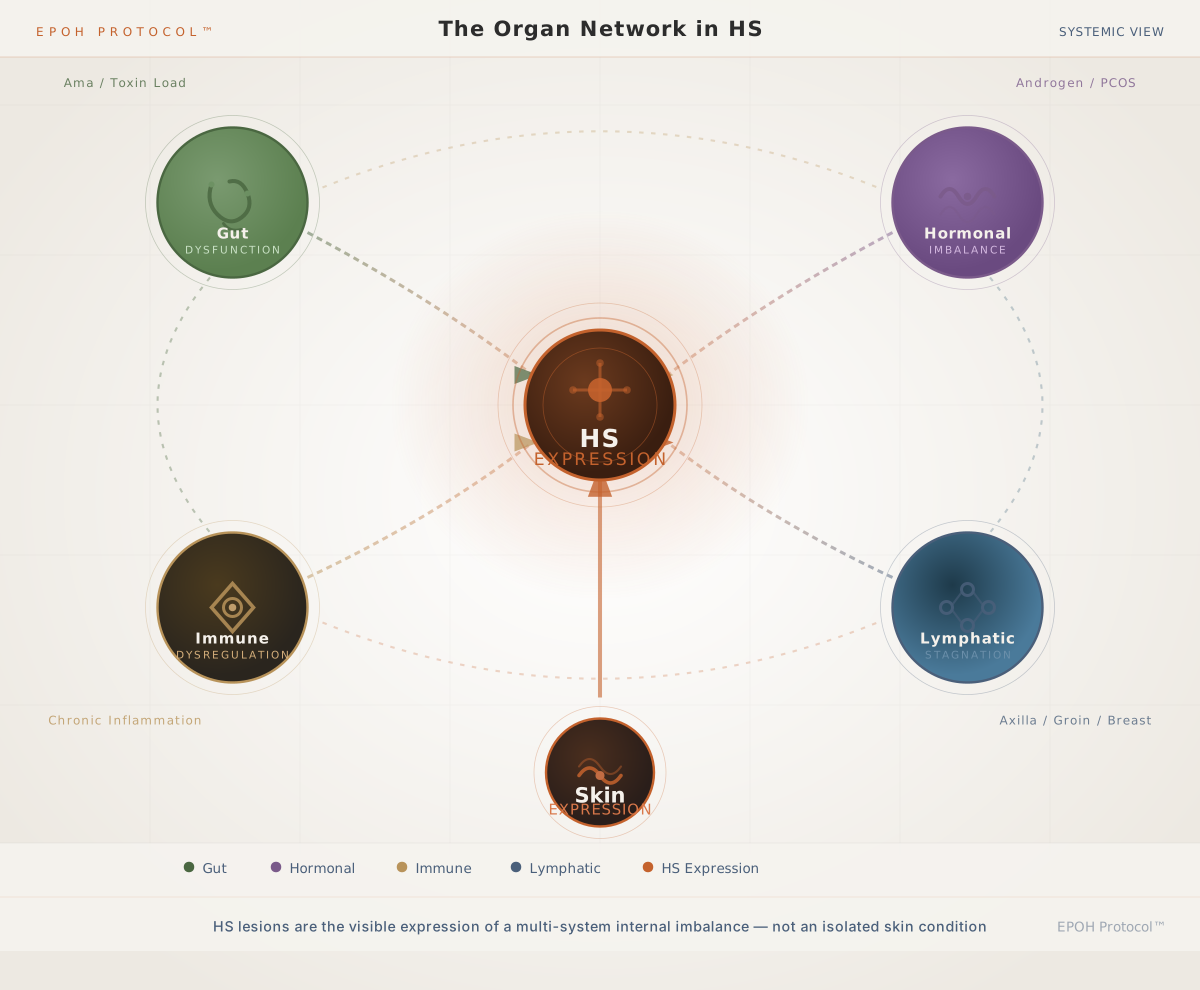
Three sources dominate in HS, and they map directly onto the internal driver systems.
Gut barrier and microbiome — the gut health driver. A compromised intestinal barrier admits bacterial endotoxin and incompletely processed food antigens into circulation, continuously. Pattern-recognition receptors on innate immune cells are chronically engaged, and systemic innate tone rises. At the same time, depletion of butyrate-producing commensals removes one of the key regulatory brakes on that response, because regulatory T cell function depends on it. Signal up, brake off. This is a large part of why HS clusters with inflammatory bowel disease.
Hormonal signalling — the hormonal balance driver. Androgen-responsive follicular units in apocrine-bearing skin hyperkeratinise and occlude. Occlusion leads to rupture, and keratin and follicular contents released into the dermis constitute one of the most potent innate immune triggers the skin can produce. Every rupture is a fresh alarm signal delivered directly into tissue. Reduce the rupture rate and you reduce the signal at source.
Metabolic load — the metabolic function driver. Insulin resistance and adipose-derived inflammatory signalling raise the baseline against which everything else happens. Adipose tissue is not inert padding; it is an endocrine and inflammatory organ in its own right.
Sitting across all three is stress and cortisol, the amplifier: sustained cortisol degrades barrier integrity, worsens insulin resistance, and shifts immune signalling.
Anatomy decides where HS appears. The driver profile decides whether it appears at all.
What biologics do — and precisely what they do not do
Respect first, because it is deserved. TNF and IL-17 blocking agents are a genuine advance in HS. For patients at EPOH-DSS Stage 3 (Sinus) or Stage 4 (Advanced Tunneling) they can reduce lesion count, drainage and pain in a way that little else reliably does. That should be said plainly and without hedging.
Now look at where they act. They sit at the far downstream end of the chain, intercepting a cytokine after the alarm has been raised: after the barrier has leaked, after the receptor has been engaged, after the follicle has ruptured, after the signal has been sent.
What they do not do is reduce the signal. The intestinal barrier is unchanged. The microbiome is unchanged. The insulin resistance is unchanged. The androgen signal reaching the follicle is unchanged. The upstream generator runs exactly as it ran before, and a very precise, very expensive block has been placed between it and your skin.
Which is why the pattern is so consistent, and so recognisable to anyone who has lived it: control while suppression continues; loss of control when suppression stops; and, for some patients, a gradual loss of response over time, as the upstream drive keeps rising against a fixed level of blockade.
None of this is a reason to stop a biologic, and you should never stop one on your own. EPOH begins while you continue your current medication. As internal correction takes effect, that medication is reviewed with your prescribing physician, and any reduction is gradual and structured — with discontinuation as the goal, not the opening move.
Phase 2: recalibration means changing the input, not blunting the output
Phase 1 — Lowering the Load (4–8 weeks) comes first: oral formulations that reduce accumulated inflammatory load (Ama), restore digestive capacity (Agni), and calm immune reactivity. You cannot recalibrate an immune system while the load provoking it is still arriving in the same volume.
Phase 2 — Internal Healing (8–16 weeks) is the primary correction phase, and in an autoinflammatory disease it does three things that belong together:
- Gut lining integrity and microbiome repair — reducing the signal at source.
- Immune recalibration — restoring the threshold at which the innate system fires.
- Hormonal patterns — reducing the rupture rate that generates the local trigger.
These are one phase because they are one problem.
"Recalibration" is a deliberate word, and it is not a synonym for suppression. The goal is not an immune system that cannot respond — that is what indefinite suppression buys, and it carries costs you already know about. The goal is an immune system that is no longer being provoked, running at a threshold appropriate to the actual threat in front of it.
In Ayurvedic terms, an innate system firing continuously at a signal it cannot clear is Rakta Dushti: disturbance at the level of blood, generated by Ama arising from weakened Agni, obstructing the Svedavaha Srotas and producing Pidaka and, in time, Dushta Vrana. Pitta drives the heat and the pus, Kapha the induration, Vata the pain. The notation is older. The causal chain is the one the cytokine literature describes.
Phase 3 (Functional Detox) follows this work; it never precedes it. Mobilising accumulated load before L and I are stable releases more than the body can clear, and the disease worsens. That is why it sits third, and why patients who attempted a cleanse first got worse rather than better.
Not every patient responds equally. Disease duration, degree of organ involvement, and remaining biological repair capacity all influence outcomes. Patients with very advanced structural changes (severe fibrotic HS) may not achieve full remission. A personalised evaluation is the only way to assess your specific response potential.
What to take from the distinction
If HS were autoimmune, the goal would be to stop the immune system from being wrong. Because HS is autoinflammatory, the goal is to stop the immune system from being provoked.
Suppression is a good answer to the first question. It was never designed to answer the second.
Identifying which drivers are sending the signal in your particular case is a personalised evaluation, done by video or WhatsApp consultation. Formulations are compounded to that profile and dispatched by courier.
Medical disclaimer. This article is for general information and is not a substitute for personalised medical advice. Ayurvedic treatment at EliteAyurveda™ is individualised following clinical assessment. Do not start, stop or alter any prescribed medication without consulting your treating physician.

