


Part of the Pemphigus & Bullous Disorders Knowledge Library
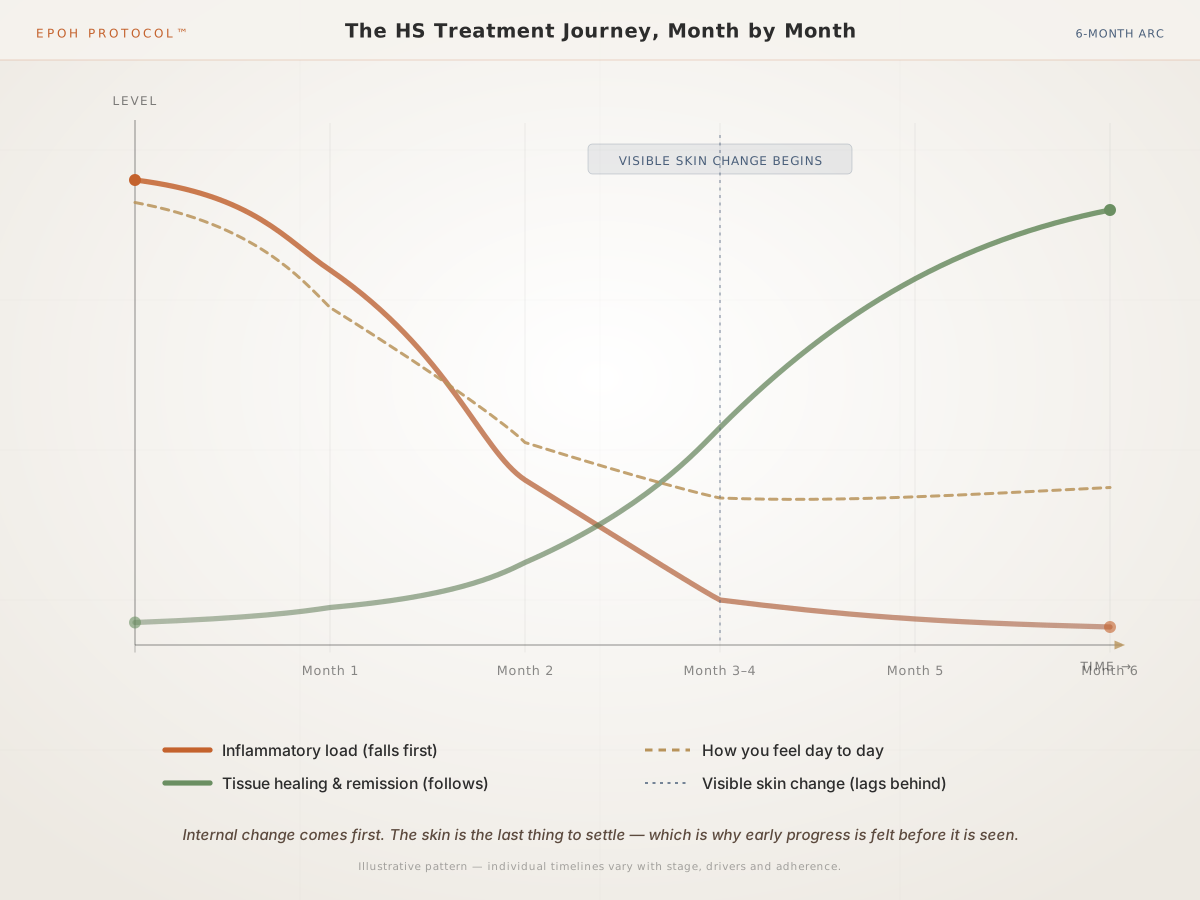
A Map, Not a Promise
What follows is the shape of an EPOH course for autoimmune blistering disease, month by month. It is a map drawn from how the protocol is designed to run and how it commonly does run.
It is not a schedule you are entitled to, and it is not a prediction about you. Some people move faster. Some stall at a phase and stay there. Some never get past month three, because it is not working and we stop. The map is useful precisely because it lets you see when you have left it.
Everything below assumes the frame that does not move: this runs alongside your dermatologist's treatment, never instead of it. No month involves changing a prescribed medication. There is no procedure and no clinic visit for most patients — the protocol is oral formulations and home-applied topicals, couriered to you.
Month 0: Assessment
Before anything is sent, we want to know what disease you actually have.
The distinction is not pedantry. Pemphigus is intraepidermal: the antibodies attack desmoglein proteins between the skin cells themselves, the blisters are flaccid and rupture almost as soon as they form, and what you live with is erosions rather than blisters. Pemphigus vulgaris is driven by antibodies against desmoglein 3 and usually starts in the mouth. Pemphigus foliaceus is driven by antibodies against desmoglein 1, sits more superficially, and spares the mucosa.
Pemphigoid is subepidermal: antibodies against BP180 and BP230 at the hemidesmosomes, the anchoring structures that hold the epidermis to what lies beneath. The blisters are tense, thick-roofed, and last for days. It is largely a disease of older people, and the itch commonly precedes any blister by months — which is why so many people are treated for eczema or scabies for half a year before anyone reaches a biopsy.
These behave differently, carry different risks, and need different External Care. So month zero is documents: the biopsy report, the direct immunofluorescence result, ELISA titres if your dermatologist has run them, the full medication list, the gut and sleep history, photographs.
If you have a diagnosis of inherited epidermolysis bullosa, stop here. EB is genetic. It is a structural fault in the proteins that anchor skin, present from birth. It is not autoimmune, it is not driven by inflammatory load, and nothing in this protocol or any other will alter its course. Only epidermolysis bullosa acquisita is autoimmune, and that is a different diagnosis established by biopsy and immunofluorescence. We will not take you on for inherited EB, and anyone who offers to should be treated as a warning.
Month 1: Phase 1 — Lowering Inflammatory Load
The first box is the Phase 1 oral set, plus an External Care topical if you have open erosions, because open skin cannot wait for a phase.
The goal this month is entirely invisible: reduce the inflammatory burden that the misdirected immune response is operating inside. Nothing about your skin is expected to change in month one, and it usually does not.
What we ask of you is the diary. Daily new blister count, itch zero to ten, erosion healing time. It will feel pointless. It is the single most useful thing you will do, because at month three it is the only evidence anyone will have about whether this is worth continuing.
Month 2: Phase 2 — Internal Healing and Gut Repair
Phase 2 overlaps and follows. The internal terrain — digestion, gut integrity, absorption, the whole system that determines what gets taken up and what gets cleared — is what will have to carry the load-clearing work in Phase 3. If it is not repaired first, Phase 3 does damage.
Some people notice things in month two, and what they notice is usually not skin. Appetite. Digestion feeling lighter. Sleep that is no longer entirely governed by itch. Record these. They are not the outcome, but they suggest something is engaging.
Somewhere in month two, disease may begin to change. Months two to four is the honest window in which surface change starts in those who respond, and it may be nothing more dramatic than an itch score coming down a point, or new blisters arriving on two days a week instead of six.
Month 3: Phase 3 — Functional Detox, Only If Ready
This is the month where the sequencing rule earns its keep.
Phase 3 is introduced only when L and I are stable. If they are not, it is not introduced, and the month is spent consolidating instead. That is not a delay to be apologised for. Running clearance work on an unstable base mobilises load faster than the body can clear it, and the result is a worse disease, not a faster recovery.
This is precisely what has happened to the people who arrive here having done a detox-first regimen elsewhere and found themselves in a flare. The approach was not the error. The order was.
So month three has two versions. If you are stable, clearance work begins. If you are not, it does not, and you are told why.
Month three also carries the first formal decision gate: continue, modify, or stop. If no leading indicator has moved at all by now, on good adherence, that is a real finding and we treat it as one rather than asking for patience.
Month 4: Phase 4 — External Care Comes Forward
External Care runs from day one for anyone with open skin, but it becomes the centre of the work around here, because this is when the surface has a chance of responding.
Home-applied topicals for erosion management, for the fragile skin around healing lesions, for the post-blister pigmentation that pemphigoid leaves behind. Applied by you, at home, on a schedule. Nobody applies anything to you. There is nothing to attend.
By the end of month four, in someone who is responding, the picture usually looks like this: fewer new blisters, lower itch, erosions closing faster than they were, and the total number of visible lesions finally starting to fall — because total burden is a stock, and it only draws down once new production has slowed.
If, at the end of month four, your surface disease is genuinely unchanged or worse on good adherence, that is a stop signal, and we will say so.
Months 5 to 7: Consolidation
Unglamorous and important.
The formulation set is revised. This is not a fixed recipe, and what you take in month six is not what you took in month one. Doses come down where they can. Clearance work continues where it is tolerated.
This is also the stretch in which, in a patient whose disease has become genuinely quiet, a dermatologist may begin to consider whether the immunosuppression can be reduced.
To be exact about whose decision that is: theirs. Entirely. We do not taper you, we do not suggest a taper to you, and we do not tell your dermatologist what to do. What we can do is ensure you arrive at that appointment with six months of daily data, which is a better basis for their decision than anyone's memory of a fluctuating disease.
Never reduce a steroid on your own. Sudden withdrawal risks adrenal insufficiency, and a rebound flare in pemphigus can be life-threatening.
Month 8 and Beyond: Phase 5 — Sustaining Remission
Sustained remission is assessed from month eight. Not before.
Anyone who tells you at month three that you are in remission is either careless or lying, because a relapsing disease is quiet often enough that three quiet weeks mean very little. Eight months of documented low activity is a different claim, and it is the only one worth making.
Phase 5 is a low-intensity maintenance set: fewer formulations, lower doses, and continued attention to the things that reliably precede a flare — gut disturbance, an infection, a course of a new drug, a stretch of poor sleep, physical stress.
We say sustained remission, and we mean exactly that and nothing more. We do not say cure. There is no cure for pemphigus or pemphigoid, from us or from anyone, and we are not going to imply one by vocabulary. These diseases can relapse, and we will not tell you they cannot.
What we can tell you is that people who keep the diary through the quiet period catch a relapse earlier than people who stop keeping it — because the itch score and the new-lesion count move before the mirror does, on the way back up as well as on the way down.
What This Map Does Not Cover
Rapid deterioration, at any month.
Spreading blistering, infected erosions, fever, mouth or throat involvement that stops you eating, or any eye symptom whatsoever — grittiness, redness, a foreign-body sensation, an inturned lash — belongs to your dermatologist or to emergency care today, not to a review call next week. Ocular mucous membrane pemphigoid scars the conjunctiva, and that threatens sight permanently.
The map is for the ordinary course. Know where the exits are, and use them without apology.
Medical disclaimer. This article is for general information and is not a substitute for personalised medical advice. Ayurvedic treatment at EliteAyurveda™ is individualised following clinical assessment. Do not start, stop or alter any prescribed medication without consulting your treating physician.

