


Part of the Pemphigus & Bullous Disorders Knowledge Library
The Week Five Thought
It arrives at about the same time for nearly everyone, and usually late at night.
Nothing has changed. I have been taking these things for five weeks. I am still getting blisters, I still itch, and I have paid for this. I have been taken in.
We are going to spend this page on that thought, because it is where this protocol loses people — not at the beginning, when they are frightened, and not at the end, when there is a result. In the gap. Weeks three through six.
And the thought is not stupid. Given the evidence available to you in week five, it is the correct inference. The only thing wrong with it is the evidence.
What Weeks One and Two Actually Are
Relief.
Not clinical relief — nothing has happened to your skin yet. Relief at having a plan. You have spent months being told the disease is chronic, that it is managed rather than treated, that you will be on steroids for a long time and nobody can say how long. Then a box arrives with a schedule in it, and for two weeks the feeling of doing something is enough.
That feeling has a half-life, and it is about a fortnight.
What Weeks Three to Six Actually Are
The plan has now produced nothing you can see. Because it was never going to.
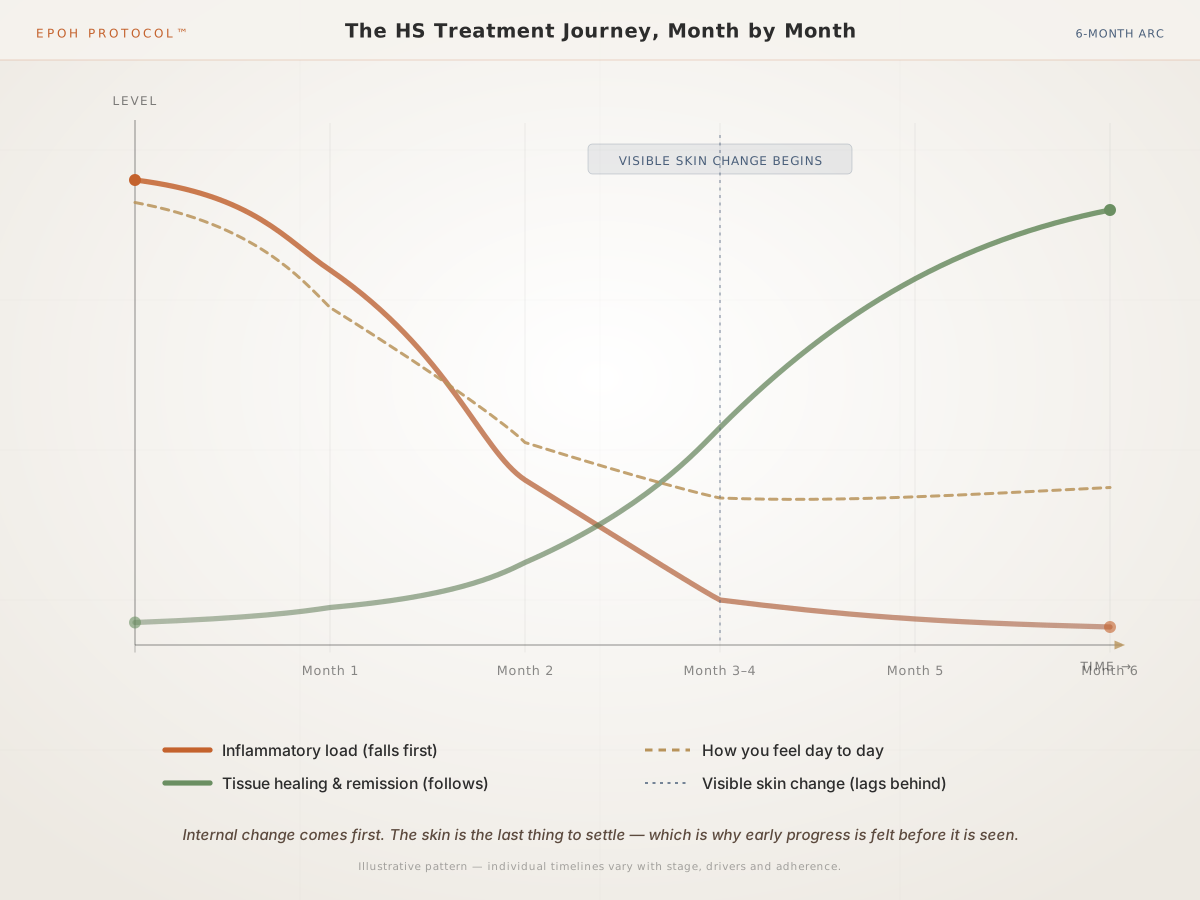
The first four to eight weeks of EPOH are internal work. The Phase 1 formulations are directed at inflammatory load. The Phase 2 formulations are directed at the internal terrain — digestion, gut repair, the system that will have to carry the clearance work later. Neither produces a visible change on the surface of your skin. We do not expect one, and we say so before you start, precisely so that this week does not feel like betrayal.
But knowing it and living it are different things, and in week five you are living it. The mirror shows what it showed in week one. You are still counting new blisters. The itch woke you at three in the morning. And the people who told you this would happen have your money.
So let us be exact about what is happening instead.
The Sequence Is the Intervention
The five phases — Lowering Inflammatory Load, Internal Healing and Gut Repair, Functional Detox, External Care, Sustaining Remission — run in that order for a reason that is genuinely counter-intuitive. It is also the reason your first six weeks look like nothing.
Phase 3, the clearance work, is the phase that most resembles what people imagine treatment should feel like. It is also the phase that will hurt you if it comes first.
Clearance mobilises load. Mobilised load has to go somewhere. If it is mobilised faster than the body can clear it — which is what happens when the inflammatory burden has not been brought down and the internal terrain has not been repaired — then it circulates. In a system already producing antibodies against the proteins that hold your own skin together, adding a circulating burden does not calm anything. It feeds the process.
This is the explanation for a pattern that took a long time to read correctly. People who came to us after a detox-first regimen — undertaken alone, or elsewhere, in perfectly good faith — were frequently in a worse flare than when they had begun. For years the natural conclusion was that clearance work is simply wrong in autoimmune blistering disease.
That conclusion was wrong. Clearance work is necessary. It is the third phase, not the first. The people who got worse had not been given a bad idea. They had been given a good idea in the wrong order, which in this disease is indistinguishable, in its consequences, from a bad one.
Which brings us back to your week five. The reason nothing visible is happening is that you are being kept out of the exact failure mode that damaged them. The invisible weeks are not the protocol failing to start. They are the protocol.
What You Should Be Looking At Instead
Not the mirror. The diary.
At week six, the question is not am I better. Nobody is asking you to be better at week six, and any clinic telling you that you should be by then is one to be more suspicious of than us.
The question at week six is narrower, and answerable: is anything moving at all?
Three things can move before your skin looks different.
Itch. In pemphigoid especially, this is the most sensitive early instrument you have. It frequently precedes blistering by months at the onset of the disease, and it often moves before the blisters do on the way back down. An itch score falling from eight to six while your blister count is unchanged is not nothing. It is the first thing.
The rate of new blister formation. Not the total number on your skin — the number of new ones per week. Total burden is a stock and falls slowly; new formation is a flow, and the flow is what tells you what today's disease is doing.
Erosion healing time. How many days a marked erosion takes to close. A disease that is quietening heals what it has already made faster, and it usually does so before it stops making new ones.
If any one of those has moved by week six, something is engaging, and the invisible weeks were doing their job. You will not see it without a written record, which is why we are so tedious about the diary.
What Would Genuinely Concern Us
Honesty cuts both ways, so here is the other half of it.
If, at week six, on genuinely good adherence, none of those three has moved — itch flat, new blister rate flat, healing time flat — that is a real finding, and we treat it as one. It does not automatically mean stop. It means the phase work is not engaging, and something has to change.
Week twelve is the formal gate, and at that gate the permitted answers include stop. A plateau at week five is expected. A plateau that has not begun to break by week twelve, with everything taken as prescribed, is a different animal, and we are not going to describe that as patience.
Two Things Not to Do in Week Five
Do not reach for a shortcut. The week-five patient is exactly the person who goes looking for a faster route, and the faster route on offer is almost always a clearance regimen — the very thing that must not be run early. Doing that now, on an unstable base, is the mechanism by which people make themselves substantially worse. If you are going to abandon the protocol, abandon it. Do not accelerate it.
Do not touch your medication. Not up, not down. Steroids, rituximab, azathioprine, mycophenolate — these belong entirely to your dermatologist, and the frustration of week five is the worst possible reason to change one. Sudden steroid reduction risks adrenal insufficiency and a rebound flare, and in pemphigus a rebound flare can be dangerous.
And Sometimes the Person Who Quit Was Right
We are not going to end this by telling you that everyone who stops at week five would have been fine if only they had held on. That is what we would say if the object were to keep you paying.
Some people stop at week five, and this was never going to work for them, and stopping was the correct decision — arrived at for the wrong reason, but correct nonetheless. We publish who this protocol suits poorly, in detail, and we would rather you read it than not.
What we are telling you is narrower than reassurance. The absence of visible change at week five is not evidence about you. It is a property of the protocol. It is equally true of the people it will help and the people it will not, and it therefore cannot distinguish between them.
If you are going to make a decision, make it at week twelve, on three numbers. Not at week five, on a feeling in front of a bathroom mirror at two in the morning.
Medical disclaimer. This article is for general information and is not a substitute for personalised medical advice. Ayurvedic treatment at EliteAyurveda™ is individualised following clinical assessment. Do not start, stop or alter any prescribed medication without consulting your treating physician.

