


Part of the Hidradenitis Suppurativa Knowledge Library
Ninety days is long enough to conclude that this was another dead end. It is also, in this condition, far too early to be right about that.
You have been here before. Something new started, you allowed yourself a small amount of hope, and by week six you were back where you began — except more tired, and more certain that nothing works. So the first 90 days are not really a clinical problem. They are a staying problem, and almost everything that goes wrong in this window goes wrong because the right treatment was measured against the wrong expectation.
This is what the window actually contains.
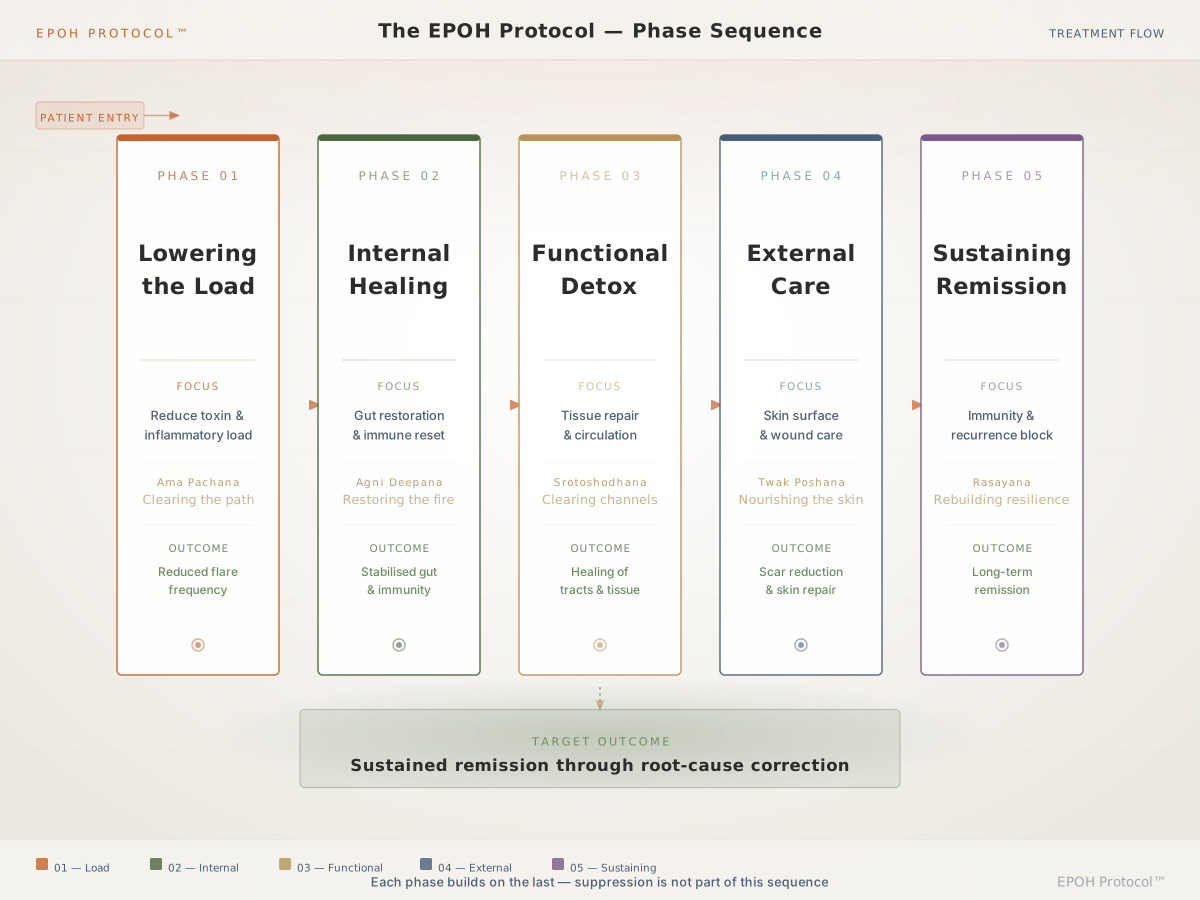
Days 1–7: starting Phase 1
You begin Phase 1 — Lowering the Load with oral formulations compounded to your driver profile, taken at home. Nothing is done to you. There is no procedure to recover from and no clinic to attend.
What changes first: almost always digestion. Bloating, sluggish or irregular bowel movements, the heaviness that sits on you after eating — these shift first because they sit closest to the mechanism being targeted. Phase 1 works on Agni, the digestive capacity, and on the accumulated inflammatory load (Ama) that weakened Agni has allowed to build.
What does not change: your skin. Not in week one, and you should not be looking. Some notice a settling in the deep ache around existing lesions; most notice nothing at the surface at all.
Some people also find the first fortnight slightly unsettling — changes in bowel habit, a period of feeling more tired before feeling less. Report it. Do not adjust anything yourself.
Weeks 2–4: Recovery Stage 1, Internal Shift
This is the first stage on the response clock, and it is misnamed in most people's heads. They hear "Recovery Stage 1" and expect a small skin improvement. That is not what it is.
Recovery Stage 1 is digestion, energy and sleep. Bowel movements regularise. You sleep through more of the night. The permanent low-grade exhaustion — the kind you stopped calling fatigue years ago, because it had simply become how you felt — starts to lighten.
Your skin, meanwhile, is usually exactly where it was.
This is the correct sequence, not a failure of it. HS is not a skin condition with systemic complications; it is a systemic condition expressing through the skin. Gut dysbiosis drives immune dysregulation, and immune dysregulation produces the tissue pathology in the sweat channels. Treat that chain in order and the gut moves first, the immune signalling second, and the skin — which sits at the end of the chain — last. Visible change lags internal change by weeks. That lag is the mechanism, not a delay in it.
If your digestion and energy have moved and your skin has not, the protocol is doing exactly what it is built to do in weeks 2–4.
Weeks 3–6: the Partial Improvement Plateau
Now the hard part. Read this section before you get there, because reading it afterwards is worth much less.
Somewhere in weeks three to six, the following happens. Your digestion is better. Your energy is better. You have started, cautiously, to believe this might be different. And then a flare arrives — same axilla, same groin, same fold as always — and the whole fragile structure of hope collapses in an afternoon.
The thought that follows is always some version of: it has stopped working. Or it was never working, and the digestion thing was a coincidence.
What it actually is. Phase 1 has done its job: the accumulated inflammatory load has come down. But Phase 1 was never designed to correct the driver — the gut-lining permeability, the disrupted microbiome, the misfiring immune response, the hormonal pattern underneath. Lowering a load is not the same as fixing what keeps producing it. Correcting the driver is Phase 2 — Internal Healing, and Phase 2 is what comes next.
So the plateau is not a sign that treatment has stalled. It is the signal that Phase 1 is complete and the transition to Phase 2 should be timed. It is the most predictable event in the whole first 90 days, which is why you are being told about it in advance rather than discovering it alone at 2 a.m.
What to do with it: report the pattern at review — how the flare behaved, how long it took to settle, whether it resolved more completely than the ones before it. Do not stop. Do not increase anything on your own. And do not attempt a cleanse or a detox programme to "push it through" — Phase 3 comes third for a reason, and mobilising internal load before Phase 1 and Phase 2 are stable pushes it back into channels that are already obstructed, which makes things worse rather than better.
Weeks 6–12: Phase 2 underway, early Recovery Stage 2
Phase 2 runs 8–16 weeks, so at day 90 you are only part-way through it. What you are watching for is not clear skin. It is a change in the shape of your flares.
The early signs of Recovery Stage 2 — Reduced Frequency (typically months 2–4) look like this:
- A flare that would have taken two weeks settles in one.
- A lesion that would have gone on to tunnel or drain instead comes up, stays shallow, and goes back down.
- Something resolves completely — not into a permanent hard lump you learn to live with, but away.
- The gap between flares gets longer. This is the one people notice last and it is the most meaningful.
None of that is dramatic. All of it is what a corrected driver looks like from the outside, early on.
What the first 90 days will not deliver
Being straight about this is more useful than being encouraging about it.
- Not stable remission. That is Recovery Stage 4, months 8 and beyond.
- Not a cleared back, groin or axilla. Reduced severity — shallower lesions, less drainage, cleaner healing — is Recovery Stage 3, months 4–8. It is downstream of where you will be at day 90.
- Not the end of flares. Flares within the first 90 days are expected. Their arrival tells you nothing. Their frequency, duration and depth over time tell you everything.
- Not a cosmetic result. Existing sinus tracts and established scarring are the slowest structures in the whole picture to respond, and some structural change does not reverse.
If you need the first 90 days to deliver those things, you will stop before the phase that produces them has finished running.
What to track — and why it matters more than it sounds
Progress in HS is non-linear, and memory is dominated by the flare you are currently in. In month four you will not accurately recall month one — you will feel however you feel that week and back-project it. A written record is the only defence against that, and it is what allows a phase transition to be timed properly.
Track, briefly, once a week:
| What | Why |
|---|---|
| Flare frequency — how many new lesions, and where | The first thing to move in Recovery Stage 2 |
| Flare duration — days from onset to settled | In many people, shortens before frequency falls |
| Resolution quality — gone, or a hard lump left behind? | Separates real improvement from a quiet flare |
| Pain — a simple 0–10 at its worst that week | Falls earlier than appearance does |
| Drainage — present or not, amount, odour | A direct read on active inflammation |
| Energy and sleep | Recovery Stage 1 markers — your earliest evidence |
| Digestion — regularity, bloating, heaviness after meals | The driver system reporting on its own state |
Bring that to review. It is the difference between "I think it's about the same" and a clear pattern that shows exactly which phase you should be in.
An honest word before you start
Not every patient responds equally. Disease duration, degree of organ involvement and remaining biological repair capacity all influence outcomes, and patients with very advanced structural change — severe fibrotic HS — may not achieve full remission. You should begin while continuing your current medication; any reduction is discussed later, gradually, and with your prescribing physician.
A personalised evaluation is the only way to assess your specific response potential. It is done by video call or WhatsApp, and if a plan follows, your formulations arrive by courier.
Medical disclaimer. This article is for general information and is not a substitute for personalised medical advice. Ayurvedic treatment at EliteAyurveda™ is individualised following clinical assessment. Do not start, stop or alter any prescribed medication without consulting your treating physician.

