


Part of the Hidradenitis Suppurativa Knowledge Library
You have almost certainly never been sent for a fasting insulin test.
You have been swabbed, cultured, photographed, biopsied and staged. You have been handed an antibiotic, then a stronger antibiotic, then a biologic. But the one blood measurement that would tell you most about why your follicles keep sealing themselves shut has probably never been ordered — because it does not belong to the department you were sent to.
Meanwhile you have noticed things nobody asked about. The afternoon crash. The waistline that changed before the disease got worse. Cycles that stopped being predictable. A flare that follows a stretch of bad sleep and bad eating, but never reliably enough to call it a food trigger, so you stopped mentioning it.
You were told these things were unrelated to your skin. They are not unrelated. They are the same driver.
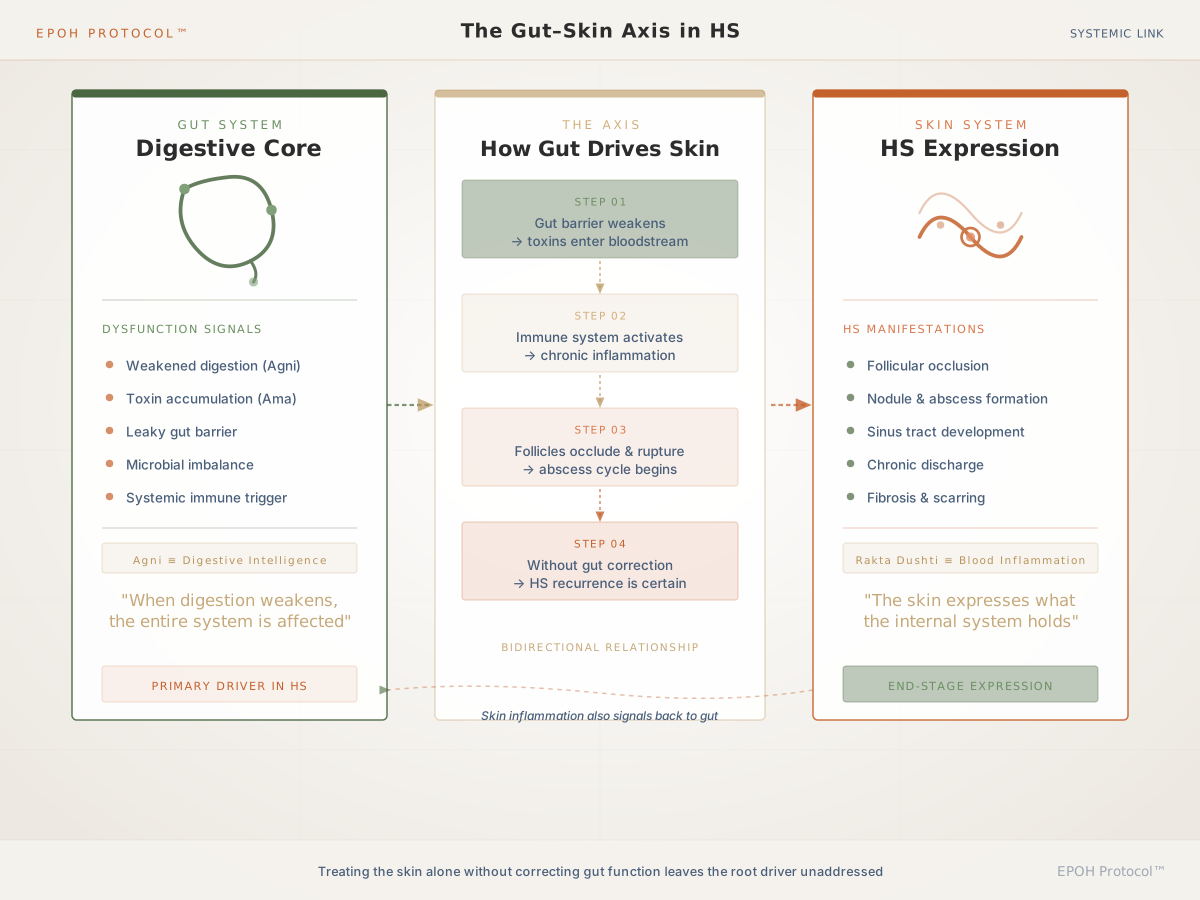
HS is not a skin condition with systemic complications — it IS a systemic condition expressing through the skin. Insulin resistance is where that sentence stops being a slogan and becomes a mechanism you can follow, step by step.
What insulin resistance actually is
It is not diabetes, and it is not a waiting room outside diabetes that you may ignore until you are called.
Cells stop responding fully to insulin's signal. The pancreas compensates by producing more of it. Because the compensation works, blood glucose can look entirely normal for years — while circulating insulin runs high. That state is hyperinsulinaemia, and it is invisible on the tests you were most likely given. A clean fasting glucose is not a clean bill of metabolic health. It is a report that the compensation is still holding.
A person can therefore be metabolically driven, thoroughly, and be told their bloods are fine.
What high insulin does to a hair follicle
Three routes, running at once.
It raises free androgens. Insulin suppresses the liver's production of sex hormone-binding globulin (SHBG) — the protein that keeps androgens bound and biologically quiet. Less SHBG means more free, active androgen reaching tissue from the same total production. Total testosterone can read normal on paper while the fraction that actually does something rises.
It raises IGF-1 activity. Insulin increases insulin-like growth factor 1 and reduces the binding proteins that restrain it. IGF-1 acts on the pilosebaceous unit, driving keratinocyte proliferation and sebaceous activity.
It acts directly. Insulin and IGF-1 receptors sit on the keratinocytes lining the follicular infundibulum. This is not a distant hormonal rumour. It is a receptor, on the exact cell, in the exact place your disease begins.
The consequence is follicular hyperkeratinisation: the follicular lining thickens, sheds abnormally, and the duct plugs. Androgens simultaneously stimulate apocrine activity. So there is now an occluded follicle, in an apocrine-dense region, with active glandular secretion accumulating behind the plug. Pressure builds. The follicle ruptures into the dermis.
Everything you have ever been treated for — the neutrophil influx, the abscess, the tract, the scar — is the immune system reacting to follicular contents where they were never supposed to be.
Notice the sequence. The immune event is the second half of the story. Conventional treatment addresses that second half with real skill. The metabolic driver builds the first half quietly, months earlier, while there is still nothing to see.
The background state that lowers the threshold
Insulin resistance is not metabolically silent. Adipose tissue is an endocrine organ, and an insulin-resistant state raises circulating inflammatory signalling into a chronic, low-grade tone.
Here is the part worth sitting with: that tone does not cause your flare. It changes what a flare costs to start.
On a low inflammatory baseline, minor follicular occlusion happens constantly and resolves without you ever knowing. On a raised baseline, the identical occlusion tips into a nodule. Same event, different threshold.
Which is why HS feels random, and why every trigger diary eventually contradicts itself. The trigger varies. The threshold has moved.
It runs both ways, too. Chronic inflammation worsens insulin sensitivity, so active disease deepens the driver that produced it. And sustained corticosteroid exposure — a feature of many HS treatment histories — reduces insulin sensitivity as a matter of pharmacology. The intervention that quiets the flare can deepen the ground beneath it. That is not a failure of intent; it is the structural consequence of treating the second half of the story.
Why HS keeps company with PCOS and metabolic syndrome
PCOS is the textbook hyperinsulinaemic, hyperandrogenic state — the mechanism above, expressed in the ovary. A woman with both HS and PCOS does not have two diseases and bad luck. She has one driver with two addresses.
Metabolic syndrome is consistently associated with HS in the published literature, and the association is reported independently of body mass. Which is a polite way of saying it is the metabolic state that tracks with HS, not the number on a scale.
That distinction is not academic. It is the difference between a driver you can correct and a lecture you have already sat through.
A driver to correct, not a verdict on you
Insulin resistance is a signalling state with real genetic loading, amplified by chronic inflammation, by disrupted sleep (which HS pain destroys reliably), by cortisol dysregulation, and by gut dysbiosis — which alters how glucose is handled before any dietary decision is made.
It is not evidence of weakness. It is a signalling problem, and signalling problems are corrected by changing the signal, not by being told to try harder. If weight loss has been offered to you as an entire treatment plan, that piece of advice deserves its own answer, and it has one.
What correction actually involves
Metabolic function is one of five internal driver systems in EPOH, alongside gut health, hormonal balance, immune regulation, and stress and cortisol. Treatment is built from the patient's driver profile, not from the condition name.
Phase 1 — Lowering the Load (4–8 weeks). Oral formulations reducing accumulated inflammatory load (Ama), with digestive support and immune-calming compounds, taken at home. Metabolic correction attempted against a high inflammatory background is slow, because inflammation is itself an insulin-desensitising signal. The load comes down first. Diet is complementary here — a supporting input, never the phase itself.
Phase 2 — Internal Healing (8–16 weeks). The primary correction phase, and where metabolic and hormonal recalibration genuinely happens: gut lining integrity and microbiome repair (glucose handling and hormone metabolism both depend on the gut), immune recalibration, and hormonal patterns — including the insulin–SHBG–androgen axis described above. This addresses the driver rather than the lesion.
Phase 3 — Functional Detox sits third, never first. Applied before L and I are stable, it mobilises internal load faster than the body can clear it and the patient gets worse. If an early "cleanse" once made your HS worse, the timing was the problem, not the idea. Phase 4 topical formulations follow, and Phase 5 sustains the result.
In Ayurvedic terms this begins at weakened Agni — digestive and metabolic fire, at gut level and tissue level. Ama accumulates; Kapha-driven metabolic sluggishness and Pitta-driven inflammatory heat obstruct the Svedavaha and Raktavaha Srotas, and Pidaka follows. Old vocabulary, same cascade.
What to expect, honestly
Metabolic correction is not fast, and anyone offering you speed is selling something. Recovery Stage 1 (Internal Shift, weeks 1–4) is largely invisible: four to eight weeks of internal work before visible surface change is normal.
Then comes the part that costs us patients. Between weeks 3 and 6, many people hit the Partial Improvement Plateau — real improvement, fewer new nodules, less heat, and then flares carry on anyway. It reads as failure. It is not. It signals that Phase 1 has done its work and Phase 2 should begin. Patients who quit, quit here.
Recovery Stage 2 (Reduced Frequency) runs months 2–4, Recovery Stage 3 (Reduced Severity) months 4–8, and Recovery Stage 4 (Stable Remission) from month 8. These describe treatment response, not disease severity — you can be EPOH-DSS Stage 3 (Sinus) and Recovery Stage 2 at the same time.
Not every patient responds equally. Disease duration, degree of organ involvement, and remaining biological repair capacity all influence outcomes. Patients with very advanced structural changes (severe fibrotic HS) may not achieve full remission. A personalised evaluation is the only way to assess your specific response potential.
You begin while continuing your current medication; as correction takes effect, any reduction is reviewed with your prescribing physician and tapered gradually.
If nobody has looked at this yet
Most HS patients have had their skin examined exhaustively and their metabolism never.
A personalised evaluation maps your driver profile — metabolic, hormonal, gut, immune, cortisol — and formulations are compounded to it and dispatched by courier. Consultation and monitoring are by video or WhatsApp; there is no clinic visit for most patients.
A driver that has never been looked for has certainly never been treated. That is worth an hour of your time.
Medical disclaimer. This article is for general information and is not a substitute for personalised medical advice. Ayurvedic treatment at EliteAyurveda™ is individualised following clinical assessment. Do not start, stop or alter any prescribed medication without consulting your treating physician.

