


Part of the Hidradenitis Suppurativa Knowledge Library
There is a drawer in your house. In it: an anti-inflammatory supplement, a zinc supplement, a probiotic with an impressive number on the label, an "anti-inflammatory blend" from a wellness brand, possibly a tea. None of it changed anything. You bought all of it in good faith and you are not going to do that again.
So the real question deserves to be asked out loud: is this that drawer, with a consultation attached to it?
No. But rather than simply assert that, here is what the difference actually consists of, so that you can check it against what you are offered — by us or by anybody else.
The difference is not "better herbs"
It is three things: what a formulation is for, when it is given, and what it was compounded against.
A supplement is a single substance, taken continuously, aimed at a general property — reduces inflammation, supports gut health. It does not change over time. It is identical for every person who buys it. Nobody reviews it, because there is nothing to review.
An EPOH formulation is a compound with a defined job inside a defined phase of a sequence, compounded against your driver profile, and replaced when the phase changes. Those are not the same category of object, whatever they may look like in a bottle.
The five functional categories
Formulations fall into five categories, one for each phase of the EPOH phase sequence.
| Category | Phase | Route | Function |
|---|---|---|---|
| Inflammatory Load Reduction | L — Lowering the Load | Oral | Reduces accumulated inflammatory load (Ama), restores Agni, calms immune reactivity. This is ground-clearing. 4–8 weeks |
| Internal Correction | I — Internal Healing | Oral | The primary correction — gut lining integrity, microbiome repair, immune recalibration, hormonal patterns. 8–16 weeks |
| Functional Clearance | F — Functional Detox | Oral | Supports lymphatic and tissue-level clearance from within. 6–12 weeks, often alongside Phase 2 |
| External Tissue Repair | E — External Care | Topical, with oral support | Lesion resolution, sinus-tract healing, barrier restoration. Runs through Phases I and F |
| Remission Maintenance | S — Sustaining Remission | Oral, tapered | Resilience and monitoring. A taper toward less, not indefinite suppression. 6–12 months |
Two things are worth pulling out of that table.
Functional Clearance is oral, and it is third. It is not something performed on you. There is no procedure, no in-clinic therapy and no clinic visit for most patients of this — it is a formulation supporting the body's own clearance pathways from the inside. And it comes after Phases L and I are stable, because mobilising accumulated load through channels that are still obstructed makes HS worse rather than better. Sequence is not a scheduling preference here. It is the safety mechanism.
External Tissue Repair works because the internal conditions have already shifted. Applied to skin still being fed by an uncorrected internal driver, a topical is a dressing. Applied once the driver has been addressed, it is doing repair on tissue that is finally in a position to repair. The same preparation, an entirely different result, purely as a function of when it was used.
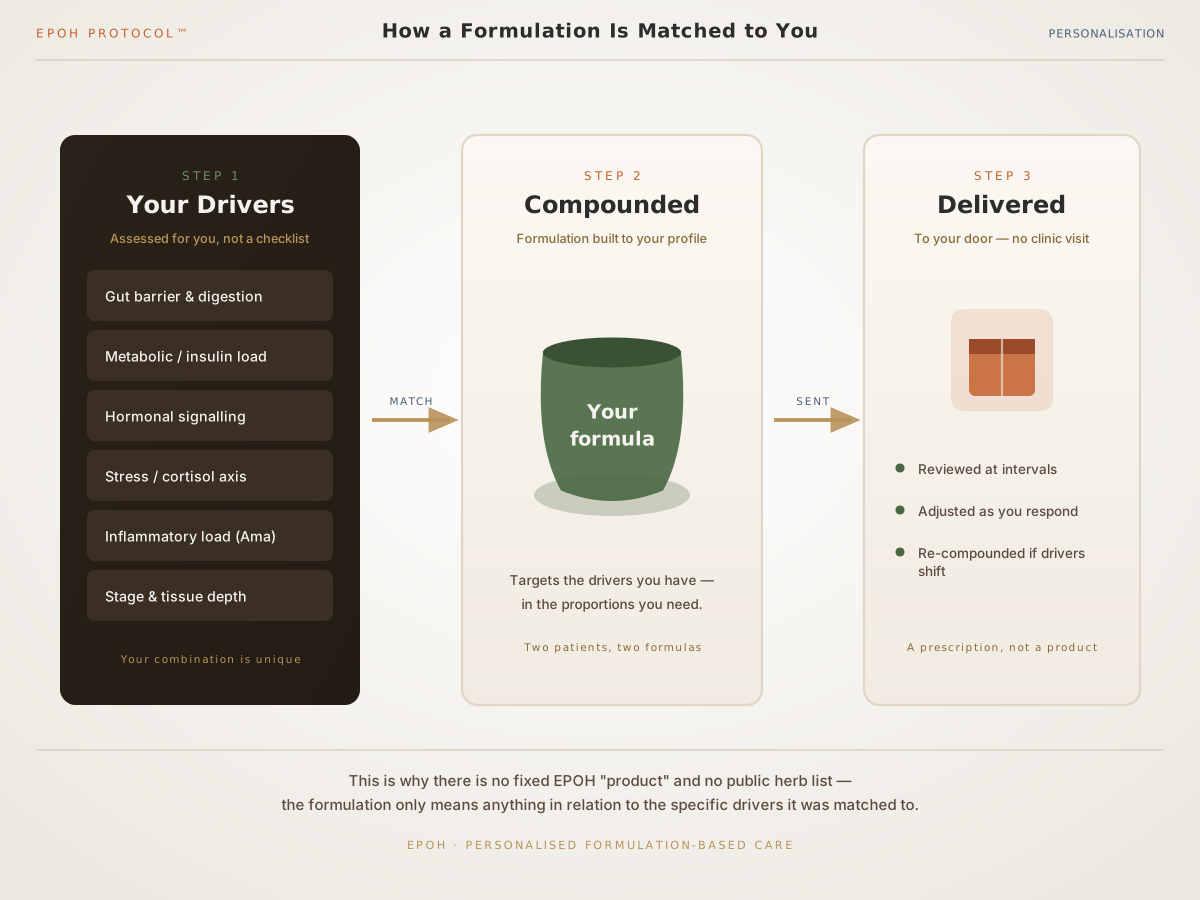
Compounded per driver profile — there is no HS pack
This is the part that cannot be replicated by a shelf product, which is why there isn't one.
Two patients. Both Hurley Stage II. Both EPOH-DSS Stage 3, with sinus tracts. Identical on paper.
- Patient A — flares track the menstrual cycle, weight has settled centrally, insulin resistance in the notes. Driver profile: hormonal and metabolic.
- Patient B — a decade of intermittent antibiotics, longstanding gut symptoms, flares that track digestion rather than cycle. Driver profile: gut and immune.
They receive different formulations. Not marginally different — differently weighted from Phase 1 onward, because the load being lowered is not the same load. Give both of them the same anti-inflammatory preparation and you should expect one to respond and one not to, and the one who does not will conclude, quite reasonably, that this whole field is nonsense.
Treatment is built from the driver profile, not the condition name. That is why there is no standard HS pack, no bundle, no subscription box, and nothing you can purchase without an evaluation. There is nothing to sell you until somebody has worked out what is actually driving your disease.
Classical, combination, proprietary
Three different kinds of thing arrive in the courier package, and the honest move is to distinguish them rather than blur them together.
A classical formulation is a preparation described in the Ayurvedic classical literature, made to a defined method — a decoction, a powder, a resin-based compound, a medicated oil for topical use. The recipe is not ours. It is centuries old, it is standardised, and it is used because it has a long recorded history for a specific action, not because it is exclusive to anyone.
A classical combination is two or more of those given together, with the ratios, the timing and the vehicle selected for your driver profile. The individual preparations are classical. The combination, the sequencing and the dosing are clinical judgements — and they are the part that requires a clinician rather than a catalogue.
A proprietary compound is a preparation developed through EPOH clinical practice, for recurring driver patterns in HS where the classical repertoire did not offer a close enough fit. It is built on classical principles and compounded per patient. It is not a shelf product and it is not sold as one.
We tell you which is which because a clinic presenting everything it dispenses as ancient wisdom is concealing something, and a clinic presenting everything as its own secret innovation is concealing something else.
The honest practicalities
Plainly, so that there is nothing left to discover later.
It is not cheap. Compounding to an individual profile costs more than filling bottles from a single batch, and there is clinician time inside every review. If price is your deciding factor, this will not be the cheapest thing you find.
It is not instant. Phase 1 is 4–8 weeks. Phase 2 is 8–16 weeks. Recovery Stage 1 — the first internal shift — is weeks 1–4, and it is internal; it is not the week your skin clears. Recovery Stage 4, stable remission, is month 8 and beyond.
You have to take them, every day, for months. Including through the Partial Improvement Plateau at weeks 3–6, when some improvement arrives, the flares continue anyway, and every instinct you have will tell you to stop.
It requires review appointments. Not as an upsell — as a structural necessity. The formulation that is correct in Phase 1 is the wrong formulation in Phase 2. If nobody is reviewing you, nobody is changing what you take. And if nobody is changing what you take, then what you have is not a sequenced protocol. It is a supplement. Which is where you came in.
Not every patient responds equally. Disease duration, degree of organ involvement, and remaining biological repair capacity all influence outcomes. Patients with very advanced structural changes may not achieve full remission. A personalised evaluation is the only way to assess your specific response potential.
Everything described here is dispensed by courier and taken at home, and consultation and monitoring are by video or WhatsApp. The only way to establish which formulations, in which sequence, at what weighting, is a personalised evaluation of your driver profile. If the honest finding is that you are not a good candidate, you will be told that instead.
Medical disclaimer. This article is for general information and is not a substitute for personalised medical advice. Ayurvedic treatment at EliteAyurveda™ is individualised following clinical assessment. Do not start, stop or alter any prescribed medication without consulting your treating physician.

