


Part of the Hidradenitis Suppurativa Knowledge Library
You have two consultants.
One is interested in your bowel. One is interested in your skin. They work in the same hospital, sometimes on the same corridor, and they have never once spoken about you. You are the only person in the entire arrangement who has noticed that the fortnight your gut goes wrong tends to be the fortnight the axilla starts to ache — and when you finally said so out loud, you were told the two are unrelated.
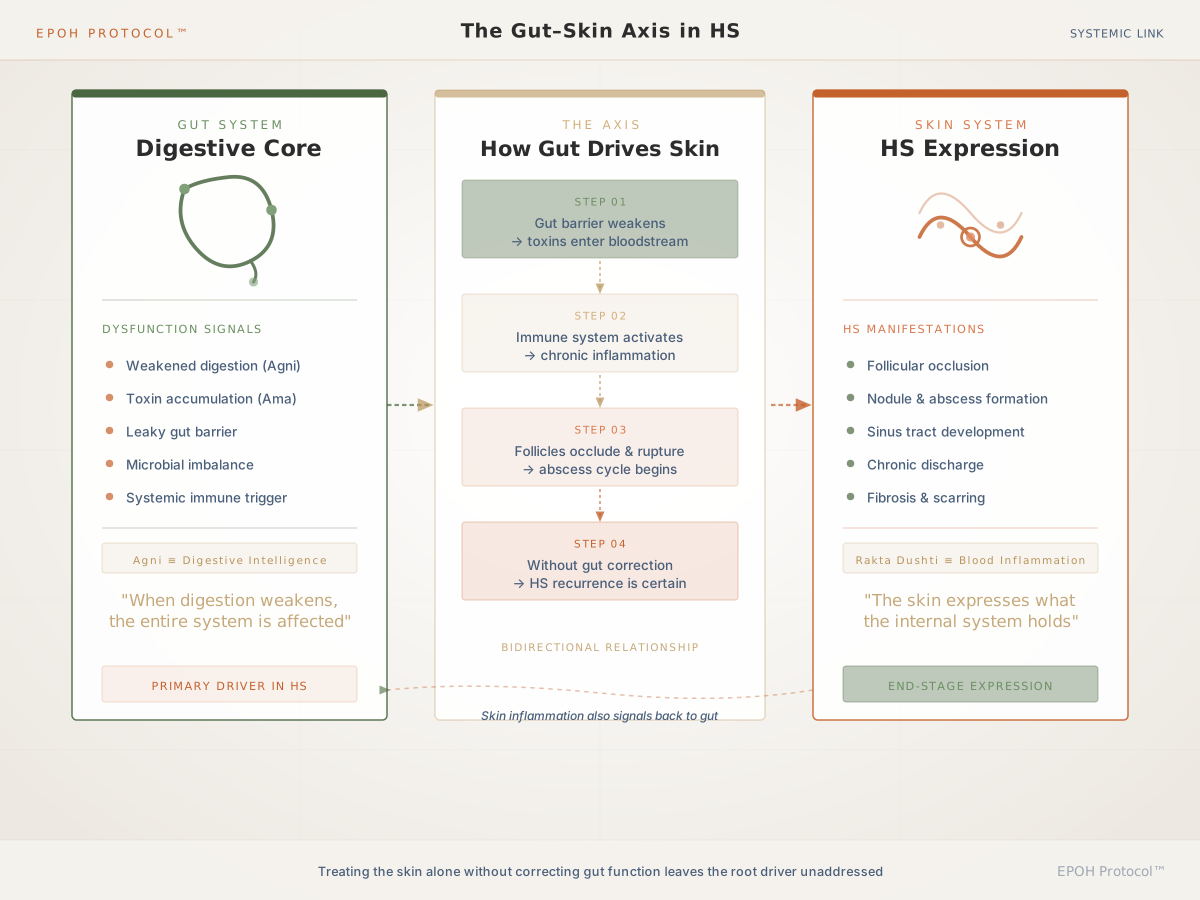
They are not unrelated. The co-occurrence of HS and Crohn's disease is one of the most consistently documented associations in either field, and it is the single strongest piece of evidence that HS was never a skin disease in the first place.
Two diseases, or one process in two places?
HS appears in people with Crohn's far more often than chance permits, and the relationship holds in the other direction too.
When two conditions in two entirely different organ systems keep turning up in the same body, only two explanations are available: coincidence, or a shared driver. Coincidence does not survive the numbers.
| Crohn's disease | Hidradenitis Suppurativa | |
|---|---|---|
| Barrier | Intestinal barrier failure; raised permeability | The same gut barrier failure upstream; follicular failure downstream |
| Immune arm | Innate dysregulation; neutrophil-rich, granuloma-forming | Innate dysregulation; neutrophil-rich, granuloma-forming |
| Depth | Transmural — the full thickness of the bowel wall | Deep dermal and subcutaneous — far below the epidermis |
| Architecture | Abscesses, sinus tracts, fistulae, strictures | Abscesses, sinus tracts, tunnels, fistulisation |
| Immune suppression | Partial response, only while suppression continues | Partial response, only while suppression continues |
| Excision | Recurrence at new sites | Recurrence at new sites, often adjacent |
Three of those rows deserve unpacking.
Gut barrier failure
Crohn's is, at the level of mechanism, a disease of a failing barrier and of an innate immune system that treats what crosses it as an invasion.
HS shares the upstream half of that description exactly: increased intestinal permeability, dysbiosis, translocation of microbial products into circulation, and an innate immune system whose threshold for responding has been reset downward and left there.
In Crohn's, the consequence lands in the bowel wall. In HS it lands at the follicle — a follicle already destabilised by hormonal and metabolic drivers, sitting in apocrine-dense skin, waiting for a systemic inflammatory tone high enough to tip it over.
The address of the lesion differs. The mechanism does not.
One inflammatory pathway, two organs
The most direct evidence that the pathway is shared is that the same class of immune-suppressing biologic agents produces a response in both conditions. Two diseases, two organ systems, one molecule. That is not a coincidence — it is a signature.
It also tells you something less comfortable. Those agents suppress the signal without correcting why the signal is being generated, which is exactly why the response is partial and holds only for as long as suppression continues — in the bowel precisely as in the skin.
The same lesion, built in different tissue
This is the observation that should have settled the argument decades ago.
Crohn's builds abscesses, sinus tracts and fistulae — tunnels between structures never meant to connect. HS builds abscesses, sinus tracts and tunnels. The morphology is not similar. It is the same.
The process is identical in both: deep, sustained inflammation destroys tissue; the destroyed channel epithelialises; and the tract cannot close, because the inflammatory environment that carved it has not changed.
In one region of the body the resemblance becomes almost absurd. Perianal HS and perianal Crohn's are genuinely difficult to tell apart on inspection. Two "different" diseases, from two different specialties, producing lesions their own specialists cannot reliably distinguish. At some point the simplest explanation deserves a hearing: it is the same process.
It also explains why surgery does not hold in either condition. You can excise a tract. You cannot excise the programme that builds tracts. Removing lesions does nothing to alter the systemic environment that produced them — so new lesions form, frequently in adjacent tissue, and the patient is told they were unlucky.
Why this is the argument that ends the debate
HS is not a skin condition with systemic complications — it IS a systemic condition expressing through the skin.
Test that sentence against the co-occurrence.
If HS were what it has been called for a century — a disease of blocked follicles caused by friction, sweat, occlusion and (that ugly, persistent implication) poor hygiene — there is no mechanism by which it should keep company with a disease of the terminal ileum. The axilla and the small bowel share no local environment whatsoever. No friction connects them. No sweat, no clothing, no shaving habit, no deodorant.
What they do share is a systemic environment: a gut barrier, a microbiome, an innate immune set point, and a circulating inflammatory tone that reaches both tissues without difficulty. That is the only place these two diseases can possibly meet — and they meet there constantly.
The co-occurrence is not a curiosity to be footnoted at the end of a review. It is the diagnosis.
What this means for treatment sequencing
Under EPOH, treatment is built from the patient's driver profile, not the condition name. A patient carrying both HS and Crohn's has a profile dominated by two of the five internal driver systems: gut health and immune regulation. That is one profile, not two — which is why it produces one programme rather than two competing ones.
Phase 1 — Lowering the Load (4–8 weeks). Oral formulations reducing accumulated inflammatory load (Ama), with digestive support and immune-calming compounds, taken at home. In a patient with active bowel inflammation this phase carries more weight than usual: the internal load is high and the barrier is already compromised.
Phase 2 — Internal Healing (8–16 weeks). The primary correction phase — gut lining integrity, microbiome repair, immune recalibration. Read that list again and notice what it is not. It is not a skin intervention. It is not a bowel intervention. It is a correction of the shared driver, which is exactly why the two conditions tend to respond in the same window. The bowel quietening and the skin quietening are not two results. They are one result, observed in two tissues.
Phase 3 — Functional Detox (6–12 weeks, often concurrent with I). Oral formulations supporting lymphatic and tissue-level clearance from within — not a procedure. Nowhere is the sequence rule more important than in this patient. Applied before L and I are stable, Phase 3 mobilises internal load faster than a compromised system can clear it, and the patient deteriorates in both organs at once. If you once attempted an aggressive "cleanse" while your bowel was active and ended up considerably worse: the timing was the problem, not the idea.
Phase 4 brings topical formulations for lesion resolution and sinus-tract healing — effective because internal conditions have already shifted. Phase 5 sustains it, over 6–12 months of tapering and monitoring.
Crohn's disease is addressed under EliteAyurveda™'s Gastroenteric department, and a patient presenting with both is assessed across both — one driver profile, one sequence, formulations compounded to the combined picture rather than two protocols negotiating over the same body.
In Ayurvedic terms both conditions begin in the same place: weakened Agni, Ama accumulating, vitiated Pitta and Kapha obstructing the srotas. In the gut it presents as one disease; in the Svedavaha and Raktavaha Srotas it presents as Dushta Vrana and Pidaka — chronic infected wounds and deep pustular inflammation. Old vocabulary, one pathology.
About your Crohn's medication
If you are taking a biologic or an immunosuppressant for Crohn's, do not stop it.
EPOH begins alongside your existing medication. As internal correction takes effect, reduction is reviewed with your prescribing physician, and any tapering is gradual and structured, with discontinuation as the goal rather than the opening move. This matters more here than almost anywhere else: an abrupt or unsupervised withdrawal of immune suppression in active bowel disease is genuinely dangerous.
Honest expectations
Recovery Stage 1 (Internal Shift, weeks 1–4) is largely invisible — four to eight weeks of internal work before visible surface change is normal. Around weeks 3–6, expect the Partial Improvement Plateau: real improvement, then flares continuing regardless. It is not failure; it signals that Phase 1 has done its work and Phase 2 should begin. Patients who quit, quit here. Recovery Stage 2 (Reduced Frequency) runs months 2–4, Recovery Stage 3 (Reduced Severity) months 4–8, and Recovery Stage 4 (Stable Remission) from month 8. These are treatment-response stages, not EPOH-DSS severity stages — a patient can be EPOH-DSS Stage 3 (Sinus) and Recovery Stage 2 at once.
Not every patient responds equally. Disease duration, degree of organ involvement, and remaining biological repair capacity all influence outcomes. Patients with very advanced structural changes (severe fibrotic HS) may not achieve full remission. A personalised evaluation is the only way to assess your specific response potential.
If you are carrying both diagnoses
You have most likely spent years being treated as two patients who happen to share an address.
A personalised evaluation maps a single driver profile across both conditions. Formulations are compounded to it and dispatched by courier; consultation and monitoring are by video or WhatsApp. There is no clinic visit for most patients — which, for anyone whose year is already built around hospital appointments, may be the least trivial detail on this page.
Medical disclaimer. This article is for general information and is not a substitute for personalised medical advice. Ayurvedic treatment at EliteAyurveda™ is individualised following clinical assessment. Do not start, stop or alter any prescribed medication without consulting your treating physician.

