


Part of the Hidradenitis Suppurativa Knowledge Library
You knew this one before anyone told you.
The week of the deadline. The month the marriage ended. The fortnight your father was in hospital. And then the axilla starts to ache in that particular, unmistakable way, and you know exactly what is coming three days before it arrives.
You have probably stopped mentioning it. The last time you did, you were advised to try and relax — by someone who had just finished lancing an abscess.
"It's stress" is one of the truest things anybody will ever tell you about HS. Offered on its own, it is also one of the most useless. It is a correct diagnosis with no treatment attached.
It is not "high cortisol". It is a broken rhythm.
Cortisol is not a villain. It is a rhythm — a sharp rise on waking, a decline across the day, a trough at night. Under short, acute stress cortisol is anti-inflammatory. That is precisely why steroids exist, and why "stress causes inflammation" sounds like a contradiction to anyone who has been handed prednisolone.
Under chronic, unrelenting stress the picture inverts.
- The rhythm flattens. The morning peak blunts. Evening cortisol refuses to fall. The amplitude that made the signal meaningful is lost.
- The receiver stops listening. Immune cells become progressively less responsive to cortisol's signal — glucocorticoid receptor resistance. The brake is still being pressed. The pads have worn through.
The net result of sustained stress is therefore a pro-inflammatory state. Cortisol was never the anti-inflammatory agent. Cortisol responsiveness was. Chronic stress destroys the responsiveness and leaves the hormone behind.
The gut is where stress becomes inflammation
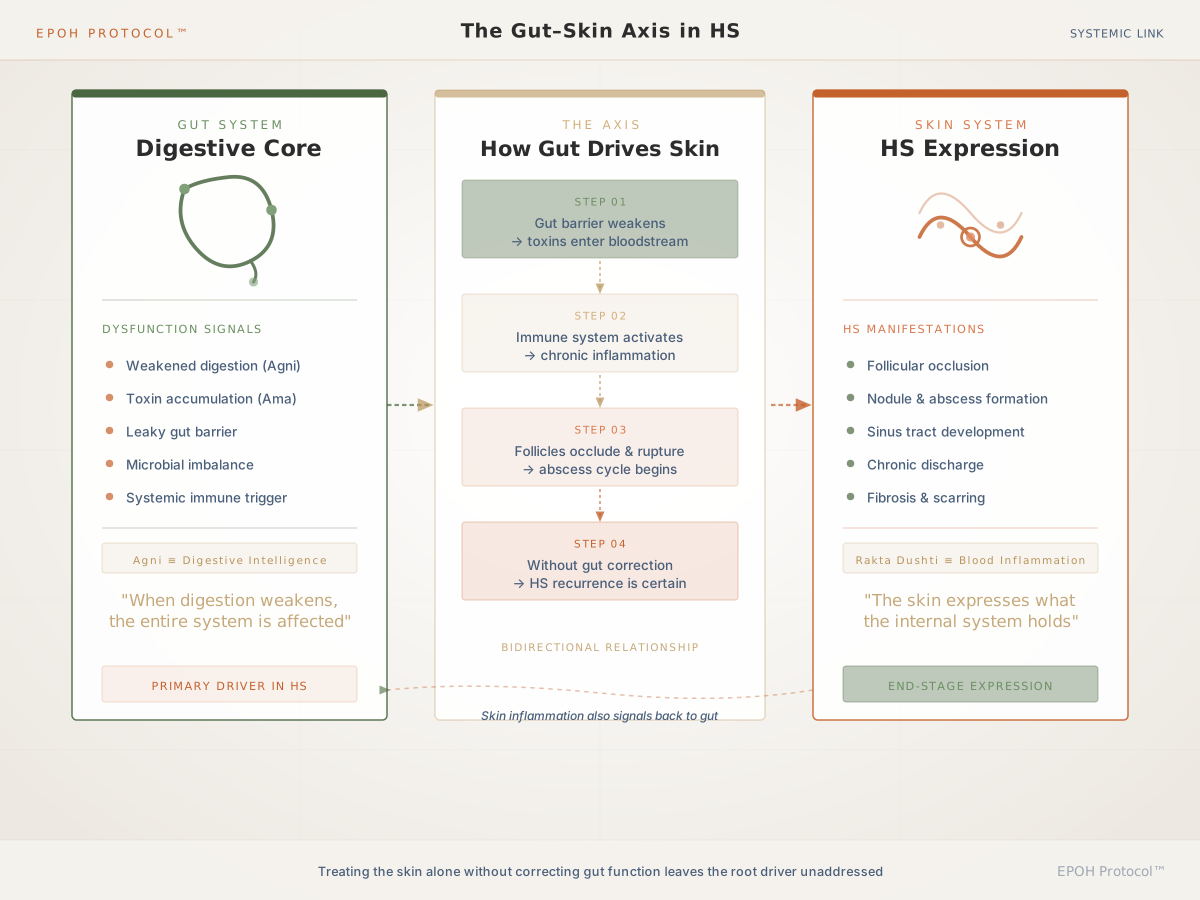
This is the step almost nobody explains, and it is the step that matters. Sustained activation of the stress axis does specific, physical things to your intestine:
- it reduces mucosal blood flow and alters motility
- it shifts microbial composition toward dysbiosis
- it degrades the tight-junction proteins holding intestinal epithelial cells sealed to one another, increasing intestinal permeability
A barrier that leaks allows bacterial cell-wall components and other microbial products into circulation in quantities the immune system was never built to overlook. The innate immune system then does what it is designed to do: it responds to what it can see. Systemic inflammatory tone rises, and circulating pro-inflammatory signalling rises with it.
This is the precise point at which the stress and cortisol driver and the gut health driver stop being two separate things. They are one cascade with two names.
And then, finally, the skin
Raised systemic inflammatory tone does not create a lesion out of nothing. It lowers the price of one.
- The follicular unit sits closer to its rupture threshold. Minor occlusion that would once have resolved in silence now tips into a nodule.
- Sympathetic activation drives apocrine secretion — more material accumulating behind a plugged duct.
- Cortisol impairs wound healing: collagen deposition slows, re-epithelialisation slows. Lesions formed in high-stress periods are not merely more frequent — they heal worse, and are likelier to leave a tract behind.
So a bad year does not only cost you flares. It costs you architecture. EPOH-DSS staging, which runs from early nodular disease through to advanced tunnelling, is in large part a record of tissue that did not close.
The loop runs in both directions
Here is what makes stress unlike any other driver in HS: the disease is itself a stressor. Not a mild one. A severe, sustained, daily one.
- Pain that turns sitting, walking, lifting an arm or choosing clothing into a calculation.
- Discharge that means dressings, spare clothes, and routes planned around laundry.
- Odour anxiety that decides where you sit in a room and how close you let anyone stand.
- Scarring in the most private regions of the body, and everything that does to intimacy.
- Cancelled plans, missed work, appointments that end with a remark about your weight, and the accumulation of small humiliations nobody who has not had this disease will ever fully see.
Depression and anxiety are reported in HS populations at rates well above the general population, and consistently so. That is not a coincidence, and it is not a personality. It is what happens to a nervous system asked to live with unpredictable pain, visible disease and social exposure for years at a stretch. It is a consequence of the disease that then becomes a driver of it.
So the loop closes:
Stress → cortisol rhythm flattens → gut permeability rises → innate immune activation → systemic inflammatory tone rises → flare → pain, discharge, isolation, broken sleep → stress.
Every circuit raises the starting point for the next one. And you cannot break a physiological loop by applying willpower at the psychological end of it. That is why "reduce your stress", offered alone, achieves nothing: it names the entry point and ignores the machinery.
None of this is a character flaw. It is a driver — one of the five internal driver systems, alongside gut health, hormonal balance, immune regulation and metabolic function.
What actually breaks the loop
You cannot remove stressors from a life. Bereavement will happen. Deadlines will happen. Any programme whose plan is "avoid stress" is asking you to live a life you do not have.
What can be changed is the amplitude of the response.
The stressor is an input. The flare is an output. Between them sits everything that sets the gain — an intestinal barrier, a microbiome, an immune baseline, an accumulated inflammatory load. That middle section is physiology, and physiology can be corrected.
Phase 1 — Lowering the Load (4–8 weeks). Oral formulations reducing accumulated inflammatory load (Ama), with digestive support and immune-calming compounds, taken at home. If your baseline already sits close to threshold, every stressor clears it. Lowering the baseline is the first thing that has to happen, not the last.
Phase 2 — Internal Healing (8–16 weeks). The primary correction phase: gut lining integrity and microbiome repair — which is to say, closing the barrier where stress converts into immune activation — together with immune recalibration and the hormonal and cortisol-axis patterns beside it.
Phase 3 — Functional Detox is third, never first. Applied before L and I are stable, it mobilises internal load faster than the body can clear it and the condition worsens. If you once tried an aggressive "cleanse" and your HS got worse, the timing was the problem, not the idea. Phase 4 topical formulations follow, working because internal conditions have already shifted, and Phase 5 sustains it.
In Ayurvedic terms this cascade is Vata-led: Vata governs movement, the nervous system and pain, and disturbed Vata weakens Agni. Weak Agni produces Ama; Ama with vitiated Pitta obstructs the Svedavaha and Raktavaha Srotas, and Pidaka — deep pustular inflammation — follows.
What success actually looks like: Recovery Stage 3
This is the part patients do not expect, so it is worth stating plainly.
The stressors do not stop. The deadline still arrives. The argument still happens. The bad news still comes on a Tuesday.
What changes is what your body does with it.
Recovery Stage 3 — Reduced Severity (months 4–8) is defined by exactly this: the same triggers produce diminished responses. The week that used to cost you a full abscess costs you a nodule that resolves. Then a few days of tenderness and nothing more. Then, eventually, nothing at all. That is the measurable signature of a broken loop — not the absence of stress, but the collapse of its consequences.
Before it: Recovery Stage 1 (Internal Shift, weeks 1–4), largely invisible, because internal work precedes surface change; then Recovery Stage 2 (Reduced Frequency, months 2–4). After it, Recovery Stage 4 (Stable Remission) from month 8. These describe treatment response and are a different axis from EPOH-DSS severity — you can be EPOH-DSS Stage 3 (Sinus) and Recovery Stage 2 at the same time.
Expect the Partial Improvement Plateau around weeks 3–6: real improvement, then flares continuing anyway. It is not failure. It signals that Phase 1 has done its work and Phase 2 should begin. Patients who quit, quit here — very often during a stressful stretch, which is exactly when the loop is at its most persuasive and least trustworthy.
Not every patient responds equally. Disease duration, degree of organ involvement, and remaining biological repair capacity all influence outcomes. Patients with very advanced structural changes (severe fibrotic HS) may not achieve full remission. A personalised evaluation is the only way to assess your specific response potential. You begin while continuing your current medication; any reduction is reviewed with your prescribing physician and tapered gradually.
Nobody is going to ask you to stop being stressed
That was never a treatment plan, and it was never fair.
The better question is different: what does your body currently do with stress, and can that be changed? A personalised evaluation maps the driver profile behind that answer — cortisol, gut, immune, metabolic, hormonal — and formulations are compounded to it and dispatched by courier. Consultation and monitoring are by video or WhatsApp. There is no clinic visit for most patients.
Medical disclaimer. This article is for general information and is not a substitute for personalised medical advice. Ayurvedic treatment at EliteAyurveda™ is individualised following clinical assessment. Do not start, stop or alter any prescribed medication without consulting your treating physician.

